Ch. 10 Muscle Tissue and Physiology
Amerman- Human Anatomy & Physiology 3e
Amerman3rd EditionHuman Anatomy & PhysiologyISBN: 9780138247201, 9780138247928, 9780138201814당신이 사용하는 게 아니라요?교과서 변경
10장, 문제 L3.4

Mr. Nasheed has cerebral palsy and suffers severe skeletal muscle spasms as a result of his condition. He is prescribed the drug dantrolene, which prevents the release of Ca2+ from the SR. Explain how this will treat his muscle spasms.

검증된 단계별 안내
1
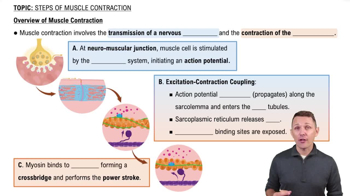
Understand the role of calcium ions (Ca2+) in muscle contraction: Calcium ions are released from the sarcoplasmic reticulum (SR) in response to a nerve signal. These ions bind to troponin, causing a conformational change that allows actin and myosin filaments to interact, leading to muscle contraction.
Recognize the problem in cerebral palsy: In Mr. Nasheed's case, severe skeletal muscle spasms occur due to excessive or uncontrolled muscle contractions, which are likely caused by overactive release of Ca2+ from the SR.
Understand the mechanism of dantrolene: Dantrolene works by inhibiting the release of Ca2+ from the SR. This reduces the availability of calcium ions needed for muscle contraction, thereby decreasing the intensity and frequency of muscle spasms.
Connect the drug's action to the treatment of spasms: By preventing excessive Ca2+ release, dantrolene helps to relax the muscles and reduce the involuntary contractions that cause spasms.
Summarize the therapeutic effect: The reduction in Ca2+ release leads to less activation of the contractile machinery in skeletal muscles, providing relief from the severe spasms associated with cerebral palsy.

비슷한 문제에 대한 검증된 영상 답변:

이 영상 해법은 위 문제에 도움이 된다고 튜터들이 추천한 것입니다.
도움이 되었나요?

주요 개념

질문에 올바르게 답하기 위해 반드시 이해해야 하는 핵심 개념들은 다음과 같습니다.

Cerebral Palsy

Cerebral palsy is a neurological disorder caused by brain damage that affects movement and muscle coordination. Individuals with this condition may experience muscle stiffness, spasms, and difficulty with motor skills. Understanding cerebral palsy is crucial for recognizing the underlying causes of muscle spasms in patients like Mr. Nasheed.
추천 영상:
3:13
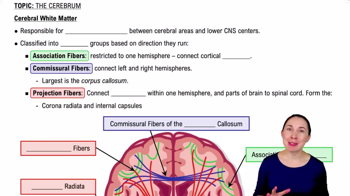
Cerebral White Matter

Calcium Release in Muscle Contraction

Muscle contraction is initiated by the release of calcium ions (Ca2+) from the sarcoplasmic reticulum (SR) into the muscle fibers. This calcium release triggers the interaction between actin and myosin, leading to muscle contraction. In conditions like cerebral palsy, excessive calcium release can lead to uncontrolled muscle spasms, making it essential to understand this process for effective treatment.
추천 영상:
4:53
Overview of Muscle Contraction

Dantrolene Mechanism of Action

Dantrolene is a muscle relaxant that works by inhibiting the release of calcium from the sarcoplasmic reticulum in muscle cells. By reducing calcium availability, dantrolene decreases the strength and frequency of muscle contractions, thereby alleviating muscle spasms. This mechanism is particularly beneficial for patients with conditions that cause excessive muscle activity, such as cerebral palsy.
추천 영상:
03:53
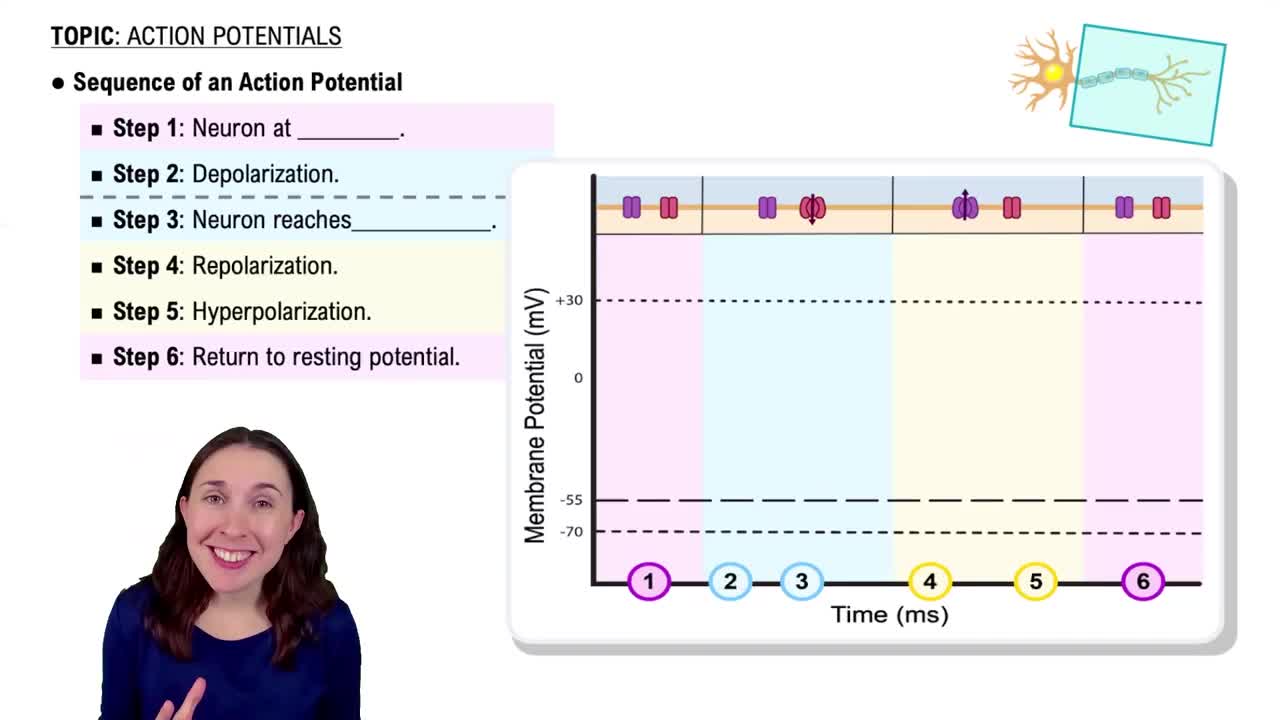
Action Potential
관련 실천
교과서 질문

Paola is a 3-year-old girl with a disease that reduces the ability of her mitochondria to generate ATP. Explain the specific effects of this disease on the ability of Paola's muscles to function properly. What other tissues and organs are likely to be especially affected by her disease, and why?

700
views
교과서 질문

Order the following events of excitation and excitation-contraction coupling. Put 1 by the first event, 2 by the second, and so on.

____ The motor end plate generates an end-plate potential.

____ The action potential spreads along the T-tubules, SR Ca2+ channels are pulled open, and Ca2+ floods the cytosol.

____ Acetylcholine binds to receptors on the motor end plate, and ligand-gated ion channels open.

____ Ca2+ bind troponin, which allows tropomyosin to move away from the actin active site, initiating a contraction cycle.

____ The action potential propagates through the sarcolemma and dives deeply into the cell along the T-tubules.

1396
views
교과서 질문

Match the following terms with the correct definition.      


____Z-disc     

____Sarcomere     

____A band     

____H zone     

____I band     

____M line


a. The dark band containing the entire length of the thick filament

b. The band of proteins in the middle of the H zone

c. The boundary between sarcomeres

d. The functional unit of contraction

e. The middle region of the A band containing only thick filaments

f. The light band containing only thin filaments

729
views
교과서 질문

Some athletes will consume only protein for several days before a competition, which reduces the amount of glycogen in both the muscle fibers and the liver. What effect would this have on their ability to perform activities that require short, powerful bursts of activity? How would it affect their ability to perform endurance activities?

811
views
교과서 질문

What is the basic mechanism of contraction at the level of myofilaments?

851
views
교과서 질문

Jesse is a 2-year-old boy who presents with difficulty in walking and poor control of movements. When the doctor examines Jesse, she notices that when his muscles contract, they are very slow to relax and remain contracted well after the movement has been performed. She sends a sample of his tissue for genetic analysis, and the lab reports a genetic defect that causes the pumps in the SR to operate much more slowly than normal. How does a defect in DNA lead to a malfunctioning protein? How does this finding explain Jesse's symptoms?

753
views