
Ch. 10 Muscle Tissue and Physiology
Amerman- Human Anatomy & Physiology 3e
Amerman3rd EditionHuman Anatomy & PhysiologyISBN: 9780138247201, 9780138247928, 9780138201814당신이 사용하는 게 아니라요?교과서 변경
10장, 문제 8

Order the following events of excitation and excitation-contraction coupling. Put 1 by the first event, 2 by the second, and so on.
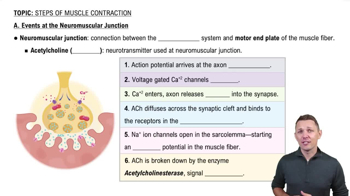
____ The motor end plate generates an end-plate potential.
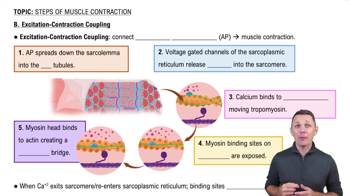
____ The action potential spreads along the T-tubules, SR Ca2+ channels are pulled open, and Ca2+ floods the cytosol.
____ Acetylcholine binds to receptors on the motor end plate, and ligand-gated ion channels open.
____ Ca2+ bind troponin, which allows tropomyosin to move away from the actin active site, initiating a contraction cycle.
____ The action potential propagates through the sarcolemma and dives deeply into the cell along the T-tubules.

검증된 단계별 안내
1
Identify the sequence of events in excitation and excitation-contraction coupling by understanding the physiological process of muscle contraction.
Step 1: Acetylcholine (ACh) is released from the motor neuron and binds to receptors on the motor end plate, causing ligand-gated ion channels to open. This allows sodium ions (Na⁺) to enter the muscle fiber, initiating depolarization.
Step 2: The motor end plate generates an end-plate potential, which is a localized depolarization that triggers an action potential in the sarcolemma.
Step 3: The action potential propagates along the sarcolemma and dives deeply into the muscle fiber through the T-tubules, ensuring the signal reaches all parts of the muscle cell.
Step 4: The action potential in the T-tubules causes the sarcoplasmic reticulum (SR) to release calcium ions (Ca²⁺) into the cytosol by opening SR Ca²⁺ channels.
Step 5: Calcium ions bind to troponin, causing a conformational change that moves tropomyosin away from the actin active sites, allowing the myosin heads to bind to actin and initiate the contraction cycle.

비슷한 문제에 대한 검증된 영상 답변:

이 영상 해법은 위 문제에 도움이 된다고 튜터들이 추천한 것입니다.

주요 개념

질문에 올바르게 답하기 위해 반드시 이해해야 하는 핵심 개념들은 다음과 같습니다.

Excitation-Contraction Coupling

Excitation-contraction coupling is the physiological process that links the electrical excitation of a muscle fiber to its contraction. It begins with the generation of an action potential in the muscle cell membrane, which then triggers the release of calcium ions from the sarcoplasmic reticulum. This increase in intracellular calcium concentration is crucial for muscle contraction, as it initiates the interaction between actin and myosin filaments.
추천 영상:
5:47
B. Excitation-Contraction Coupling

Role of Acetylcholine

Acetylcholine is a neurotransmitter that plays a vital role in muscle contraction. It is released from motor neurons and binds to receptors on the motor end plate of the muscle fiber, leading to the opening of ligand-gated ion channels. This influx of sodium ions generates an end-plate potential, which is essential for initiating the action potential that propagates along the muscle membrane and into the T-tubules.
추천 영상:
5:56
A. Events at the Neuromuscular Junction

Calcium Ion Functionality

Calcium ions (Ca2+) are critical for muscle contraction. When the action potential reaches the T-tubules, it causes the sarcoplasmic reticulum to release Ca2+ into the cytosol. The binding of Ca2+ to troponin causes a conformational change that moves tropomyosin away from the actin active sites, allowing myosin heads to bind to actin and initiate the contraction cycle.
추천 영상:
01:55
Ions - Sodium and Potassium Example 3
관련 실천
교과서 질문

Which of the following statements accurately describes the role of ATP in a muscle contraction?

a. ATP is directly responsible for the power stroke.

b. ATP moves troponin and tropomyosin away from actin.

c. ATP breaks the actin/myosin attachment and 'cocks' the myosin head.

d. ATP causes the myofilaments to shorten.

1007
views
교과서 질문

Which of the following energy sources would provide the majority of the ATP for a person running a 26-mile marathon?

a. Stored ATP

b. Glycolytic catabolism

c. Oxidative catabolism

d. Creatine phosphate

790
views
교과서 질문

Mr. Nasheed has cerebral palsy and suffers severe skeletal muscle spasms as a result of his condition. He is prescribed the drug dantrolene, which prevents the release of Ca2+ from the SR. Explain how this will treat his muscle spasms.

819
views
교과서 질문

A muscle fiber relaxes when:

a. The concentration of Ca2+ in the cytosol returns to resting levels.

b. The supply of ATP is exhausted.

c. Ca2+ flood the cytosol.

d. Acetylcholine is released from the axon terminal and the sarcolemma depolarizes.

814
views
교과서 질문

Match the following terms with the correct definition.      


____Z-disc     

____Sarcomere     

____A band     

____H zone     

____I band     

____M line


a. The dark band containing the entire length of the thick filament

b. The band of proteins in the middle of the H zone

c. The boundary between sarcomeres

d. The functional unit of contraction

e. The middle region of the A band containing only thick filaments

f. The light band containing only thin filaments

729
views
교과서 질문

What is the basic mechanism of contraction at the level of myofilaments?

851
views