
Ch. 11 Introduction to the Nervous System and Nervous Tissue
Amerman- Human Anatomy & Physiology 3e
Amerman3rd EditionHuman Anatomy & PhysiologyISBN: 9780138247201, 9780138247928, 9780138201814당신이 사용하는 게 아니라요?교과서 변경
11장, 문제 14d

Mark the following statements as true or false. If a statement is false, correct it to make a true statement.
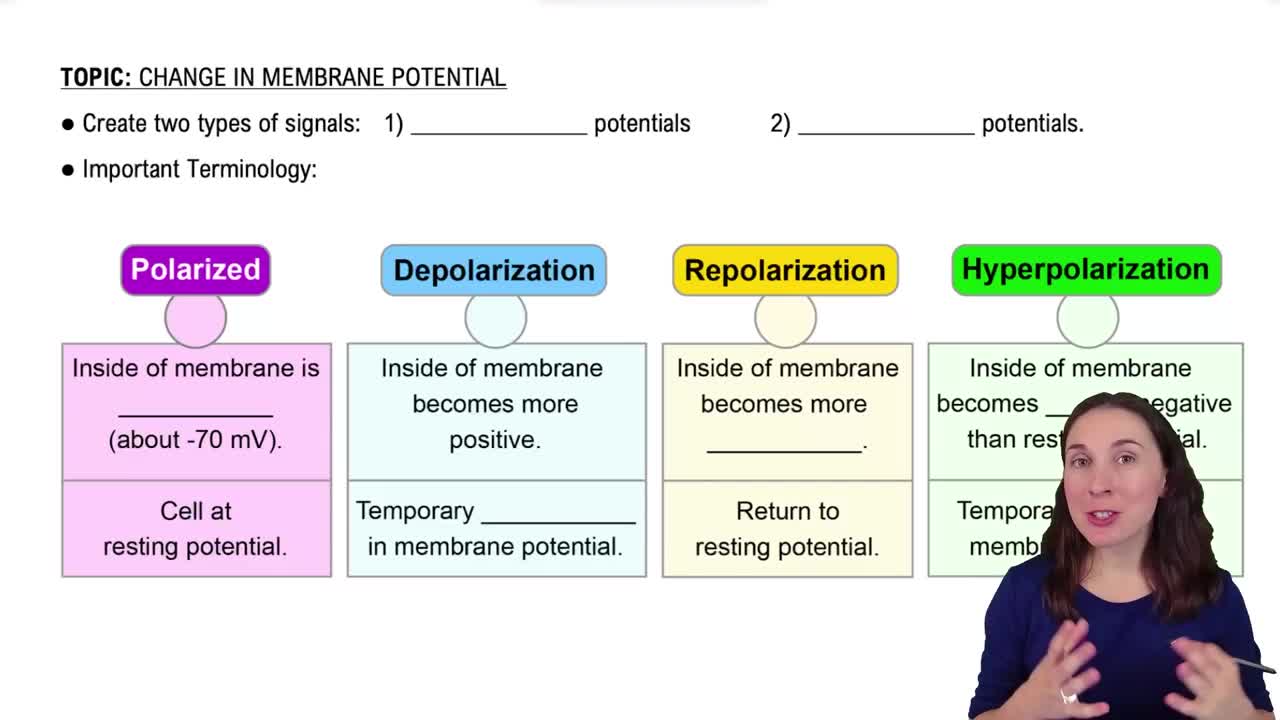
A depolarization is a change in membrane potential that makes the potential less negative.

검증된 단계별 안내
1
Understand the concept of depolarization: Depolarization refers to a change in the membrane potential of a cell, typically a neuron or muscle cell, where the inside of the cell becomes less negative compared to the resting membrane potential.
Recall the resting membrane potential: The resting membrane potential is usually around -70 mV in neurons, meaning the inside of the cell is more negative relative to the outside.
Analyze the statement: A depolarization occurs when the membrane potential becomes less negative (e.g., moving from -70 mV to -60 mV or even positive values). This is caused by the influx of positively charged ions, such as sodium (Na⁺), into the cell.
Determine if the statement is true or false: Based on the definition of depolarization, the statement 'A depolarization is a change in membrane potential that makes the potential less negative' is true.
If the statement were false, correct it: If the statement had been false, you would need to clarify that depolarization specifically refers to the membrane potential becoming less negative, not more negative (which would be hyperpolarization).

비슷한 문제에 대한 검증된 영상 답변:

이 영상 해법은 위 문제에 도움이 된다고 튜터들이 추천한 것입니다.
도움이 되었나요?

주요 개념

질문에 올바르게 답하기 위해 반드시 이해해야 하는 핵심 개념들은 다음과 같습니다.

Depolarization

Depolarization refers to a change in the membrane potential of a cell, where the inside of the cell becomes less negative compared to the outside. This occurs when sodium ions (Na+) flow into the cell, reducing the voltage difference across the membrane. It is a critical process in the generation of action potentials in neurons and muscle cells.
추천 영상:
가이드 코스
3:49
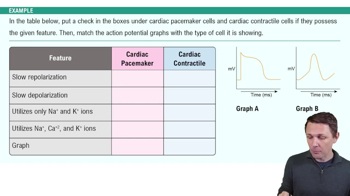
Cardiac Action Potentials Example 1

Membrane Potential

Membrane potential is the electrical potential difference across a cell's plasma membrane, resulting from the distribution of ions inside and outside the cell. It is typically measured in millivolts (mV) and can vary based on ion permeability and concentration gradients. A resting membrane potential is usually negative, indicating that the inside of the cell is more negative than the outside.
추천 영상:
03:31
Change in Membrane Potential

Action Potential

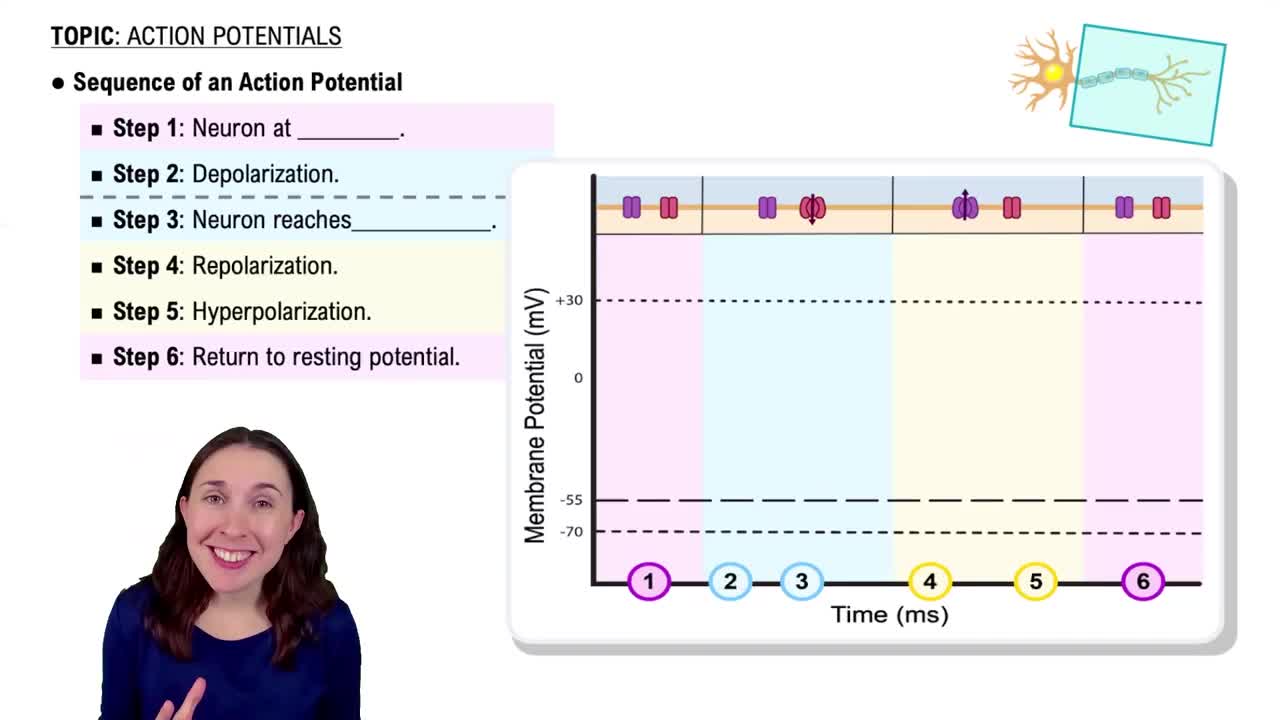
An action potential is a rapid, temporary change in membrane potential that occurs when a neuron or muscle cell is stimulated. It involves a sequence of depolarization followed by repolarization, allowing for the transmission of electrical signals along neurons and the contraction of muscle fibers. Understanding action potentials is essential for grasping how signals are propagated in the nervous system.
추천 영상:
03:53
Action Potential
관련 실천
교과서 질문

Which of the following is not a method by which the effects of neurotransmitters are terminated?

a. Reuptake into the presynaptic neuron

b. Diffusion away from the synaptic cleft and uptake by glial cells

c. Movement back to the cell body by retrograde axonal transport

d. Degradation by enzymes in the synaptic cleft

636
views
교과서 질문

Mark the following statements as true or false. If a statement if false, correct it to make a true statement.

An inhibitory postsynaptic potential causes the membrane potential of the postsynaptic neuron to approach threshold.

679
views
교과서 질문

Mark the following statements as true or false. If a statement is false, correct it to make a true statement.

The Na+/K+ pumps and gated channels maintain the Na+ and K+ gradients necessary for action potentials to occur.

665
views
교과서 질문

A ________ is characterized by multiple input neurons synapsing on one postsynaptic neuron.

a. Diverging circuit

b. Discharge zone

c. Facilitation zone

d. Converging circuit

1018
views
교과서 질문

Mark the following statements as true or false. If a statement is false, correct it to make a true statement.

A local potential is a change in membrane potential that conducts the long-distance signals of the nervous system.

701
views
교과서 질문

Mark the following statements as true or false. If a statement if false, correct it to make a true statement.

Postsynaptic potentials may summate by spatial summation in which multiple neurons fire onto a single postsynaptic neuron.

663
views