
Ch. 11 Introduction to the Nervous System and Nervous Tissue
Amerman- Human Anatomy & Physiology 3e
Amerman3rd EditionHuman Anatomy & PhysiologyISBN: 9780138247201, 9780138247928, 9780138201814당신이 사용하는 게 아니라요?교과서 변경
11장, 문제 10

The trigger for exocytosis of synaptic vesicles from the presynaptic neuron is:
a. Arrival of an action potential at the axon terminal and influx of calcium ions.
b. Summation of IPSPs at the presynaptic neuron.
c. Binding of neurotransmitters to the axon hillock.
d. Influx of Na+ into the postsynaptic neuron.

검증된 단계별 안내
1
Understand the process of synaptic transmission: Synaptic vesicles in the presynaptic neuron store neurotransmitters, which are released into the synaptic cleft to communicate with the postsynaptic neuron.
Recall the role of an action potential: An action potential travels down the axon of the presynaptic neuron and reaches the axon terminal, triggering a series of events.
Identify the role of calcium ions: The arrival of the action potential at the axon terminal causes voltage-gated calcium channels to open, allowing calcium ions (Ca²⁺) to flow into the presynaptic neuron.
Connect calcium influx to exocytosis: The influx of calcium ions triggers the synaptic vesicles to fuse with the presynaptic membrane, releasing neurotransmitters into the synaptic cleft through exocytosis.
Eliminate incorrect options: Summation of IPSPs (b) occurs at the postsynaptic neuron, binding of neurotransmitters (c) happens at the postsynaptic membrane, and Na⁺ influx (d) is part of postsynaptic depolarization, not exocytosis.

비슷한 문제에 대한 검증된 영상 답변:

이 영상 해법은 위 문제에 도움이 된다고 튜터들이 추천한 것입니다.
도움이 되었나요?

주요 개념

질문에 올바르게 답하기 위해 반드시 이해해야 하는 핵심 개념들은 다음과 같습니다.

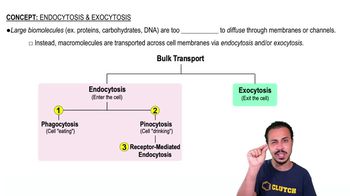
Exocytosis

Exocytosis is a cellular process where vesicles fuse with the plasma membrane to release their contents outside the cell. In the context of neurons, synaptic vesicles containing neurotransmitters undergo exocytosis when triggered, allowing communication between neurons. This process is essential for neurotransmission and is regulated by various factors, including calcium ion concentration.
추천 영상:
가이드 코스
02:02
Endocytosis and Exocytosis

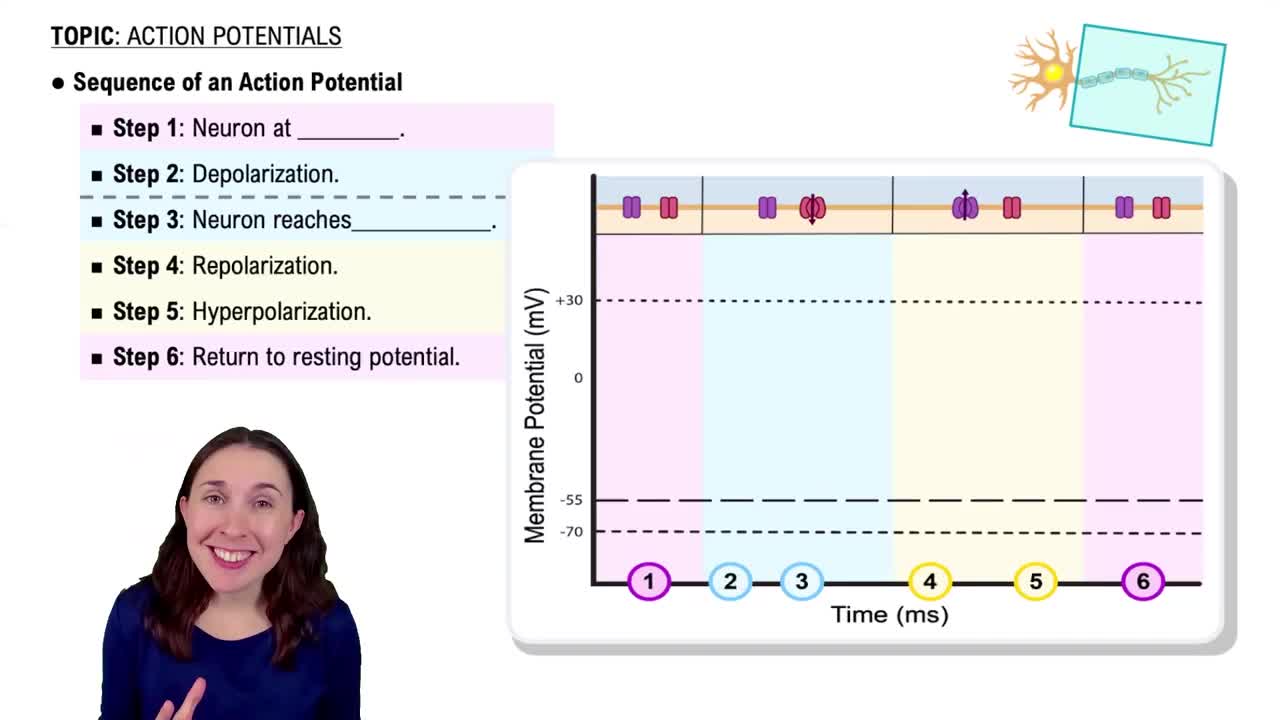
Action Potential

An action potential is a rapid, temporary change in the membrane potential of a neuron, which occurs when a stimulus causes depolarization. This electrical signal travels along the axon to the axon terminal, where it triggers the opening of voltage-gated calcium channels. The influx of calcium ions is crucial for initiating the exocytosis of neurotransmitters from synaptic vesicles.
추천 영상:
03:53
Action Potential

Calcium Ions (Ca<sup>2+</sup>) in Neurotransmission

Calcium ions play a pivotal role in neurotransmission by acting as a signaling molecule. When an action potential reaches the axon terminal, calcium channels open, allowing Ca<sup>2+</sup> to flow into the neuron. This increase in intracellular calcium concentration is the key trigger for the fusion of synaptic vesicles with the membrane, leading to the release of neurotransmitters into the synaptic cleft.
추천 영상:
2:30
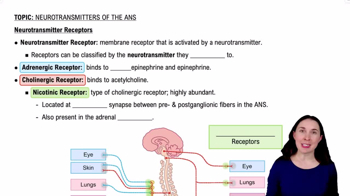
Neurotransmitter Receptors
관련 실천
교과서 질문

Which of the following is not a method by which the effects of neurotransmitters are terminated?

a. Reuptake into the presynaptic neuron

b. Diffusion away from the synaptic cleft and uptake by glial cells

c. Movement back to the cell body by retrograde axonal transport

d. Degradation by enzymes in the synaptic cleft

636
views
교과서 질문

Identify the following as properties of electrical synapses (ES), chemical synapses (CS), or both (B).           

a. ______ The plasma membranes of presynaptic and postsynaptic neurons are joined by gap junctions.          

b. ______ Transmission is unidirectional and delayed.          

c. ______ A presynaptic neuron and a postsynaptic neuron are involved.          

d. ______ The use of neurotransmitters packaged into synaptic vesicles is required.          

e. ______ Transmission is nearly instantaneous and bidirectional.

918
views
교과서 질문

The ________ is the period of time during which it is impossible to stimulate a neuron to have an action potential, whereas the ________ is the period of time during which a larger-than-normal stimulus is required to elicit an action potential.

1081
views
교과서 질문

Mark the following statements as true or false. If a statement is false, correct it to make a true statement.

The Na+/K+ pumps and gated channels maintain the Na+ and K+ gradients necessary for action potentials to occur.

665
views
교과서 질문

A ________ is characterized by multiple input neurons synapsing on one postsynaptic neuron.

a. Diverging circuit

b. Discharge zone

c. Facilitation zone

d. Converging circuit

1018
views
교과서 질문

Which of the following statements best describes saltatory conduction?

a. Every section of the axolemma must be depolarized and triggered to generate an action potential.

b. The internodes must generate action potentials.

c. The dendrites and cell bodies propagate EPSPs toward the trigger zone.

d. Only the nodes of Ranvier must generate action potentials.

924
views