Ch. 18 The Cardiovascular System II: The Blood Vessels
Amerman- Human Anatomy & Physiology 3e
Amerman3rd EditionHuman Anatomy & PhysiologyISBN: 9780138247201, 9780138247928, 9780138201814당신이 사용하는 게 아니라요?교과서 변경
18장, 문제 4

Which of the following factors would increase peripheral resistance?
a. Increased blood viscosity
b. Shorter vessel
c. Vasodilation
d. An increase in vessel radius

검증된 단계별 안내
1
Understand the concept of peripheral resistance: Peripheral resistance refers to the resistance to blood flow in the blood vessels, primarily influenced by vessel diameter, blood viscosity, and vessel length.
Analyze the effect of blood viscosity: Increased blood viscosity (thicker blood) leads to greater resistance because thicker blood is harder to move through vessels. This factor increases peripheral resistance.
Evaluate the impact of vessel length: Shorter vessels reduce the distance blood must travel, which decreases resistance. Therefore, shorter vessels do not increase peripheral resistance.
Examine the role of vasodilation: Vasodilation refers to the widening of blood vessels, which decreases resistance by increasing the vessel diameter. This factor reduces peripheral resistance.
Consider the effect of vessel radius: An increase in vessel radius decreases resistance because resistance is inversely proportional to the fourth power of the radius, as described by Poiseuille's law: \( R = \frac{8 \eta L}{\pi r^4} \), where \( R \) is resistance, \( \eta \) is viscosity, \( L \) is vessel length, and \( r \) is radius. Therefore, an increase in vessel radius reduces peripheral resistance.

비슷한 문제에 대한 검증된 영상 답변:

이 영상 해법은 위 문제에 도움이 된다고 튜터들이 추천한 것입니다.
도움이 되었나요?

주요 개념

질문에 올바르게 답하기 위해 반드시 이해해야 하는 핵심 개념들은 다음과 같습니다.

Peripheral Resistance

Peripheral resistance refers to the resistance to blood flow in the small blood vessels, primarily arterioles. It is a crucial factor in determining blood pressure and is influenced by the diameter of the blood vessels, blood viscosity, and the overall length of the vascular system. Increased peripheral resistance can lead to higher blood pressure and is a key consideration in cardiovascular health.
추천 영상:
3:33
Peripheral Nervous System

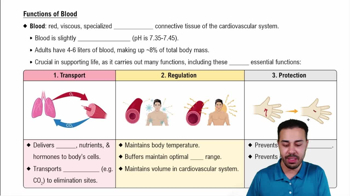
Blood Viscosity

Blood viscosity is a measure of the thickness and stickiness of blood, which affects how easily it flows through the vessels. Higher viscosity means that the blood is thicker, which increases resistance to flow and can elevate peripheral resistance. Factors such as dehydration or increased red blood cell count can lead to increased blood viscosity.
추천 영상:
가이드 코스
6:11
Functions of Blood

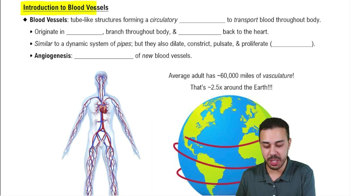
Vessel Radius

The radius of a blood vessel significantly impacts peripheral resistance, as described by Poiseuille's law. A smaller radius increases resistance, while a larger radius decreases it. Vasodilation (widening of blood vessels) decreases resistance, whereas vasoconstriction (narrowing of blood vessels) increases it, making vessel radius a critical factor in regulating blood flow and pressure.
추천 영상:
관련 실천
교과서 질문

The two pressures within the systemic arterial circuit are the_____ pressure and _____ pressure. The difference between these two pressures is the_____ pressure.

771
views

교과서 질문

You are babysitting two children who are having a contest to see who can hang upside-down for the longest time. At the end of the contest, both children feel dizzy and are worried they are sick. Explain to them why they feel this way and why the effect is only temporary. (Hint: Consider how the baroreceptor reflex responds when a person hangs upside-down.)

767
views
교과서 질문

Which of the following would produce a decrease in blood pressure?

a. Increased cardiac output

b. Vasodilation

c. Vasoconstriction

d. Increased blood volume

1209
views
교과서 질문

Fill in the blanks: The coronary arteries are the first branches off the ________. The right coronary artery becomes the ________ on the posterior side of the heart. The left coronary artery branches into the ________ and the ________.

1222
views
1
rank
교과서 질문

Match the following terms with the correct definition.

____ Auricle      

____ Aorta      

____ Coronary sinus       

____ Papillary muscle      

____ Fossa ovalis     

____ Pectinate muscle      

____ Venae cavae      

____ Pulmonary trunk      

____ Chordae tendineae      

____ Pulmonary veins 

a. Drainage point for the coronary veins

b. Extensions that attach papillary muscles to valves

c. Remnant of a hole present in the fetal interatrial septum

d. Two largest veins of the systemic circuit

e. Flaplike extension from the right or left atrium

f. Finger-like projections of ventricular muscle

g. Main artery of the pulmonary circuit

h. Veins that drain the pulmonary circuit

i. Largest artery of the systemic circuit

j. Ridges of muscle in the atria

677
views
교과서 질문

Ms. Rodgers has been diagnosed with secretion of inappropriate ADH syndrome (SIADH). What effect will SIADH have on the amount of water in her body? What symptoms would you expect from this condition? How would it affect her blood pressure and net filtration pressure?

835
views