
Ch. 19 Blood
Amerman- Human Anatomy & Physiology 3e
Amerman3rd EditionHuman Anatomy & PhysiologyISBN: 9780138247201, 9780138247928, 9780138201814당신이 사용하는 게 아니라요?교과서 변경
19장, 문제 13

How do the intrinsic/contact activation and extrinsic/tissue factor coagulation pathways differ? How are they similar?

검증된 단계별 안내
1
Understand the purpose of the coagulation pathways: Both the intrinsic/contact activation pathway and the extrinsic/tissue factor pathway are part of the blood clotting process, which prevents excessive bleeding by forming a stable fibrin clot.
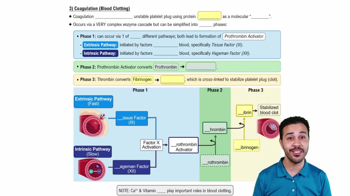
Examine the intrinsic/contact activation pathway: This pathway is initiated when blood comes into contact with negatively charged surfaces, such as exposed collagen in damaged blood vessels. It involves factors XII, XI, IX, and VIII, which sequentially activate each other. The pathway is slower and does not require external tissue factors.
Examine the extrinsic/tissue factor pathway: This pathway is triggered by the release of tissue factor (TF) from damaged tissues. TF interacts with factor VII, forming a TF-factor VII complex that activates factor X. This pathway is faster and relies on external signals from damaged tissues.
Identify the point of convergence: Both pathways converge at the activation of factor X, which leads to the common pathway. Factor X converts prothrombin into thrombin, and thrombin then converts fibrinogen into fibrin, forming the clot.
Compare and contrast the pathways: The intrinsic pathway is activated by internal damage to blood vessels and involves more clotting factors, while the extrinsic pathway is activated by external tissue damage and is faster. Both pathways ultimately lead to the same common pathway and the formation of a fibrin clot.

비슷한 문제에 대한 검증된 영상 답변:

이 영상 해법은 위 문제에 도움이 된다고 튜터들이 추천한 것입니다.
도움이 되었나요?

주요 개념

질문에 올바르게 답하기 위해 반드시 이해해야 하는 핵심 개념들은 다음과 같습니다.

Intrinsic Coagulation Pathway

The intrinsic coagulation pathway is activated by damage to blood vessels and involves a series of reactions that lead to the activation of factor XII, which subsequently activates other factors in a cascade. This pathway is crucial for the formation of a stable blood clot and is typically assessed through the activated partial thromboplastin time (aPTT) test.
추천 영상:
4:40
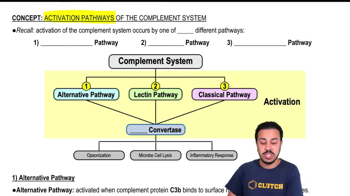
Alternative Pathway

Extrinsic Coagulation Pathway

The extrinsic coagulation pathway is initiated by external trauma to blood vessels, leading to the release of tissue factor (TF) from damaged tissues. This pathway is faster than the intrinsic pathway and is primarily assessed using the prothrombin time (PT) test. It plays a key role in the initial response to vascular injury.
추천 영상:
10:05
Coagulation (Blood Clotting)

Coagulation Cascade

The coagulation cascade is a complex series of events involving various clotting factors that ultimately lead to the formation of a fibrin clot. Both the intrinsic and extrinsic pathways converge at the common pathway, where factor X is activated, highlighting their interdependence despite their different activation mechanisms. Understanding this cascade is essential for comprehending how the body responds to bleeding.
추천 영상:
10:05
Coagulation (Blood Clotting)