Ch. 2 The Chemistry of Life
Amerman- Human Anatomy & Physiology 3e
Amerman3rd EditionHuman Anatomy & PhysiologyISBN: 9780138247201, 9780138247928, 9780138201814당신이 사용하는 게 아니라요?교과서 변경
2장, 문제 L2.3

Explain why monosaccharides are polar and fatty acids are nonpolar even though they both contain the same atoms.

검증된 단계별 안내
1
Monosaccharides are polar because they contain multiple hydroxyl (-OH) groups, which are highly electronegative. These groups create regions of partial negative and positive charges, allowing monosaccharides to form hydrogen bonds with water molecules, making them hydrophilic (water-soluble).
Fatty acids, on the other hand, have a long hydrocarbon chain that is composed of nonpolar covalent bonds between carbon and hydrogen atoms. These bonds do not create significant charge separation, making the hydrocarbon chain hydrophobic (water-insoluble).
Although both monosaccharides and fatty acids contain carbon, hydrogen, and oxygen atoms, the arrangement and type of bonds differ. Monosaccharides have a higher proportion of polar functional groups (e.g., hydroxyl groups), while fatty acids have a dominant nonpolar hydrocarbon chain.
The carboxyl group (-COOH) at the end of a fatty acid is polar, but its effect is overshadowed by the long nonpolar hydrocarbon chain, making the overall molecule nonpolar.
In summary, the polarity of a molecule depends on the distribution of polar and nonpolar bonds. Monosaccharides are polar due to their hydroxyl groups, while fatty acids are nonpolar because of their extensive hydrocarbon chains.

비슷한 문제에 대한 검증된 영상 답변:

이 영상 해법은 위 문제에 도움이 된다고 튜터들이 추천한 것입니다.

주요 개념

질문에 올바르게 답하기 위해 반드시 이해해야 하는 핵심 개념들은 다음과 같습니다.

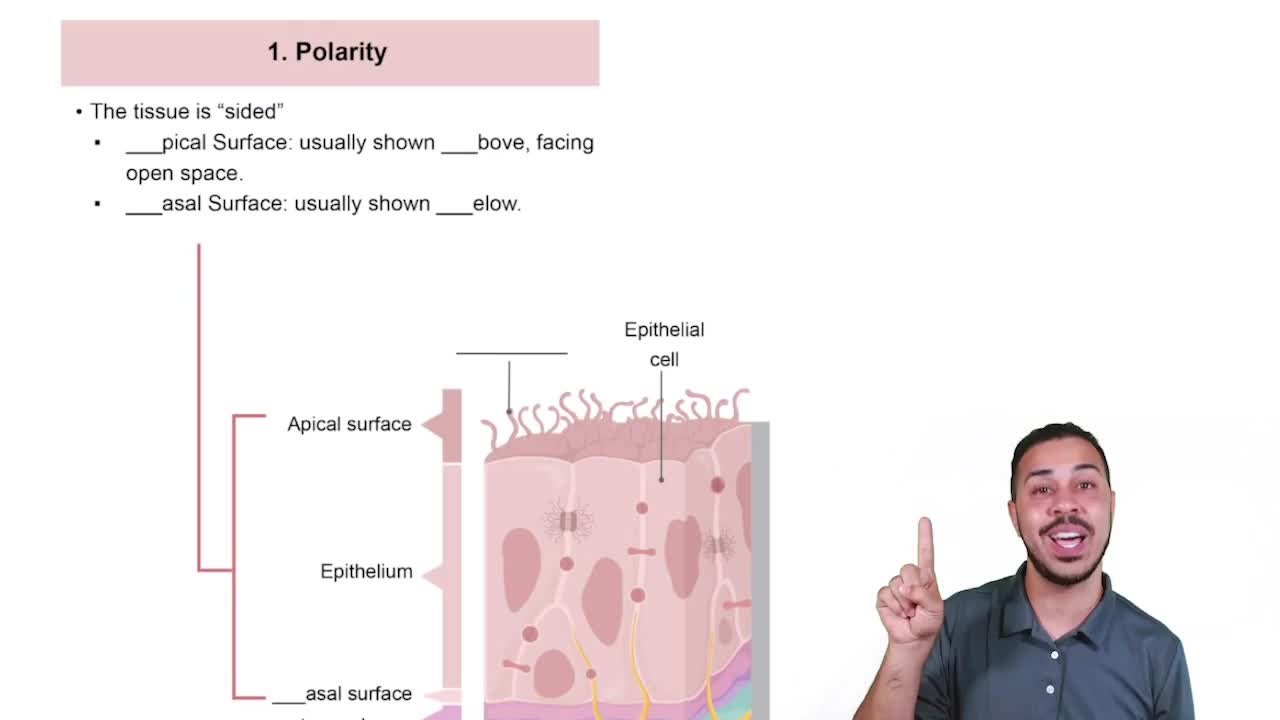
Polarity

Polarity refers to the distribution of electrical charge around atoms, molecules, or chemical groups. A molecule is considered polar if it has a significant difference in electronegativity between its atoms, leading to a partial positive charge on one end and a partial negative charge on the other. This uneven distribution allows polar molecules, like monosaccharides, to interact with water and other polar substances, making them soluble.
추천 영상:
04:15
Characteristic 1: Polarity

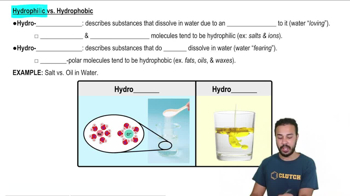
Hydrophilicity vs. Hydrophobicity

Hydrophilicity describes the tendency of a substance to interact favorably with water, while hydrophobicity refers to the tendency to repel water. Monosaccharides, being polar, are hydrophilic and readily dissolve in water. In contrast, fatty acids, despite containing similar atoms, have long hydrocarbon chains that are nonpolar, making them hydrophobic and less soluble in water.
추천 영상:
가이드 코스
03:43
Hydrophilic vs. Hydrophobic

Molecular Structure and Functional Groups

The molecular structure and the presence of functional groups significantly influence a molecule's polarity. Monosaccharides contain hydroxyl (-OH) groups that enhance their polarity, while fatty acids have long hydrocarbon tails with a carboxyl (-COOH) group at one end. The hydrocarbon tail is nonpolar, overshadowing the polar nature of the carboxyl group, resulting in an overall nonpolar character for fatty acids.
추천 영상:
가이드 코스
06:04
Functional Groups