
Ch. 2 The Chemistry of Life
Amerman- Human Anatomy & Physiology 3e
Amerman3rd EditionHuman Anatomy & PhysiologyISBN: 9780138247201, 9780138247928, 9780138201814당신이 사용하는 게 아니라요?교과서 변경
2장, 문제 3

Which of the following statements correctly describes a solution?
a. In a solution the solute is chemically dissolved by the solvent.
b. Solutions involve large particles suspended in another component.
c. The particles in a solution will settle out if left to sit.
d. The amount of solute in a solution is expressed as the solution's concentration.

검증된 단계별 안내
1
Step 1: Understand the definition of a solution. A solution is a homogeneous mixture where one substance (the solute) is dissolved in another substance (the solvent). The solute is evenly distributed at the molecular level within the solvent.
Step 2: Analyze option a. This statement says that the solute is chemically dissolved by the solvent. This is correct because in a solution, the solute dissolves in the solvent to form a uniform mixture.
Step 3: Analyze option b. This statement mentions large particles suspended in another component. This is incorrect because solutions involve particles that are molecular or ionic in size, not large particles. Large particles are characteristic of suspensions, not solutions.
Step 4: Analyze option c. This statement claims that particles in a solution will settle out if left to sit. This is incorrect because in a true solution, the solute particles do not settle out over time; they remain evenly distributed.
Step 5: Analyze option d. This statement says the amount of solute in a solution is expressed as the solution's concentration. This is correct because concentration is a measure of how much solute is present in a given amount of solvent or solution.

비슷한 문제에 대한 검증된 영상 답변:

이 영상 해법은 위 문제에 도움이 된다고 튜터들이 추천한 것입니다.
도움이 되었나요?

주요 개념

질문에 올바르게 답하기 위해 반드시 이해해야 하는 핵심 개념들은 다음과 같습니다.

Solution Definition

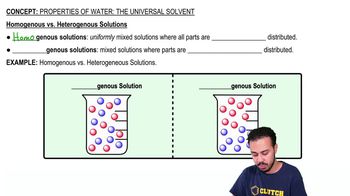
A solution is a homogeneous mixture where one substance, the solute, is completely dissolved in another, the solvent. This means that the solute's particles are distributed evenly at the molecular level, resulting in a clear and uniform appearance. For example, when salt is dissolved in water, it forms a solution where the salt ions are dispersed throughout the water.
추천 영상:
가이드 코스
02:19
Homogenous vs. Heterogenous Solutions

Concentration

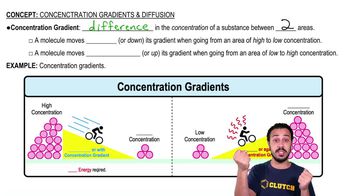
Concentration refers to the amount of solute present in a given volume of solution. It is a crucial concept in chemistry as it quantifies how much solute is dissolved in the solvent, often expressed in units such as molarity (moles per liter) or percentage. Understanding concentration helps in predicting the behavior of solutions in various chemical reactions.
추천 영상:
가이드 코스
04:51
Concentration Gradients and Diffusion

Suspension vs. Solution

A suspension is a heterogeneous mixture where large particles are dispersed in a liquid but not dissolved, causing them to settle over time. In contrast, a solution is stable and does not allow particles to settle out, as the solute is fully dissolved. This distinction is important for understanding the properties and behaviors of different types of mixtures in chemistry.
추천 영상:
가이드 코스
02:19
Homogenous vs. Heterogenous Solutions
관련 실천
교과서 질문

The drug methotrexate is used to treat several different types of cancer and diseases of the immune system. It works by inhibiting an enzyme in the cell necessary for folic acid synthesis. Without folic acid, the cell cannot make nucleotides. What, specifically, does an enzyme do in the cell? Why would inhibiting this enzyme disrupt folic acid synthesis? What effect would a disruption in folic acid synthesis have on the cell as a whole? (Hint: Think about the role that folic acid plays in the cell.) (Connects to Chapter 2)

798
views
교과서 질문

Considering that water is a main component of the juices in the stomach and intestines, explain why digestion of lipids is more complicated than digestion of carbohydrates and proteins.

674
views
교과서 질문

Explain how buffer systems in the body work if the pH of body fluids increases. Is this an example of a negative or a positive feedback loop? Explain.

1028
views
교과서 질문

In certain types of radioactive decay, the isotope releases a particle called an alpha particle, which contains two protons and two neutrons. When this happens, is the product still the same element? Why or why not?

974
views
교과서 질문

Some claim that the pH of your blood can be affected by eating acidic foods such as citrus. Do you believe this to be true? Explain your answer. (Hint: What happens when extra hydrogen ions are added to the blood?)

1181
views
교과서 질문

Explain why monosaccharides are polar and fatty acids are nonpolar even though they both contain the same atoms.

1242
views