Ch. 2 The Chemistry of Life
Amerman- Human Anatomy & Physiology 3e
Amerman3rd EditionHuman Anatomy & PhysiologyISBN: 9780138247201, 9780138247928, 9780138201814당신이 사용하는 게 아니라요?교과서 변경
2장, 문제 6

What are hydrogen bonds, and how do they form?

검증된 단계별 안내
1
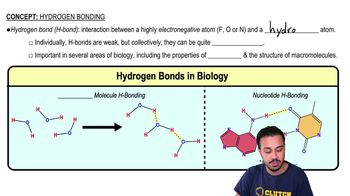
Hydrogen bonds are weak interactions that occur between a hydrogen atom covalently bonded to an electronegative atom (such as oxygen, nitrogen, or fluorine) and another electronegative atom nearby. These bonds are crucial in maintaining the structure of biological molecules like DNA and proteins.
To understand how hydrogen bonds form, first recognize that electronegative atoms attract electrons more strongly, creating a partial negative charge (δ⁻) on the electronegative atom and a partial positive charge (δ⁺) on the hydrogen atom bonded to it.
When a molecule with a δ⁺ hydrogen atom comes close to another molecule with a δ⁻ electronegative atom, the partial charges attract each other, forming a hydrogen bond. This is an intermolecular force rather than a covalent or ionic bond.
Hydrogen bonds are directional, meaning they form at specific angles that align the δ⁺ hydrogen and the δ⁻ electronegative atom. This alignment contributes to the stability and specific structure of molecules like water, DNA, and proteins.
In biological systems, hydrogen bonds play a key role in processes such as the pairing of DNA bases (adenine-thymine and cytosine-guanine) and the folding of proteins into their functional three-dimensional shapes.

비슷한 문제에 대한 검증된 영상 답변:

이 영상 해법은 위 문제에 도움이 된다고 튜터들이 추천한 것입니다.
도움이 되었나요?

주요 개념

질문에 올바르게 답하기 위해 반드시 이해해야 하는 핵심 개념들은 다음과 같습니다.

Hydrogen Bonds

Hydrogen bonds are a type of weak chemical bond that occurs when a hydrogen atom covalently bonded to a highly electronegative atom, such as oxygen or nitrogen, experiences an attraction to another electronegative atom. This interaction is crucial in many biological processes, including the structure of water and the formation of proteins and nucleic acids.
추천 영상:
가이드 코스
05:03
Hydrogen Bonding

Electronegativity

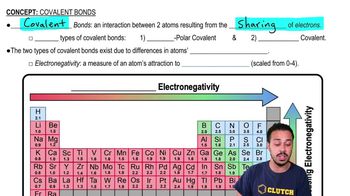
Electronegativity is a measure of an atom's ability to attract and hold onto electrons. In the context of hydrogen bonds, atoms like oxygen and nitrogen have high electronegativity, which creates a partial negative charge on these atoms and a partial positive charge on the hydrogen atom. This charge difference facilitates the formation of hydrogen bonds between molecules.
추천 영상:

Molecular Interactions

Molecular interactions refer to the various forces that hold molecules together or influence their behavior. Hydrogen bonds are one of these interactions, alongside ionic and covalent bonds. Understanding these interactions is essential for grasping how substances like water exhibit unique properties, such as high surface tension and boiling points, due to the presence of hydrogen bonds.
추천 영상:
8:47
Pacemakers: Molecular Physiology
관련 실천
교과서 질문

Explain the difference between an ionic and a covalent bond.

1395
views
교과서 질문

Identify each of the following molecules or compounds as ionic, polar covalent, or nonpolar covalent.

a. H2O _________

b. LiI _________

c. C10H22 _________

d. N2 _________

e. MgBr2 _________

f. H2S _________

833
views
교과서 질문

The polysaccharide cellulose is not digestible by humans, as we lack the enzyme cellulase, which is required to break it down. Certain dietary supplements contain the enzyme cellulase and claim that being able to break down cellulose will help a person lose weight. But what do you think would happen if we could digest the cellulose we ate?

1006
views
교과서 질문

Which of the following would not result in an increase in reaction rate?

a. Increase in temperature

b. Particles in the solid phase

c. Presence of a catalyst

d. Smaller particle size

867
views
교과서 질문

Describe what takes place during a chemical reaction.

854
views
1
rank
교과서 질문

Match the following terms with the correct definition:

      Endergonic reaction

      Potential energy

      Electrical energy

      Anabolic reaction

      Oxidation-reduction reaction

      Chemical energy

      Catabolic reaction

      Kinetic energy

a. Energy in motion

b. Energy stored in chemical bonds

c. Reaction that consumes energy

d. A decomposition reaction

e. The energy of moving charged particles

f. Stored energy

g. Synthesis reaction

h. Reaction where electrons are transferred between reactants  

724
views