
교과서 질문
Mark the following statements as true or false. If a statement is false, correct it to make a true statement.
d.Interleukin-1 is a cytokine that prevents viral replication in infected cells.
987
views

 검증된 단계별 안내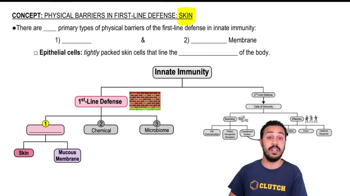
 1:28
1:28
 04:34
04:34 6:59
6:59Mark the following statements as true or false. If a statement is false, correct it to make a true statement.
d.Interleukin-1 is a cytokine that prevents viral replication in infected cells.
Which of the following does not describe the relationship between the lymphatic and immune systems?
a. Lymphoid organs and tissues house cells of the immune system.
b. Lymphoid organs and tissues trap pathogens for the immune system.
c. Lymphoid organs activate cells of the immune system.
d. Lymphoid organs and tissues create the surface barriers of the immune system.
Mark the following statements as true or false. If a statement is false, correct it to make a true statement.
NK cells are cytotoxic cells that lyse and kill cancer cells and cells infected with certain viruses.
Nonspecific immunity is also known as_____. Specific immunity is also known as_____. Specific immunity has the capacity for immunological ______ .
Mark the following statements as true or false. If a statement is false, correct it to make a true statement.
Fever is generated by pyrogens that reset the temperature set point of the hypothalamus to a lower value.
Which of the following make up the body's first line of defense?
a. Surface barriers
b. Cells and proteins of adaptive immunity
c. Cells and proteins of innate immunity
d. All of the above