Ch. 20 The Lymphatic System and Immunity
Amerman- Human Anatomy & Physiology 3e
Amerman3rd EditionHuman Anatomy & PhysiologyISBN: 9780138247201, 9780138247928, 9780138201814당신이 사용하는 게 아니라요?교과서 변경
20장, 문제 17a

Mark the following statements as true or false. If a statement is false, correct it to make a true statement.
The cells involved in organ and transplant rejection are primarily B cells.

검증된 단계별 안내
1
Step 1: Understand the role of B cells and T cells in the immune system. B cells are primarily responsible for producing antibodies, while T cells are involved in cell-mediated immunity, including the rejection of transplanted organs.
Step 2: Recall that organ and transplant rejection is primarily mediated by T cells, specifically cytotoxic T cells, which attack foreign cells recognized as non-self.
Step 3: Evaluate the statement: 'The cells involved in organ and transplant rejection are primarily B cells.' This statement is false because B cells are not the primary cells responsible for transplant rejection.
Step 4: Correct the false statement to make it true: 'The cells involved in organ and transplant rejection are primarily T cells.'
Step 5: Review the corrected statement and ensure it aligns with the understanding of the immune system's role in transplant rejection.

비슷한 문제에 대한 검증된 영상 답변:

이 영상 해법은 위 문제에 도움이 된다고 튜터들이 추천한 것입니다.
도움이 되었나요?

주요 개념

질문에 올바르게 답하기 위해 반드시 이해해야 하는 핵심 개념들은 다음과 같습니다.

Immune Response

The immune response is the body's defense mechanism against foreign substances, including pathogens and transplanted organs. It involves various cells, primarily T cells and B cells, which recognize and attack these foreign entities. Understanding the immune response is crucial for comprehending how organ rejection occurs.
추천 영상:
6:59
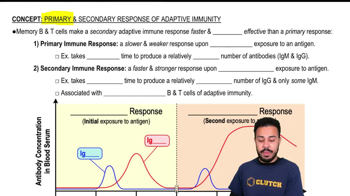
Primary and Secondary Response of Adaptive Immunity

T Cells vs. B Cells

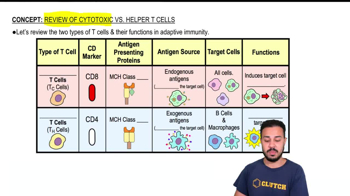
T cells and B cells are two main types of lymphocytes in the immune system. T cells are primarily responsible for cell-mediated immunity, attacking infected or foreign cells directly, while B cells are responsible for humoral immunity, producing antibodies. In the context of organ rejection, T cells play a more significant role than B cells.
추천 영상:
4:27
Review of Cytotoxic vs Helper T Cells

Organ Transplant Rejection

Organ transplant rejection occurs when the recipient's immune system identifies the transplanted organ as foreign and mounts an attack against it. This process can be acute or chronic and is primarily mediated by T cells, which recognize the differences in the donor's tissue antigens. Understanding this concept is essential for addressing the statement about B cells in organ rejection.
추천 영상:
가이드 코스
05:04
The Levels of Organization