Ch. 20 The Lymphatic System and Immunity
Amerman- Human Anatomy & Physiology 3e
Amerman3rd EditionHuman Anatomy & PhysiologyISBN: 9780138247201, 9780138247928, 9780138201814당신이 사용하는 게 아니라요?교과서 변경
20장, 문제 14

On which type(s) of cells are class I MHC molecules located?
a. Antigen-presenting cells only
b. B cells only
c. All nucleated body cells
d. Antigen-presenting cells and B cells

검증된 단계별 안내
1
Step 1: Understand the role of class I MHC (Major Histocompatibility Complex) molecules. These molecules are responsible for presenting endogenous antigens (antigens originating from within the cell) to cytotoxic T cells (CD8+ T cells). This process is crucial for immune surveillance and the detection of infected or abnormal cells.
Step 2: Recall the distribution of class I MHC molecules. Class I MHC molecules are expressed on the surface of all nucleated cells in the body. This includes most body cells, as opposed to class II MHC molecules, which are restricted to antigen-presenting cells (APCs) like macrophages, dendritic cells, and B cells.
Step 3: Exclude incorrect options based on the distribution of class I MHC molecules. For example, option 'a' (Antigen-presenting cells only) and option 'b' (B cells only) are incorrect because class I MHC molecules are not limited to these cell types.
Step 4: Consider option 'c' (All nucleated body cells). This is consistent with the fact that class I MHC molecules are found on all nucleated cells, including epithelial cells, muscle cells, and immune cells, but not on non-nucleated cells like red blood cells.
Step 5: Evaluate option 'd' (Antigen-presenting cells and B cells). While APCs and B cells do express class I MHC molecules, this option is incomplete because it excludes other nucleated cells that also express class I MHC molecules. Therefore, option 'c' is the most accurate answer.

비슷한 문제에 대한 검증된 영상 답변:

이 영상 해법은 위 문제에 도움이 된다고 튜터들이 추천한 것입니다.
도움이 되었나요?

주요 개념

질문에 올바르게 답하기 위해 반드시 이해해야 하는 핵심 개념들은 다음과 같습니다.

Class I MHC Molecules

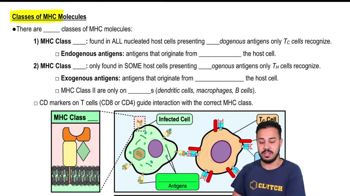
Class I Major Histocompatibility Complex (MHC) molecules are proteins found on the surface of all nucleated cells in the body. They play a crucial role in the immune system by presenting endogenous antigens (from within the cell) to CD8+ cytotoxic T cells, which are essential for recognizing and eliminating infected or cancerous cells.
추천 영상:
7:17
Classes of MHC Molecules

Nucleated Cells

Nucleated cells are cells that contain a nucleus, which houses the cell's genetic material. This includes most body cells, except for mature red blood cells and platelets. The presence of a nucleus allows these cells to express Class I MHC molecules, enabling them to present antigens to the immune system.
추천 영상:
05:33
Cell Junctions

Antigen-Presenting Cells (APCs)

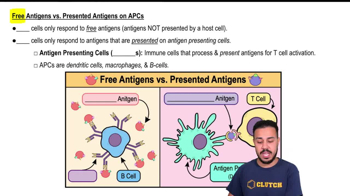
Antigen-presenting cells (APCs) are specialized immune cells, such as dendritic cells, macrophages, and B cells, that capture, process, and present antigens to T cells. While Class I MHC molecules are present on all nucleated cells, APCs also express Class II MHC molecules, which present exogenous antigens to CD4+ helper T cells, highlighting their role in initiating immune responses.
추천 영상:
4:11
Free Antigens vs. Presented Antigens on APCs