Ch. 22 The Digestive System
Amerman- Human Anatomy & Physiology 3e
Amerman3rd EditionHuman Anatomy & PhysiologyISBN: 9780138247201, 9780138247928, 9780138201814당신이 사용하는 게 아니라요?교과서 변경
22장, 문제 10

Which of the following statements about accessory organ secretions is not true?
a. Hepatocytes produce bile, which drains out of the liver via the common hepatic ducts.
b. Saliva contains secretory IgA and lysozyme, which play an important role in preventing the growth of pathogenic bacteria in the oral cavity.
c. Pancreatic juice contains digestive enzymes and bicarbonate ions to neutralize the acidic chyme.
d. The gallbladder produces bile, which drains out of the gallbladder via the cystic duct.

검증된 단계별 안내
1
Step 1: Understand the role of accessory organs in the digestive system. Accessory organs include the liver, gallbladder, pancreas, and salivary glands. Each of these organs produces or stores substances that aid in digestion.
Step 2: Analyze each statement provided in the question. For each statement, determine whether it accurately describes the function or secretion of the accessory organ mentioned.
Step 3: For statement (a), recall that hepatocytes (liver cells) produce bile, which is transported out of the liver via the common hepatic ducts. This is a true statement.
Step 4: For statement (b), note that saliva contains secretory IgA and lysozyme, which are antimicrobial agents that help prevent bacterial growth in the oral cavity. This is also a true statement.
Step 5: For statement (d), evaluate whether the gallbladder produces bile. The gallbladder does not produce bile; it stores and concentrates bile produced by the liver. This makes statement (d) incorrect, as bile drains out of the gallbladder via the cystic duct but is not produced there.

비슷한 문제에 대한 검증된 영상 답변:

이 영상 해법은 위 문제에 도움이 된다고 튜터들이 추천한 것입니다.
도움이 되었나요?

주요 개념

질문에 올바르게 답하기 위해 반드시 이해해야 하는 핵심 개념들은 다음과 같습니다.

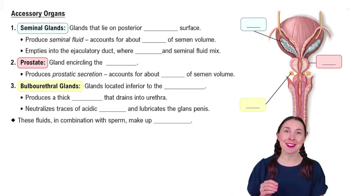
Accessory Organs of Digestion

Accessory organs of digestion include the liver, pancreas, and gallbladder, which play crucial roles in the digestive process. The liver produces bile, the pancreas secretes digestive enzymes and bicarbonate, and the gallbladder stores and concentrates bile. Understanding the functions of these organs is essential for analyzing statements about their secretions.
추천 영상:
3:21
Accessory Organs

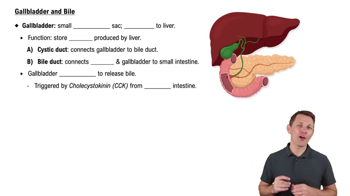
Bile Production and Function

Bile is produced by hepatocytes in the liver and is essential for the emulsification and digestion of fats. It is stored in the gallbladder and released into the small intestine via the common bile duct. Recognizing the correct pathways and functions of bile is vital for evaluating statements regarding its production and drainage.
추천 영상:
6:54
Gallbladder and Bile

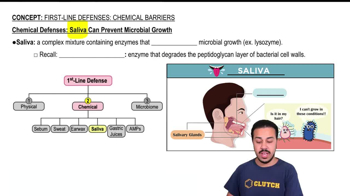
Components of Saliva

Saliva is a complex fluid produced by salivary glands, containing enzymes, electrolytes, and antimicrobial agents like secretory IgA and lysozyme. These components help in the initial digestion of food and protect the oral cavity from pathogens. Understanding the role of saliva is important for assessing its contributions to oral health and digestion.
추천 영상:
관련 실천
교과서 질문

Mark the following statements as true or false. If a statement is false, correct it to make a true statement.

c. Smooth muscle of the stomach contracts when food enters from the esophagus.

781
views

교과서 질문

How does absorption of lipids differ from absorption of carbohydrates and proteins in the small intestine?

a. Lipids are absorbed into a capillary; carbohydrates and proteins are absorbed into a lacteal.

b. Lipids are not absorbed in the small intestine.

c. Lipids are absorbed into a lacteal; carbohydrates and proteins are absorbed into a capillary.

d. They are all absorbed into the same structure.

1250
views
교과서 질문

Mark the following statements as true or false. If a statement is false, correct it to make a true statement.

b. The esophageal and pharyngeal phases of swallowing are mediated by the swallowing reflex of the brainstem and the enteric nervous system.

782
views
교과서 질문

Match the following terms with the correct definition. 

__Chief cells          

__Parietal cells           

__Gastrin           

__Pyloric sphincter         

__Diffuse neuroendocrine (DNES) cells         

__Gastroesophageal sphincter         

__Pepsin         

__Chyme

a. Hormone that stimulates multiple digestive processes

b. Enzyme that begins protein digestion

c. Produce acid and intrinsic factor

d. Liquid produced as a result of stomach churning

e. Produce pepsinogen

f. Cells in gastric glands that produce hormones

g. Controls passage of bolus from esophagus to stomach

h. Controls passage of stomach contents to duodenum

618
views
교과서 질문

Which of the following best describes the microscopic structure of the liver?

a. Hexagonal plates of hepatocytes surrounding a central vein with portal triads at each corner

b. Octagonal plates of hepatocytes surrounding a central artery with portal triads at each corner

c. Irregular groups of hepatocytes surrounding a central vein with bile ducts at each corner

d. Hexagonal plates of hepatocytes surrounding a portal vein with bile ducts at each corner

784
views
교과서 질문

What are the three folds of the small intestine called? What is their purpose?

1010
views