
Ch. 25 Fluid, Electrolyte, and Acid-Base Homeostasis
Amerman- Human Anatomy & Physiology 3e
Amerman3rd EditionHuman Anatomy & PhysiologyISBN: 9780138247201, 9780138247928, 9780138201814당신이 사용하는 게 아니라요?교과서 변경
25장, 문제 16d

Mark the following statements as true or false. If a statement is false, correct it to make a true statement.
d. Renal compensation for metabolic alkalosis consists of reabsorption of hydrogen ions and secretion of bicarbonate ions.

검증된 단계별 안내
1
Step 1: Understand the concept of metabolic alkalosis. Metabolic alkalosis occurs when there is an increase in blood pH due to an excess of bicarbonate ions (HCO₃⁻) or a loss of hydrogen ions (H⁺). The body compensates for this imbalance primarily through respiratory and renal mechanisms.
Step 2: Review the role of renal compensation in metabolic alkalosis. The kidneys help restore pH balance by adjusting the reabsorption and secretion of hydrogen ions (H⁺) and bicarbonate ions (HCO₃⁻).
Step 3: Analyze the statement provided. The statement claims that renal compensation for metabolic alkalosis involves reabsorption of hydrogen ions and secretion of bicarbonate ions. Consider whether this aligns with the physiological response to metabolic alkalosis.
Step 4: Correct the statement if it is false. In metabolic alkalosis, the kidneys typically respond by decreasing the reabsorption of bicarbonate ions (HCO₃⁻) and increasing the excretion of bicarbonate ions into the urine. This helps lower the blood bicarbonate levels and restore pH balance. Additionally, the reabsorption of hydrogen ions (H⁺) is not a primary mechanism in this process.
Step 5: Rewrite the corrected statement if necessary. The corrected statement should read: 'Renal compensation for metabolic alkalosis consists of decreased reabsorption of bicarbonate ions and increased excretion of bicarbonate ions.'

비슷한 문제에 대한 검증된 영상 답변:

이 영상 해법은 위 문제에 도움이 된다고 튜터들이 추천한 것입니다.
영상 길이:
2m
도움이 되었나요?

주요 개념

질문에 올바르게 답하기 위해 반드시 이해해야 하는 핵심 개념들은 다음과 같습니다.

Metabolic Alkalosis

Metabolic alkalosis is a condition characterized by an increase in blood pH due to an excess of bicarbonate or a loss of hydrogen ions. This can occur from various causes, including prolonged vomiting, diuretic use, or excessive intake of alkaline substances. Understanding this condition is crucial for recognizing how the body attempts to restore acid-base balance.
추천 영상:
가이드 코스
02:17
Introduction to Metabolism

Renal Compensation

Renal compensation refers to the kidneys' ability to regulate blood pH by adjusting the excretion or reabsorption of acids and bases. In response to metabolic alkalosis, the kidneys typically decrease bicarbonate reabsorption and increase hydrogen ion secretion to help lower blood pH. This process is essential for maintaining homeostasis in the body's acid-base balance.
추천 영상:
4:58
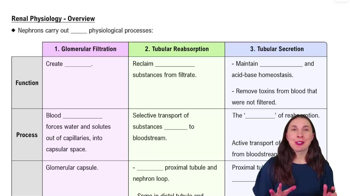
Overview of Renal Physiology

Bicarbonate and Hydrogen Ion Balance

The balance between bicarbonate (HCO3-) and hydrogen ions (H+) is critical for maintaining the body's pH level. Bicarbonate acts as a buffer, neutralizing excess acids, while hydrogen ions contribute to acidity. In metabolic alkalosis, the body must adjust this balance, often leading to decreased bicarbonate reabsorption and increased hydrogen ion secretion by the kidneys to correct the elevated pH.
추천 영상:
가이드 코스
05:03
Hydrogen Bonding