Ch. 25 Fluid, Electrolyte, and Acid-Base Homeostasis
Amerman- Human Anatomy & Physiology 3e
Amerman3rd EditionHuman Anatomy & PhysiologyISBN: 9780138247201, 9780138247928, 9780138201814당신이 사용하는 게 아니라요?교과서 변경
25장, 문제 16b

Mark the following statements as true or false. If a statement is false, correct it to make a true statement.
b. Renal compensation for acid-base disturbances begins within minutes, whereas respiratory compensation begins within several hours.

검증된 단계별 안내
1
Understand the two types of compensation mechanisms for acid-base disturbances: respiratory compensation and renal compensation. Respiratory compensation involves changes in breathing rate to adjust CO2 levels, while renal compensation involves the kidneys adjusting bicarbonate (HCO3⁻) and hydrogen ion (H⁺) levels.
Recall the timeframes for each mechanism. Respiratory compensation is faster because it involves immediate changes in breathing patterns, typically beginning within minutes. Renal compensation, on the other hand, is slower because it requires physiological changes in kidney function, which can take hours to days.
Evaluate the statement: 'Renal compensation for acid-base disturbances begins within minutes, whereas respiratory compensation begins within several hours.' Based on the timeframes, this statement is incorrect because it reverses the timing of the two mechanisms.
Correct the false statement: 'Respiratory compensation for acid-base disturbances begins within minutes, whereas renal compensation begins within several hours to days.'
Review the corrected statement to ensure it aligns with the physiological processes of acid-base regulation and the respective timeframes for respiratory and renal compensation.

비슷한 문제에 대한 검증된 영상 답변:

이 영상 해법은 위 문제에 도움이 된다고 튜터들이 추천한 것입니다.
도움이 되었나요?

주요 개념

질문에 올바르게 답하기 위해 반드시 이해해야 하는 핵심 개념들은 다음과 같습니다.

Acid-Base Balance

Acid-base balance refers to the mechanisms that maintain the pH of body fluids within a narrow range, crucial for normal physiological functions. The body utilizes buffers, respiratory control of carbon dioxide, and renal regulation of bicarbonate and hydrogen ions to achieve this balance. Understanding these processes is essential for evaluating how the body responds to disturbances in pH.
추천 영상:
가이드 코스
01:29
Acids and Bases

Renal Compensation

Renal compensation involves the kidneys adjusting the excretion or reabsorption of bicarbonate and hydrogen ions to correct acid-base imbalances. This process can take hours to days to fully engage, making it a slower response compared to respiratory compensation. Recognizing the timeline and mechanisms of renal compensation is vital for understanding how the body stabilizes pH over time.
추천 영상:
4:58
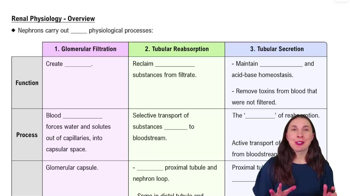
Overview of Renal Physiology

Respiratory Compensation

Respiratory compensation is the body's immediate response to acid-base disturbances, primarily through changes in breathing rate and depth to regulate carbon dioxide levels. This mechanism can begin within minutes, allowing for rapid adjustments to pH. Understanding the speed and function of respiratory compensation is key to grasping how the body quickly reacts to maintain acid-base homeostasis.
추천 영상:
가이드 코스
1:38
Secondary Lymphoid Organs: The Spleen Example 1
관련 실천
교과서 질문

Mark the following statements as true or false. If a statement is false, correct it to make a true statement.

c. Respiratory compensation for metabolic acidosis consists of hypoventilation.

391
views

교과서 질문

Mark the following statements as true or false. If a statement is false, correct it to make a true statement.

d. Renal compensation for metabolic alkalosis consists of reabsorption of hydrogen ions and secretion of bicarbonate ions.

399
views
교과서 질문

Mark the following statements as true or false. If a statement is false, correct it to make a true statement.

e. You would expect to find an elevated Pco₂ in arterial blood gas analysis of a patient with respiratory acidosis.

335
views
교과서 질문

Which of the following mechanisms is/are used by the kidneys to regulate the pH of the blood? Circle all that apply.

a. Hydrogen ions are secreted from the proximal and distal tubules and the collecting system.

b. Hydrogen ions are reabsorbed from the nephron loop.

c. New bicarbonate ions are formed from glutamine and carbon dioxide in the interstitial fluid that enters proximal tubule cells.

d. Bicarbonate ions can be secreted.

e. Bicarbonate ions are reabsorbed directly from the filtrate.

475
views
교과서 질문

An increase in ventilation ________ the pH of the blood due to a/an ________ of carbon dioxide in the blood. A decrease in ventilation ________ the pH of the blood due to a/an ________ of carbon dioxide in the blood.

408
views
교과서 질문

Mark the following statements as true or false. If a statement is false, correct it to make a true statement.

a. Respiratory acidosis is caused by hypoventilation.

333
views