Ch. 25 Fluid, Electrolyte, and Acid-Base Homeostasis
Amerman- Human Anatomy & Physiology 3e
Amerman3rd EditionHuman Anatomy & PhysiologyISBN: 9780138247201, 9780138247928, 9780138201814당신이 사용하는 게 아니라요?교과서 변경
25장, 문제 10e

Mark the following statements as true or false. If a statement is false, correct it to make a true statement.
e. Chloride ions are generally reabsorbed from the kidneys, along with bicarbonate ions.

검증된 단계별 안내
1
Understand the context: The question is about the reabsorption of ions in the kidneys, specifically chloride ions and bicarbonate ions. This involves understanding renal physiology, particularly the processes of filtration, reabsorption, and secretion in the nephron.
Review the nephron's function: The nephron is the functional unit of the kidney. It filters blood, reabsorbs essential substances, and secretes waste. Chloride ions (Cl⁻) and bicarbonate ions (HCO₃⁻) are both involved in maintaining acid-base balance and electrolyte homeostasis.
Analyze the statement: Chloride ions are reabsorbed in the nephron, primarily in the proximal tubule, loop of Henle, and distal tubule. However, their reabsorption is not directly coupled with bicarbonate ions. Instead, bicarbonate reabsorption is closely linked to hydrogen ion (H⁺) secretion and sodium ion (Na⁺) reabsorption.
Correct the false statement: If the statement is false, revise it to reflect accurate physiology. For example, 'Chloride ions are generally reabsorbed from the kidneys, but their reabsorption is not directly coupled with bicarbonate ions. Instead, bicarbonate ions are reabsorbed through a process involving hydrogen ion secretion.'
Summarize the corrected understanding: Ensure the student understands that chloride and bicarbonate ions are reabsorbed through distinct mechanisms in the nephron, contributing to the kidney's role in maintaining electrolyte and acid-base balance.

비슷한 문제에 대한 검증된 영상 답변:

이 영상 해법은 위 문제에 도움이 된다고 튜터들이 추천한 것입니다.
도움이 되었나요?

주요 개념

질문에 올바르게 답하기 위해 반드시 이해해야 하는 핵심 개념들은 다음과 같습니다.

Chloride Ion Reabsorption

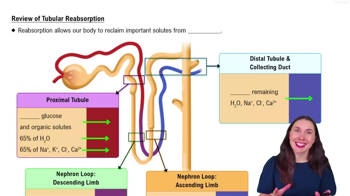
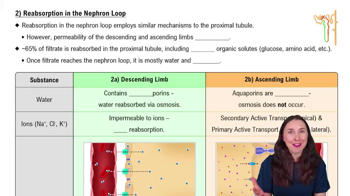
Chloride ions (Cl-) are essential electrolytes in the body, primarily involved in maintaining fluid balance and acid-base homeostasis. In the kidneys, chloride is reabsorbed in various segments of the nephron, particularly in the loop of Henle and the distal convoluted tubule, often coupled with sodium reabsorption to maintain electrical neutrality.
추천 영상:
2:01
Review of Tubular Reabsorption

Bicarbonate Ion Reabsorption

Bicarbonate ions (HCO3-) play a crucial role in the body's buffering system, helping to maintain pH balance. In the kidneys, bicarbonate is reabsorbed primarily in the proximal convoluted tubule, where it is converted to carbonic acid and then back to bicarbonate, ensuring that the body retains this important buffer while excreting excess hydrogen ions.
추천 영상:
3:25
2) Reabsorption in the Nephron Loop

Kidney Function and Electrolyte Balance

The kidneys are vital organs responsible for filtering blood, excreting waste, and regulating electrolyte levels, including sodium, potassium, chloride, and bicarbonate. This regulation is crucial for maintaining homeostasis, as imbalances can lead to serious health issues. The reabsorption processes in the nephron segments are finely tuned to respond to the body's needs, ensuring optimal electrolyte balance.
추천 영상:
07:59
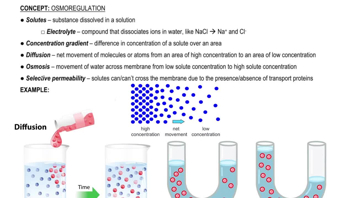
Osmosis and Osmolarity