Ch. 9 The Muscular System
Amerman- Human Anatomy & Physiology 3e
Amerman3rd EditionHuman Anatomy & PhysiologyISBN: 9780138247201, 9780138247928, 9780138201814당신이 사용하는 게 아니라요?교과서 변경
9장, 문제 L2.2

Explain how the diaphragm muscle is able to increase the size of the thoracic cavity even though it doesn't insert into a bone.

검증된 단계별 안내
1
Understand the anatomy of the diaphragm: The diaphragm is a dome-shaped sheet of skeletal muscle that separates the thoracic cavity from the abdominal cavity. It is unique because it does not insert into a bone but attaches to structures such as the central tendon, the lower ribs, the sternum, and the lumbar vertebrae.
Learn the mechanism of contraction: When the diaphragm contracts, its muscle fibers shorten, causing the dome-shaped structure to flatten and move downward. This movement increases the vertical dimension of the thoracic cavity.
Explore the role of the central tendon: The diaphragm's central tendon is a strong, fibrous structure that serves as the insertion point for the muscle fibers. When the diaphragm contracts, the central tendon is pulled downward, facilitating the expansion of the thoracic cavity.
Understand the pressure changes: As the diaphragm moves downward, it reduces the pressure in the thoracic cavity relative to the atmospheric pressure. This creates a vacuum effect, allowing air to flow into the lungs during inhalation.
Connect the movement to respiration: The diaphragm's ability to increase the size of the thoracic cavity is essential for breathing. By expanding the thoracic cavity, the diaphragm enables the lungs to fill with air, supporting the process of gas exchange necessary for oxygen delivery and carbon dioxide removal.

비슷한 문제에 대한 검증된 영상 답변:

이 영상 해법은 위 문제에 도움이 된다고 튜터들이 추천한 것입니다.
도움이 되었나요?

주요 개념

질문에 올바르게 답하기 위해 반드시 이해해야 하는 핵심 개념들은 다음과 같습니다.

Diaphragm Anatomy

The diaphragm is a dome-shaped muscle that separates the thoracic cavity from the abdominal cavity. It is primarily composed of skeletal muscle fibers and is innervated by the phrenic nerve. Although it does not insert into a bone, it is anchored to the lower ribs, sternum, and lumbar vertebrae, allowing it to function effectively during respiration.
추천 영상:
4:14
Clitoral Anatomy

Mechanics of Breathing

Breathing involves the expansion and contraction of the thoracic cavity, which is essential for inhalation and exhalation. When the diaphragm contracts, it flattens and moves downward, increasing the volume of the thoracic cavity. This decrease in pressure allows air to flow into the lungs, demonstrating how muscle contraction can influence cavity size without direct bony attachment.
추천 영상:
3:02
Internal Regulation - The Myogenic Mechanism

Pressure Gradient in Respiration

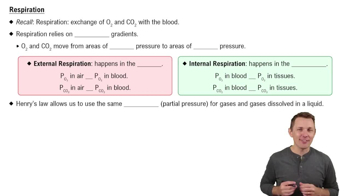
The principle of pressure gradient is crucial in respiration, as air moves from areas of higher pressure to lower pressure. When the diaphragm contracts and the thoracic cavity expands, the pressure inside the cavity decreases relative to atmospheric pressure. This pressure difference is what drives air into the lungs, illustrating the diaphragm's role in respiratory mechanics despite its lack of bony insertion.
추천 영상:
3:59
Respiration