교과서 질문
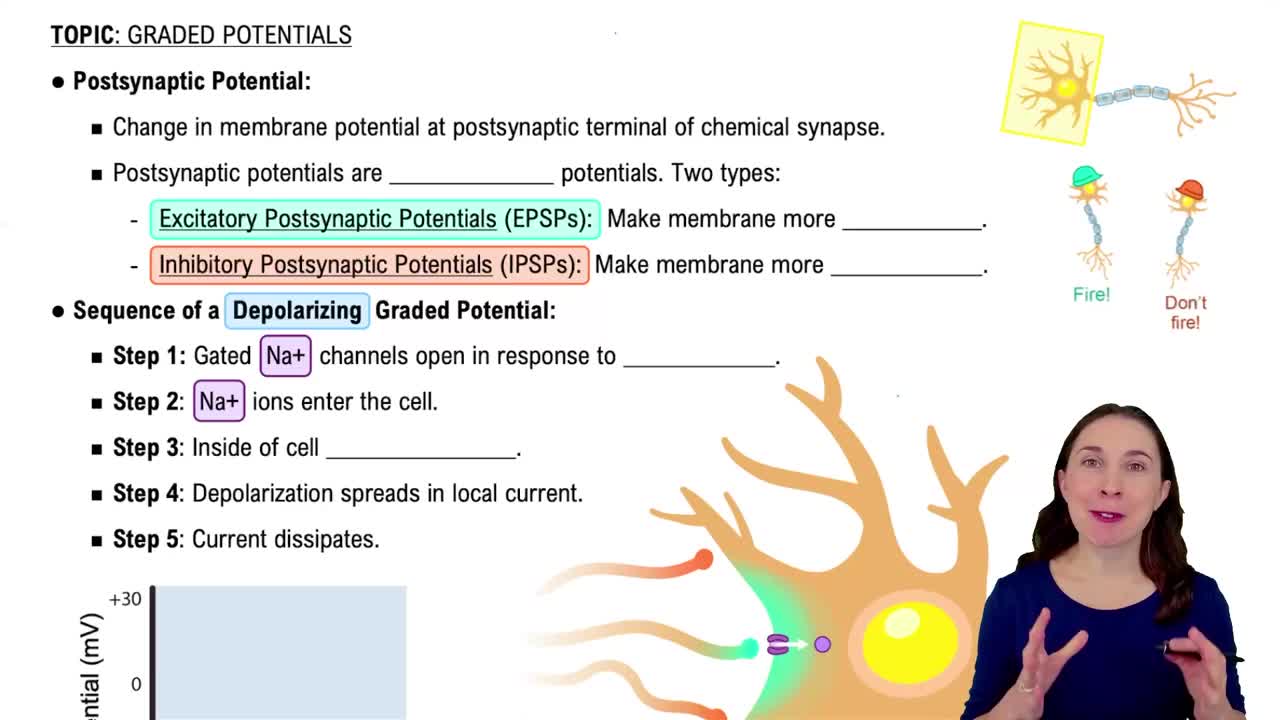
During a neurobiology lecture, a professor repeatedly refers to group A and group B fibers, absolute refractory period, and myelin sheath gaps. Define these terms.
632
views
1
rank

 Hoehn, Haynes, Abbott 12th EditionCh. 11 Fundamentals of the Nervous System and Nervous Tissue문제 9
 검증된 단계별 안내
 05:55
05:55 05:55
05:55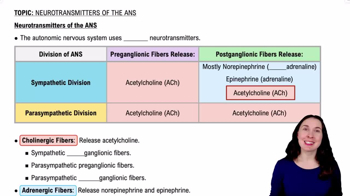 4:14
4:14During a neurobiology lecture, a professor repeatedly refers to group A and group B fibers, absolute refractory period, and myelin sheath gaps. Define these terms.
Neuropeptides that act as natural opiates include
a. Substance P
b. Somatostatin and cholecystokinin
c. Tachykinins
d. Enkephalins
Inhibition of acetylcholinesterase by poisoning blocks neurotransmission at the neuromuscular junction because
a. ACh is no longer released by the presynaptic terminal.
b. ACh synthesis in the presynaptic terminal is blocked.
c. ACh is not degraded, so prolonged depolarization is enforced on the postsynaptic cell.
d. ACh is blocked from attaching to the postsynaptic ACh receptors.
a. What is myelin?
b. How does the myelination process differ in the CNS and PNS?
The anatomical region of a multipolar neuron where the AP is initiated is the
a. Soma
b. Dendrites
c. Axon's initial segment
d. Axon terminals
Since all APs generated by a given nerve fiber have the same magnitude, how does the CNS 'know' whether a stimulus is strong or weak?