Ch. 13 The Peripheral Nervous System and Reflex Activity

Hoehn, Haynes, Abbott12th EditionMarieb Human Anatomy & PhysiologyISBN: 9780138242732
당신이 사용하는 게 아니라요?교과서 변경다른 교과서를 선택하세요
TOC.tableOfContents
- Ch. 1 The Human Body: An Orientation25
- Ch. 2 Chemistry Comes Alive24
- Ch. 3 Cells: The Living Units24
- Ch. 4 Tissue: The Living Fabric19
- Ch. 5 The Integumentary System12
- Ch. 6 Bones and Skeletal Tissues19
- Ch. 7 The Skeleton14
- Ch. 8 Joints7
- Ch. 9 Muscles and Muscle Tissue26
- Ch. 10 The Muscular System25
- Ch. 11 Fundamentals of the Nervous System and Nervous Tissue23
- Ch. 12 The Central Nervous System25
- Ch. 13 The Peripheral Nervous System and Reflex Activity30
- Ch. 14 The Autonomic Nervous System16
- Ch. 15 The Special Senses26
- Ch. 16 The Endocrine System26
- Ch. 17 Blood27
- Ch. 18 The Cardiovascular System: The Heart25
- Ch. 19 The Cardiovascular System: Blood Vessels27
- Ch. 20 The Lymphatic System and Lymphoid Organs and Tissues16
- Ch. 21 The Immune System: Innate and Adaptive Body Defenses27
- Ch. 22 The Respiratory System21
- Ch. 23 The Digestive System31
- Ch. 24 Nutrition, Metabolism, and Energy Balance26
- Ch. 25 The Urinary System26
- Ch. 26 Fluid, Electrolyte, and Acid-Base Balance24
- Ch. 27 The Reproductive System24
- Ch. 28 Pregnancy and Human Development25
- Ch. 29 Heredity11
Hoehn, Haynes, Abbott12th EditionMarieb Human Anatomy & PhysiologyISBN: 9780138242732당신이 사용하는 게 아니라요?교과서 변경
모든 교과서 Hoehn, Haynes, Abbott 12th EditionCh. 13 The Peripheral Nervous System and Reflex Activity문제 21
Hoehn, Haynes, Abbott 12th EditionCh. 13 The Peripheral Nervous System and Reflex Activity문제 2113장, 문제 21
Compare and contrast flexor and crossed-extensor reflexes.
 검증된 단계별 안내
1
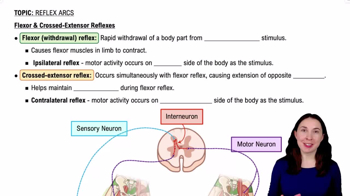
Step 1: Define the flexor reflex. Explain that it is a protective, polysynaptic reflex that causes the withdrawal of a limb from a painful stimulus by activating flexor muscles and inhibiting extensor muscles on the same side of the body (ipsilateral response).
Step 2: Define the crossed-extensor reflex. Describe it as a complementary reflex that occurs simultaneously with the flexor reflex, involving the opposite limb (contralateral side). It activates extensor muscles and inhibits flexor muscles to support body weight when the other limb withdraws.
Step 3: Compare the pathways involved. Note that the flexor reflex involves sensory neurons synapsing with interneurons that excite ipsilateral flexor motor neurons and inhibit ipsilateral extensor motor neurons, while the crossed-extensor reflex involves interneurons crossing the spinal cord to excite contralateral extensor motor neurons and inhibit contralateral flexor motor neurons.
Step 4: Contrast their functional roles. Emphasize that the flexor reflex primarily serves to remove the limb from harm, whereas the crossed-extensor reflex helps maintain balance and posture by stabilizing the opposite limb.
Step 5: Summarize by highlighting that both reflexes work together during a painful stimulus to coordinate a rapid, protective response involving both limbs, ensuring withdrawal and postural support.
비슷한 문제에 대한 검증된 영상 답변:
이 영상 해법은 위 문제에 도움이 된다고 튜터들이 추천한 것입니다.

영상 길이:
1m주요 개념
질문에 올바르게 답하기 위해 반드시 이해해야 하는 핵심 개념들은 다음과 같습니다.
Flexor Reflex
The flexor reflex is a protective, withdrawal response that causes the contraction of flexor muscles to pull a limb away from a harmful stimulus. It is a polysynaptic reflex involving sensory neurons, interneurons, and motor neurons, primarily resulting in limb flexion to avoid injury.
추천 영상:
 2:42
2:42
Flexor & Crossed-Extensor Reflexes
Crossed-Extensor Reflex
The crossed-extensor reflex complements the flexor reflex by extending the opposite limb to maintain balance when the other limb withdraws. It involves contralateral motor neurons activating extensor muscles, ensuring postural stability during the withdrawal response.
추천 영상:
2:42Flexor & Crossed-Extensor Reflexes
Neural Pathways and Integration
Both reflexes involve complex neural circuits with sensory input, interneuronal processing, and motor output. The flexor reflex is ipsilateral, while the crossed-extensor reflex involves contralateral pathways, demonstrating how the spinal cord integrates signals to coordinate coordinated, bilateral motor responses.
추천 영상:
가이드 코스
 4:40
4:40Alternative Pathway
관련 실천