
Ch. 22 The Respiratory System
Hoehn - Marieb Human Anatomy & Physiology, 12th edition
Hoehn, Haynes, Abbott12th EditionMarieb Human Anatomy & PhysiologyISBN: 9780138242732당신이 사용하는 게 아니라요?교과서 변경
22장, 문제 22

Describe the functional relationships between volume changes and gas flow into and out of the lungs.

검증된 단계별 안내
1
Understand that the movement of air into and out of the lungs is governed by pressure differences created by changes in lung volume, according to the principles of pulmonary ventilation.
Recall Boyle's Law, which states that pressure and volume of a gas are inversely related when temperature is constant, expressed as \(P \times V = \text{constant}\).
During inspiration, the diaphragm and intercostal muscles contract, increasing the thoracic cavity volume, which decreases the intrapulmonary pressure below atmospheric pressure, causing air to flow into the lungs.
During expiration, these muscles relax, decreasing thoracic volume, which increases intrapulmonary pressure above atmospheric pressure, pushing air out of the lungs.
Summarize that the functional relationship is that changes in lung volume alter intrapulmonary pressure, and air flows from areas of higher pressure to lower pressure, facilitating ventilation.

비슷한 문제에 대한 검증된 영상 답변:

이 영상 해법은 위 문제에 도움이 된다고 튜터들이 추천한 것입니다.
영상 길이:
3m
도움이 되었나요?

주요 개념

질문에 올바르게 답하기 위해 반드시 이해해야 하는 핵심 개념들은 다음과 같습니다.

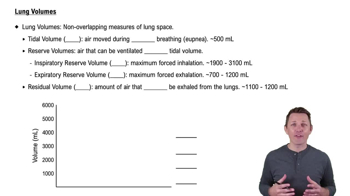
Lung Volume Changes

Lung volume changes refer to the expansion and contraction of the lungs during breathing. When the diaphragm and intercostal muscles contract, lung volume increases, creating negative pressure that draws air in. Conversely, relaxation of these muscles decreases lung volume, pushing air out.
추천 영상:

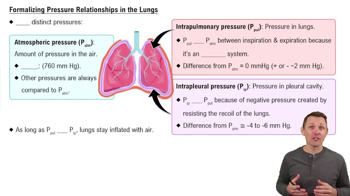
Pressure-Volume Relationship in the Lungs

The pressure-volume relationship explains how changes in lung volume affect intrapulmonary pressure. As lung volume increases, pressure inside the lungs drops below atmospheric pressure, causing air to flow in. When lung volume decreases, pressure rises above atmospheric pressure, driving air out.
추천 영상:
가이드 코스
5:46
Formalizing Pressure Relationships in the Lungs

Gas Flow Dynamics

Gas flow into and out of the lungs is driven by pressure gradients created by volume changes. Air moves from areas of higher pressure to lower pressure, so inhalation occurs when lung pressure is less than atmospheric pressure, and exhalation occurs when lung pressure exceeds atmospheric pressure.
추천 영상:
가이드 코스
03:59
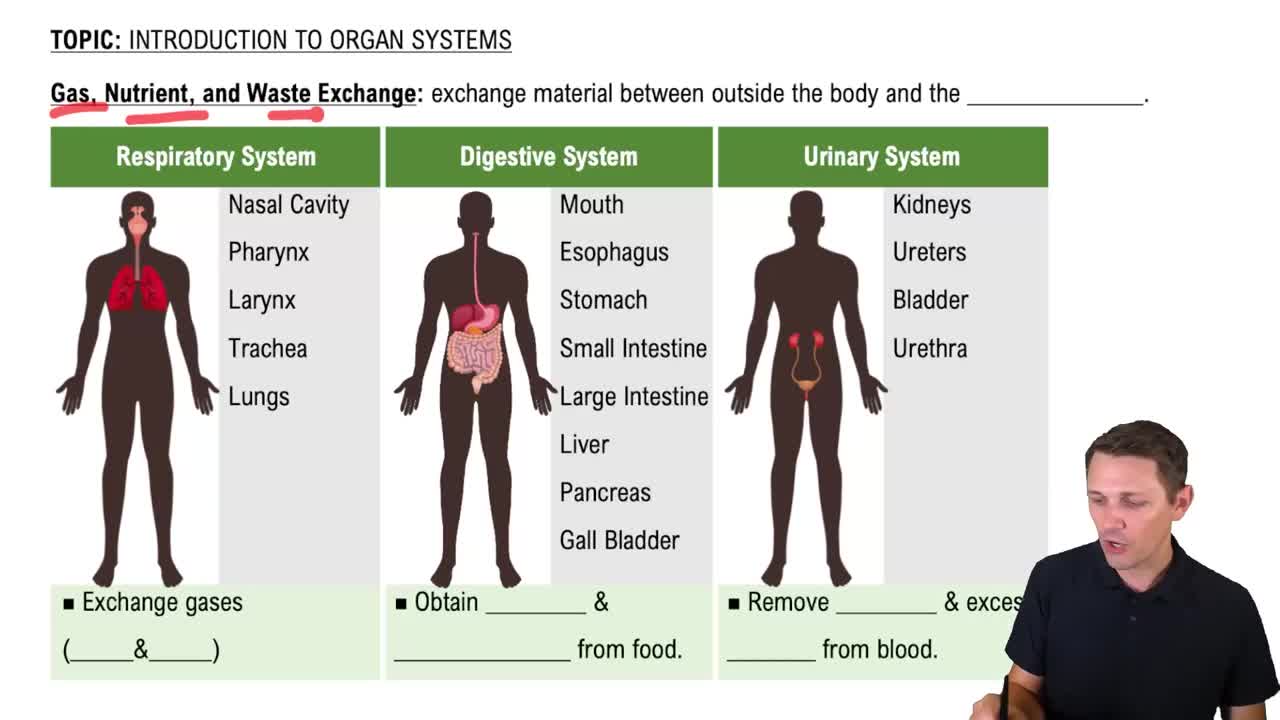
Gas, Nutrient and Waste Exchange