
Ch. 7 The Skeleton
Hoehn - Marieb Human Anatomy & Physiology, 12th edition
Hoehn, Haynes, Abbott12th EditionMarieb Human Anatomy & PhysiologyISBN: 9780138242732당신이 사용하는 게 아니라요?교과서 변경
7장, 문제 5

What is the function of the intervertebral discs?

검증된 단계별 안내
1
Understand that intervertebral discs are structures located between the vertebrae in the spinal column.
Recognize that these discs serve as cushions or shock absorbers to reduce the impact of movements such as walking, running, or jumping on the spine.
Know that each intervertebral disc consists of a tough outer layer called the annulus fibrosus and a gel-like center called the nucleus pulposus, which together allow flexibility and resilience.
Identify that the discs also help maintain the spacing between vertebrae, which is important for the proper functioning of spinal nerves that exit the spinal cord.
Summarize that the primary function of intervertebral discs is to provide shock absorption, allow flexibility, and maintain spinal stability.

비슷한 문제에 대한 검증된 영상 답변:

이 영상 해법은 위 문제에 도움이 된다고 튜터들이 추천한 것입니다.
영상 길이:
2m
도움이 되었나요?

주요 개념

질문에 올바르게 답하기 위해 반드시 이해해야 하는 핵심 개념들은 다음과 같습니다.

Structure of Intervertebral Discs

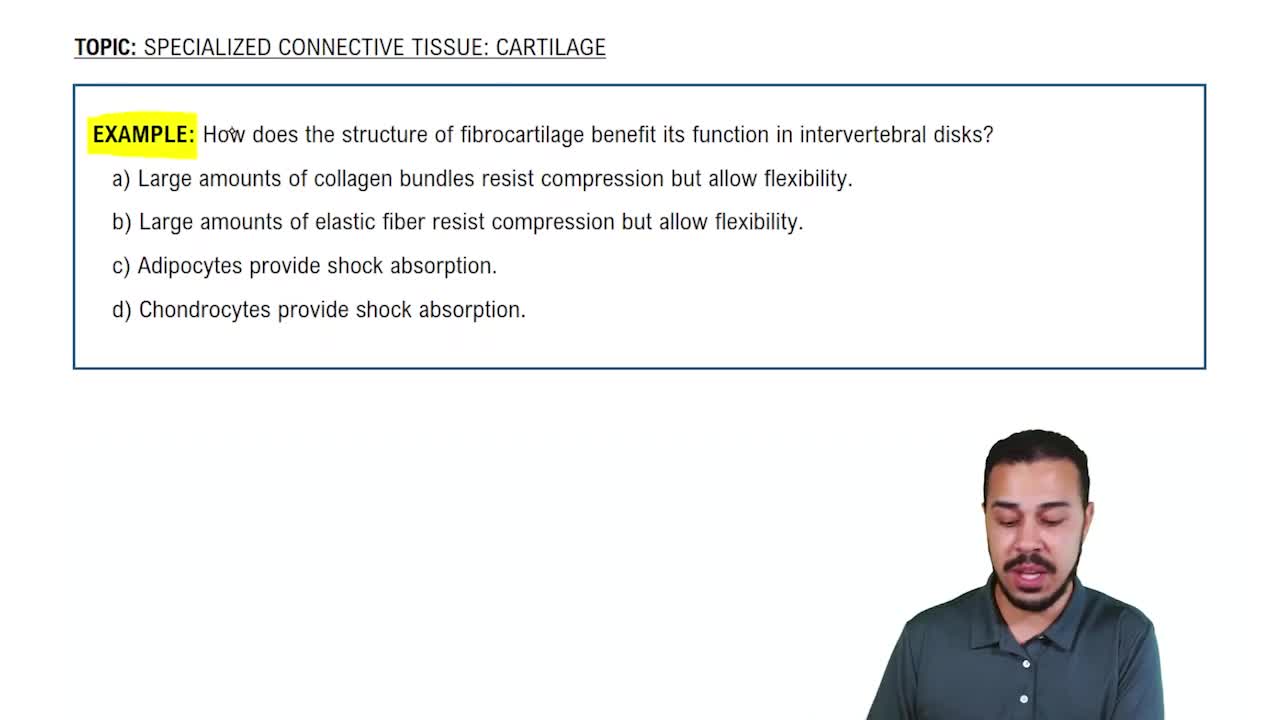
Intervertebral discs are fibrocartilaginous cushions located between adjacent vertebrae in the spine. Each disc consists of a tough outer layer called the annulus fibrosus and a gel-like inner core called the nucleus pulposus, which together provide both strength and flexibility.
추천 영상:
가이드 코스
6:01
Structure of the Sarcomere: Bands, Zones, Discs & Lines

Shock Absorption

One primary function of intervertebral discs is to absorb and distribute mechanical loads and shocks that occur during activities like walking, running, or lifting. This cushioning effect protects the vertebrae and spinal cord from damage caused by impact and pressure.
추천 영상:
가이드 코스
02:48
Specialized Connective Tissue: Cartilage Example 3

Facilitation of Spinal Movement

Intervertebral discs allow slight movement between vertebrae, enabling flexibility and mobility of the spine. This permits bending, twisting, and other motions while maintaining the stability and alignment of the vertebral column.
추천 영상:
04:59
Simple and Facilitated Diffusion