Ch. 11 Fundamentals of the Nervous System and Nervous Tissue
Marieb - Human Anatomy & Physiology 11th Edition
Marieb, Hoehn11th EditionHuman Anatomy & PhysiologyISBN: 9780136874034당신이 사용하는 게 아니라요?교과서 변경
11장, 문제 1

Which of the following structures is not part of the central nervous system?
a. The brain
b. A nerve
c. The spinal cord
d. A tract

검증된 단계별 안내
1
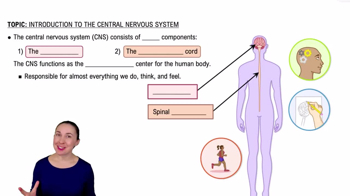
Step 1: Understand the components of the central nervous system (CNS). The CNS consists of the brain and the spinal cord, which are responsible for processing and integrating information.
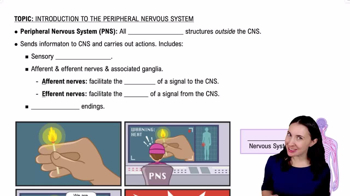
Step 2: Recognize the peripheral nervous system (PNS) components. Nerves are part of the PNS and serve to connect the CNS to limbs and organs.
Step 3: Identify what a tract is. A tract is a bundle of nerve fibers (axons) within the CNS that carry information to and from different parts of the brain and spinal cord.
Step 4: Compare each option to the definitions: the brain (CNS), spinal cord (CNS), tract (CNS), and nerve (PNS).
Step 5: Conclude that the structure not part of the CNS is the nerve, as it belongs to the peripheral nervous system.

비슷한 문제에 대한 검증된 영상 답변:

이 영상 해법은 위 문제에 도움이 된다고 튜터들이 추천한 것입니다.
영상 길이:
1m

주요 개념

질문에 올바르게 답하기 위해 반드시 이해해야 하는 핵심 개념들은 다음과 같습니다.

Central Nervous System (CNS)

The CNS consists of the brain and spinal cord, serving as the main control center for processing information and coordinating bodily functions. It integrates sensory input and generates motor output.
추천 영상:
1:32
The Central Nervous System

Peripheral Nervous System (PNS)

The PNS includes all nerves outside the CNS, such as cranial and spinal nerves. It connects the CNS to limbs and organs, transmitting signals to and from the CNS.
추천 영상:
3:33
Peripheral Nervous System

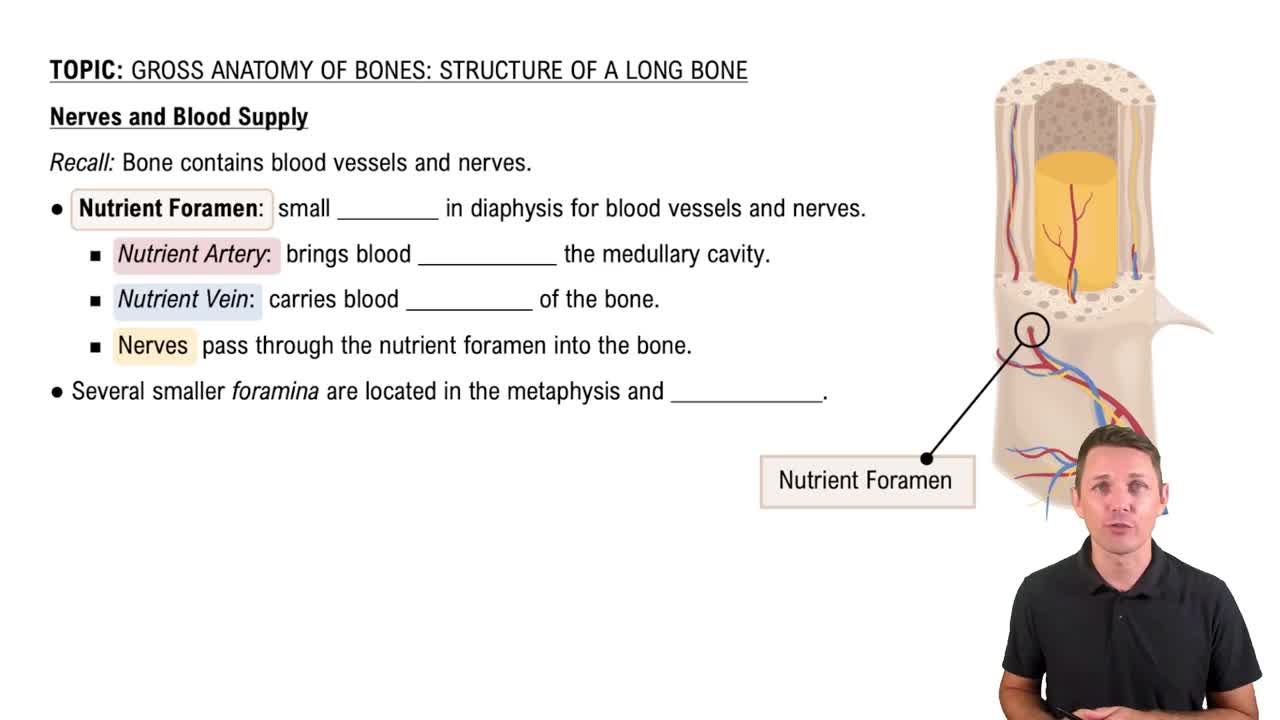
Nerves vs. Tracts

Nerves are bundles of axons in the PNS, while tracts are bundles of axons within the CNS. This distinction helps identify which structures belong to the CNS or PNS.
추천 영상:
2:25
Nerves and Blood Supply