Ch. 13 The Peripheral Nervous System and Reflex Activity
Marieb - Human Anatomy & Physiology 11th Edition
Marieb, Hoehn11th EditionHuman Anatomy & PhysiologyISBN: 9780136874034당신이 사용하는 게 아니라요?교과서 변경
13장, 문제 24

Mr. Frank, a former stroke victim who had made a remarkable recovery, suddenly began to have problems reading. He complained of seeing double and also had problems navigating steps. He was unable to move his left eye downward and laterally. Which cranial nerve was the site of lesion? (Right or left?)

검증된 단계별 안내
1
Identify the symptoms described: inability to move the left eye downward and laterally, double vision (diplopia), and difficulty with spatial navigation (such as steps).
Recall the functions of the cranial nerves controlling eye movement: Cranial Nerve III (Oculomotor), Cranial Nerve IV (Trochlear), and Cranial Nerve VI (Abducens).
Understand that the inability to move the eye downward and laterally specifically implicates the Trochlear nerve (Cranial Nerve IV), which innervates the superior oblique muscle responsible for downward and lateral eye movement.
Determine the side of the lesion by noting that the left eye is affected, so the lesion is on the left Trochlear nerve because each Trochlear nerve controls the superior oblique muscle of the ipsilateral eye.
Conclude that the lesion is on the left Cranial Nerve IV (Trochlear nerve), which explains the symptoms of double vision and impaired downward and lateral movement of the left eye.

주요 개념

질문에 올바르게 답하기 위해 반드시 이해해야 하는 핵심 개념들은 다음과 같습니다.

Cranial Nerve III (Oculomotor Nerve) Function

The oculomotor nerve controls most eye movements, including moving the eye downward and laterally, as well as eyelid elevation and pupil constriction. Damage to this nerve can cause double vision and difficulty moving the eye in specific directions.
추천 영상:
2:25
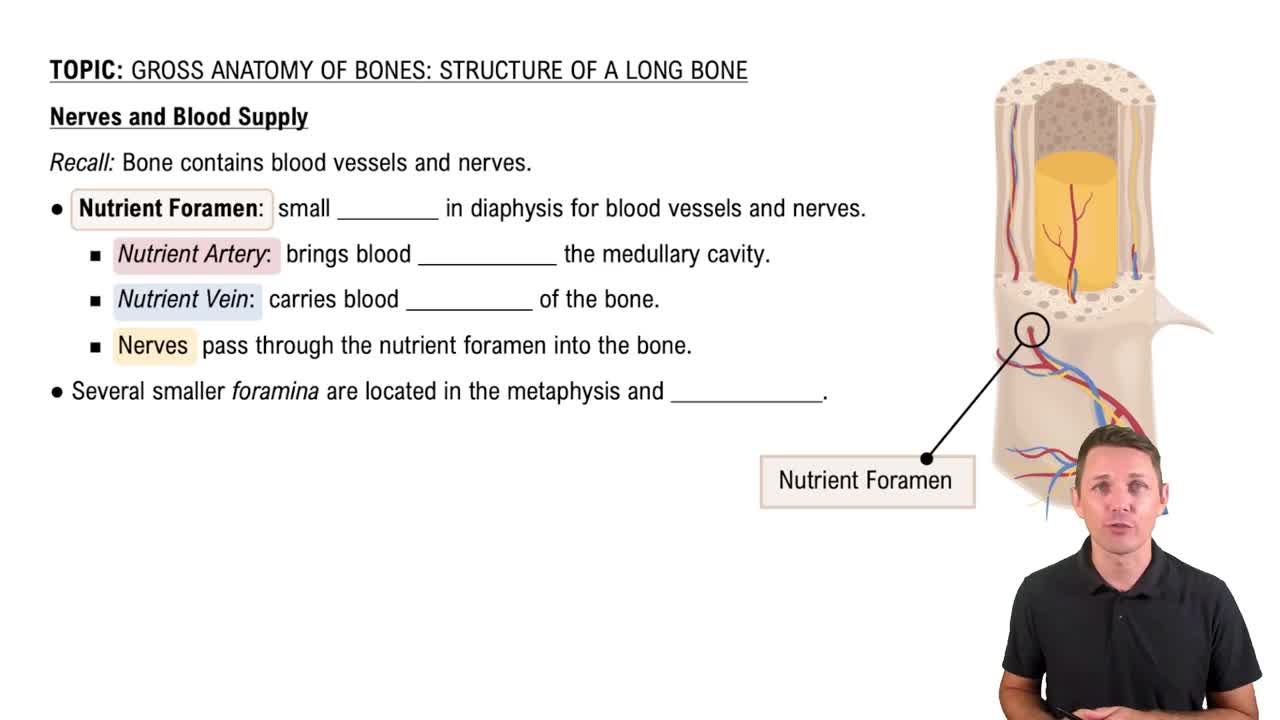
Nerves and Blood Supply

Clinical Signs of Oculomotor Nerve Lesion

A lesion in the oculomotor nerve typically results in eye movement deficits such as inability to move the eye downward and laterally, ptosis (drooping eyelid), and diplopia (double vision). These signs help localize the lesion to this nerve.
추천 영상:
0:45
Control of the ANS Example 1

Lateralization of Cranial Nerve Lesions

Cranial nerve lesions usually affect the same side (ipsilateral) as the lesion because these nerves exit the brainstem without crossing. Therefore, symptoms like eye movement problems indicate the lesion is on the same side as the affected eye.
추천 영상:
8:20
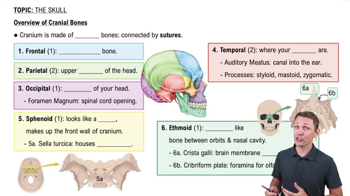
Overview of Cranial Bones