Ch. 2 Chemistry Comes Alive
Marieb - Human Anatomy & Physiology 11th Edition
Marieb, Hoehn11th EditionHuman Anatomy & PhysiologyISBN: 9780136874034당신이 사용하는 게 아니라요?교과서 변경
2장, 문제 2

All of the following are examples of the four major elements contributing to body mass except:
a. Hydrogen
b. Carbon
c. Nitrogen
d. Sodium
e. Oxygen

검증된 단계별 안내
1
Step 1: Understand the question is asking to identify which element is NOT one of the four major elements contributing to body mass in the human body.
Step 2: Recall that the four major elements making up most of the human body's mass are Oxygen (O), Carbon (C), Hydrogen (H), and Nitrogen (N). These elements are fundamental components of organic molecules such as proteins, lipids, carbohydrates, and nucleic acids.
Step 3: Review the options given: Hydrogen, Carbon, Nitrogen, Sodium, and Oxygen.
Step 4: Compare each option to the four major elements. Hydrogen, Carbon, Nitrogen, and Oxygen are all part of the four major elements, while Sodium is a mineral and an electrolyte but does not contribute significantly to body mass.
Step 5: Conclude that Sodium is the element that does not belong to the four major elements contributing to body mass.

비슷한 문제에 대한 검증된 영상 답변:

이 영상 해법은 위 문제에 도움이 된다고 튜터들이 추천한 것입니다.
영상 길이:
2m

주요 개념

질문에 올바르게 답하기 위해 반드시 이해해야 하는 핵심 개념들은 다음과 같습니다.

Four Major Elements Contributing to Body Mass

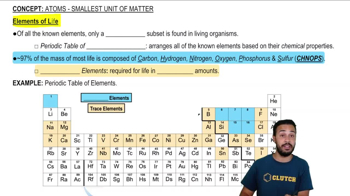
The human body is primarily composed of four major elements: oxygen, carbon, hydrogen, and nitrogen. These elements make up about 96% of the body's mass and are essential for forming biomolecules like proteins, lipids, carbohydrates, and nucleic acids.
추천 영상:
가이드 코스
7:17
Classes of MHC Molecules

Role of Trace Elements in the Body

Trace elements such as sodium, potassium, calcium, and others are present in smaller amounts compared to the major elements. Although vital for physiological functions like nerve transmission and muscle contraction, they contribute minimally to overall body mass.
추천 영상:
가이드 코스
03:36
Elements of Life

Distinguishing Major Elements from Minor Elements

Understanding the difference between major and minor elements involves recognizing their relative abundance and function. Major elements form the structural basis of cells and tissues, while minor elements support specific biochemical processes without significantly affecting total body mass.
추천 영상:
가이드 코스
03:36
Elements of Life