Ch. 27 The Reproductive System
Marieb - Human Anatomy & Physiology 11th Edition
Marieb, Hoehn11th EditionHuman Anatomy & PhysiologyISBN: 9780136874034당신이 사용하는 게 아니라요?교과서 변경
27장, 문제 1

The normal diploid number of human chromosomes is:
a. 48
b. 47
c. 46
d. 23
e. 24

검증된 단계별 안내
1
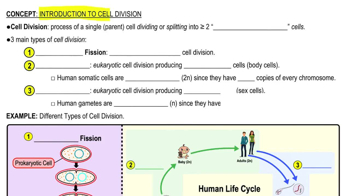
Understand that the diploid number refers to the total number of chromosomes present in a typical somatic (body) cell, which includes two sets of chromosomes—one set inherited from each parent.
Recall that humans have 23 pairs of chromosomes, meaning each pair consists of two homologous chromosomes.
Calculate the total number of chromosomes by multiplying the number of pairs by 2: \(23 \times 2\).
Recognize that this total represents the diploid number, which is the standard chromosome count in human somatic cells.
Compare the calculated diploid number to the options provided to identify the correct answer.

비슷한 문제에 대한 검증된 영상 답변:

이 영상 해법은 위 문제에 도움이 된다고 튜터들이 추천한 것입니다.
영상 길이:
1m
도움이 되었나요?

주요 개념

질문에 올바르게 답하기 위해 반드시 이해해야 하는 핵심 개념들은 다음과 같습니다.

Diploid Number

The diploid number refers to the total number of chromosomes present in a typical somatic cell of an organism, containing two sets—one from each parent. In humans, this number represents paired chromosomes, essential for maintaining genetic stability across generations.
추천 영상:
가이드 코스
09:40
Introduction to Cell Division

Human Chromosome Count

Humans normally have 46 chromosomes in their somatic cells, arranged in 23 pairs. This includes 22 pairs of autosomes and one pair of sex chromosomes, which determine biological sex. This count is fundamental to human genetics and cell biology.
추천 영상:
4:48
Introduction to Human Development

Haploid Number

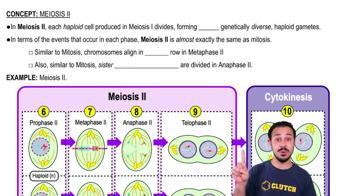
The haploid number is the number of chromosomes in gametes (sperm and egg cells), which is half the diploid number. For humans, the haploid number is 23, ensuring that upon fertilization, the diploid number of 46 is restored.
추천 영상: