Ch. 13 The Peripheral Nervous System and Reflex Activity
Marieb - Human Anatomy & Physiology 7th Edition
Marieb, Hoehn7th EditionHuman Anatomy & PhysiologyISBN: 9780805359091당신이 사용하는 게 아니라요?교과서 변경
13장, 문제 6

Accessory glands that produce an oily secretion are the
a. Conjunctiva
b. Lacrimal glands
c. Tarsal glands

검증된 단계별 안내
1
Step 1: Understand the function of each gland mentioned in the options. The conjunctiva is a membrane that covers the front of the eye and lines the inside of the eyelids, but it does not produce oily secretions.
Step 2: Recognize that lacrimal glands are responsible for producing tears, which are primarily watery and help lubricate the eye surface, but they do not produce oily secretions.
Step 3: Identify that tarsal glands, also known as Meibomian glands, are specialized sebaceous glands located in the eyelids that secrete an oily substance.
Step 4: Understand the role of the oily secretion from the tarsal glands, which is to prevent evaporation of the eye's tear film and keep the eyes lubricated.
Step 5: Conclude that the accessory glands producing an oily secretion are the tarsal glands, based on their anatomical location and function.

비슷한 문제에 대한 검증된 영상 답변:

이 영상 해법은 위 문제에 도움이 된다고 튜터들이 추천한 것입니다.
영상 길이:
2m

주요 개념

질문에 올바르게 답하기 위해 반드시 이해해야 하는 핵심 개념들은 다음과 같습니다.

Accessory glands of the eye

Accessory glands are structures associated with the eye that produce secretions to protect and maintain the eye's surface. They include glands like the lacrimal glands, which produce tears, and the tarsal glands, which secrete oils to prevent tear evaporation.
추천 영상:
3:21
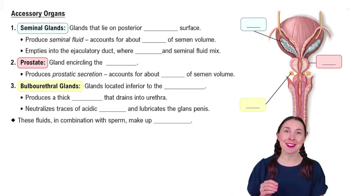
Accessory Organs

Tarsal glands (Meibomian glands)

Tarsal glands are specialized sebaceous glands located along the edges of the eyelids. They produce an oily secretion that lubricates the eye surface and prevents the evaporation of the tear film, helping maintain eye moisture and comfort.
추천 영상:
7:10
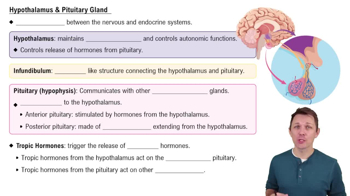
Hypothalamus & Pituitary Gland

Lacrimal glands and conjunctiva

Lacrimal glands produce watery tears that cleanse and moisten the eye, while the conjunctiva is a membrane covering the eye and inner eyelids, contributing to eye protection but not producing oily secretions. Understanding their roles helps differentiate the source of eye secretions.
추천 영상:
7:10
Hypothalamus & Pituitary Gland
관련 실천
교과서 질문

The portion of the fibrous layer that is white and opaque is the

a. Choroid

b. Cornea

c. Retina

d. Sclera

138
views
교과서 질문

Match the names of the cranial nerves in column B to the appropriate description in column A.

Column A 

_______    (1) Causes pupillary constriction 

_______    (2) The major sensory nerve of the face

_______    (3) Serves the sternocleido-mastoid and trapezius muscles 

_______    (4) Purely sensory (two nerves) 

_______    (5) Serves the tongue muscles 

_______    (6) Allows you to chew your food 

_______    (7) Impaired in Bell's palsy

_______    (8) Helps regulate heart activity

_______    (9) Helps you hear and maintain your balance 

_______   (10) Contain parasympathetic motor fibers (four nerves)

Column B

a. Abducens

b. Accessory

c. Facial

d. Glossopharyngeal

e. Hypoglossal

f. Oculomotor

g. Olfactory

h. Optic

i. Trigeminal

j. Trochlear

k. Vagus

l. Vestibulocochlear

1053
views
교과서 질문

The connective tissue sheath that surrounds a fascicle of nerve fibers is the

a. Epineurium

b. Endoneurium

c. Perineurium

d. Epimysium

1461
views
교과서 질문

Which sequence best describes a normal route for the flow of tears from the eyes into the nasal cavity?

a. Lacrimal canaliculi, lacrimal sacs, nasolacrimal ducts

b. Lacrimal ducts, lacrimal canaliculi, nasolacrimal ducts

c. Nasolacrimal ducts, lacrimal canaliculi, lacrimal sacs

1042
views
교과서 질문

Match the receptor type in column B to the correct description in column A.

Column A

______    (1) Pain, itch, and temperature receptors

______    (2) Contains intrafusal fibers and anulospiral and flower spray endings

______    (3) Discriminative touch receptor in hairless skin (fingertips)

______    (4) Contains receptor endings wrapped around thick collagen bundles

______    (5) Rapidly adapting deep-pressure receptor

______    (6) Slowly adapting deep-pressure receptor

Column B

a. Bulbous corpuscles

b. Tendon organ

c. Muscle spindle

d. Free nerve endings

e. Lamellar corpuscle

f. Tactile corpuscle

935
views
교과서 질문

Of the neurons in the retina, the axons of which of these form the optic nerve?

a. Bipolar cells

b. Ganglion cells

c. Cone cells

d. Horizontal cells

218
views