뒤로
뒤로
문제 1
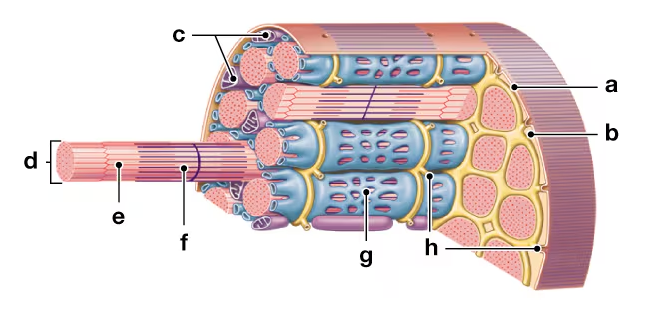
Identify the structures in the following figure.
a. ___
b. ___
c. ___
d. ___
e. ___
f. ___
g. ___
h. ___
문제 7
Which of the following statements about myofibrils is not correct?
(a) Each skeletal muscle fiber contains hundreds to thousands of myofibrils.
(b) Myofibrils contain repeating units called sarcomeres.
(c) Myofibrils extend the length of a skeletal muscle fiber.
(d) Filaments consist of bundles of myofibrils.
(e) Myofibrils are attached to the plasma membrane at both ends of a muscle fiber.
문제 8
An action potential can travel quickly from one cardiac muscle cell to another because of the presence of
(a) Gap junctions
(b) Tight junctions
(c) Intercalated discs
(d) Both a and c
문제 10
What three layers of connective tissue are part of each muscle? What functional role does each layer play?
문제 12
What structural feature of a skeletal muscle fiber propagates action potentials into the interior of the cell?
문제 15
What forms of energy reserves do resting skeletal muscle fibers contain?
문제 17
What is the calcium-binding protein in smooth muscle tissue?
문제 19
Areas of the body where you would not expect to find slow fibers include the
(a) Back and calf muscles
(b) Eye and hand
(c) Chest and abdomen
(d) All of these
문제 22
For each portion of a myogram tracing a twitch in a stimulated calf muscle fiber, describe the events that occur within the muscle fiber.
문제 24
How does cardiac muscle tissue contract without neural stimulation?
문제 29
Linda's father suffers an apparent heart attack and is rushed to the emergency room of the local hospital. The doctor on call tells her that he has ordered some blood work and that he will be able to tell if her father actually had a heart attack by looking at the blood levels of CK and cardiac troponin. Why would knowing the level of CK and cardiac troponin help to indicate if a person suffered a heart attack?
문제 30
Bill broke his leg in a football game, and after six weeks the cast is finally removed. As he steps down from the examination table, he loses his balance and falls. Why?