뒤로
뒤로
문제 1
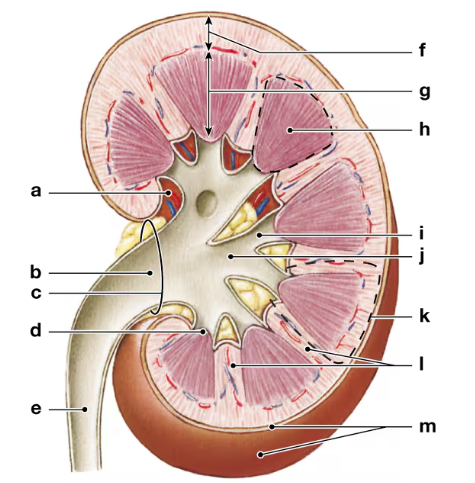
Identify the structures of the kidney in the following diagram.
a. ___
b. ___
c. ___
d. ___
e. ___
f. ___
g. ___
h. ___
i. ___
j. ___
k. ___
l. ___
m. ___
문제 2
The basic functional unit of the kidney is the __________.
문제 3
The process of urine formation involves all of the following, except
(a) Filtration of plasma
(b) Reabsorption of water
(c) Reabsorption of certain solutes
(d) Secretion of wastes
(e) Secretion of excess lipoprotein and glucose molecules
문제 4
The glomerular filtration rate is regulated by all of the following, except
(a) Autoregulation
(b) Sympathetic neural control
(c) Cardiac output
(d) Angiotensin II
(e) The hormone ADH
문제 5
The distal convoluted tubule is an important site for
(a) Active secretion of ions
(b) Active secretion of acids and other materials
(c) Selective reabsorption of sodium ions from the tubular fluid
(d) All of these
문제 6
Changing the luminal diameters of the afferent and efferent arterioles to alter the GFR can be an example of
(a) Hormonal regulation
(b) Autonomic regulation
(c) Autoregulation
(d) All of these
문제 7
What are the primary functions of the urinary system?
문제 8
What are the primary functions of the urinary system?
문제 9
Trace the pathway of the protein-free filtrate from where it is produced in the renal corpuscle until it drains into the renal pelvis in the form of urine. (Use arrows to indicate the direction of flow.)
문제 10
Name the segments of the nephron distal to the renal corpuscle, and state the functions of each.
문제 11
What is the function of the juxtaglomerular complex?
문제 12
Trace the path of a drop of blood from its entry into the renal artery until its exit at a renal vein.
문제 13
Name and define the three distinct processes involved in the production of urine.
문제 14
What are the primary effects of angiotensin II on kidney function and regulation?
문제 15
Which structures of the urinary system are responsible for the transport, storage, and elimination of urine?
문제 16
When the renal threshold for a substance exceeds its tubular maximum:
(a) More of the substance will be filtered
(b) More of the substance will be reabsorbed
(c) More of the substance will be secreted
(d) The amount of the substance that exceeds the tubular maximum will be found in the urine
(e) Both a and d occur
문제 17
Sympathetic activation of nerve fibers in the nephron causes
(a) the regulation of glomerular blood flow and pressure,
(b) the stimulation of renin release from the juxtaglomerular complex,
(c) the direct stimulation of water and Na+ reabsorption,
(d) all of these.
문제 18
Sodium reabsorption in the DCT and in the cortical portion of the collecting system is accelerated by the secretion of
(a) ADH
(b) Renin
(c) Aldosterone
(d) Erythropoietin
문제 19
When ADH levels rise,
(a) The amount of water reabsorbed increases.
(b) The DCT becomes impermeable to water.
(c) The amount of water reabsorbed decreases.
(d) Sodium ions are exchanged for potassium ions.
문제 20
The control of blood pH by the kidneys during acidosis involves
(a) The secretion of hydrogen ions and reabsorption of bicarbonate ions from the tubular fluid
(b) A decrease in the amount of water reabsorbed
(c) Hydrogen ion reabsorption and bicarbonate ion loss
(d) Potassium ion secretion
문제 21
How are proteins excluded from filtrate? Why is this important?
문제 22
What interacting controls stabilize the glomerular filtration rate (GFR)?
문제 23
What primary changes occur in the composition and concentration of filtrate as a result of activity in the proximal convoluted tubule?
문제 24
Describe two functions of countercurrent multiplication in the kidney.
문제 25
Describe the urine voiding reflex.
문제 26
In a normal kidney, which of the following conditions would cause an increase in the glomerular filtration rate (GFR)?
(a) Constriction of the afferent arteriole
(b) A decrease in the pressure of the glomerulus
(c) An increase in the capsular hydrostatic pressure
(d) A decrease in the concentration of plasma proteins in the blood
(e) A decrease in the net glomerular filtration process
문제 27
In response to excess water in the body,
(a) Antidiuretic hormone is secreted by the anterior lobe of the pituitary gland.
(b) The active transport mechanisms in the ascending thick limb of the nephron loop cease functioning.
(c) The permeability of the distal convoluted tubules and collecting ducts to water is decreased.
(d) The permeability of the ascending limb of the nephron loop is increased.
(e) The glomerular filtration rate is reduced.
문제 28
Sylvia is suffering from severe edema in her arms and legs. Her physician prescribes a diuretic (a substance that increases the volume of urine produced). Why might this help alleviate Sylvia’s problem?
문제 29
David’s grandfather suffers from hypertension. His doctor tells him that part of his problem stems from renal arteriosclerosis. Why would this cause hypertension?
문제 30
Mannitol is a sugar that is filtered, but not reabsorbed, by the kidneys. What effect would drinking a solution of mannitol have on the volume of urine produced?