뒤로
뒤로
문제 1
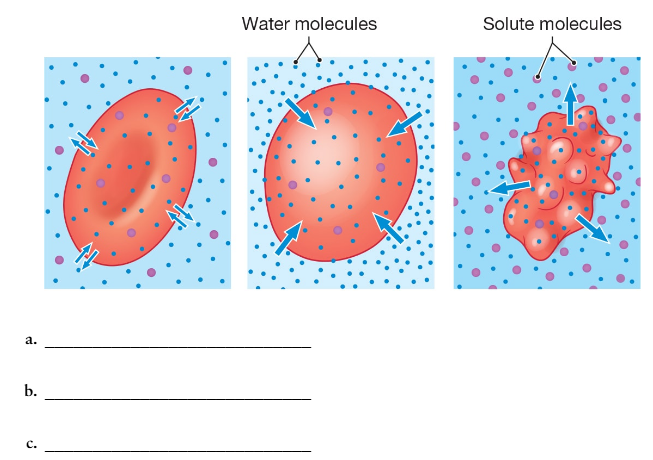
In the following diagram, identify the type of solution (hypertonic, hypotonic, or isotonic) in which the red blood cells are immersed.
문제 2
The process that transports solid objects such as bacteria into the cell is called
(a) Pinocytosis
(b) Phagocytosis
(c) Exocytosis
(d) Receptor-mediated endocytosis
(e) Channel-mediated transport
문제 3
Plasma membranes are said to be
(a) Impermeable
(b) Freely permeable
(c) Selectively permeable
(d) Actively permeable
(e) Slightly permeable
문제 4
____ ion concentration is high in extracellular fluids, and____ion concentration is high in the cytoplasm.
(a) Calcium; magnesium
(b) Chloride; sodium
(c) Potassium; sodium
(d) Sodium; potassium
문제 5
At resting membrane potential, the cytoplasmic side of the membrane surface of the cell is___, and the cell extracellular membrane surface is___.
(a) slightly negative; slightly positive
(b) slightly positive; slightly negative
(c) slightly positive; neutral
(d) slightly negative; neutral
문제 6
The organelle responsible for a variety of functions centering on the synthesis of lipids and carbohydrates is
(a) The Golgi apparatus
(b) The rough endoplasmic reticulum
(c) The smooth endoplasmic reticulum
(d) Mitochondria
문제 7
The synthesis of a functional polypeptide using the information in an mRNA strand is
(a) Translation
(b) Transcription
(c) Replication
(d) Gene activation
문제 8
Our somatic cell nuclei contain___pairs of chromosomes.
(a) 8
(b) 16
(c) 23
(d) 46
문제 9
The movement of water across a membrane from an area of low solute concentration to an area of higher solute concentration is known as
(a) Osmosis
(b) Active transport
(c) Diffusion
(d) Facilitated transport
(e) Filtration
문제 10
The interphase of the cell life cycle is divided into
(a) Prophase, metaphase, anaphase, and telophase
(b) G0, G1, S, and G2
(c) Mitosis and cytokinesis
(d) All of these
문제 12
What are four general functions of the plasma membrane?
문제 13
What are the primary functions of membrane proteins?
문제 14
By what three major transport mechanisms do substances get into and out of cells?
문제 15
List five important factors that influence diffusion rates.
문제 16
What are the four major functions of the endoplasmic reticulum?
문제 17
Diffusion is important in body fluids, because it tends to
(a) Increase local concentration gradients
(b) Eliminate local concentration gradients
(c) Move substances against concentration gradients
(d) Create concentration gradients
문제 18
Microvilli are found
(a) Mostly in muscle cells
(b) On the inside of plasma membranes
(c) In large numbers on cells that secrete hormones
(d) In cells that are actively engaged in absorption
(e) Only on cells lining the reproductive tract
문제 19
When a cell is placed in a(n)___solution, the cell will lose water through osmosis. This process results in the___ of red blood cells
(a) hypotonic; crenation
(b) hypertonic; crenation
(c) isotonic; hemolysis
(d) hypotonic; hemolysis
문제 20
Suppose that a DNA segment has the following nucleotide sequence:
CTC–ATA–CGA–TTC–AAG–TTA.
Which nucleotide sequences would a complementary mRNA strand have?
(a) GAG–UAU–GAU–AAC–UUG–AAU
(b) GAG–TAT–GCT–AAG–TTC–AAT
(c) GAG–UAU–GCU–AAG–UUC–AAU
(d) GUG–UAU–GGA–UUG–AAC–GGU
문제 21
How many amino acids are coded in the DNA segment:
CTC–ATA–CGA–TTC–AAG–TTA?
(a) 18
(b) 9
(c) 6
(d) 3
문제 22
The sodium–potassium exchange pump
(a) Is an example of facilitated diffusion
(b) Does not require the input of cellular energy in the form of ATP
(c) Moves the sodium and potassium ions along their concentration gradients
(d) Is composed of a carrier protein located in the plasma membrane
(e) Is not necessary for the maintenance of homeostasis
문제 23
If a cell lacked ribosomes, it would not be able to
(a) Move
(b) Synthesize proteins
(c) Produce DNA
(d) Metabolize sugar
(e) Divide
문제 24
List, in sequence, the phases of the interphase stage of the cell life cycle, and briefly describe what happens in each.
문제 25
List the stages of mitosis, and briefly describe the events that occur in each.
문제 26
(a) What is cytokinesis?
문제 27
The transport of a certain molecule exhibits the following characteristics:
(1) The molecule moves down its concentration gradient;
(2) at concentrations above a given level, the rate of transport does not increase; and
(3) cellular energy is not required for transport to occur.
Which transport process is at work?
문제 28
Solutions A and B are separated by a selectively permeable barrier. Over time, the level of fluid on side A increases. Which solution initially had the higher concentration of solute?
문제 29
A molecule that blocks the ion channels lining integral proteins in the plasma membrane would interfere with
(a) Cell recognition
(b) The movement of lipid-soluble molecules
(c) Producing changes in the electrical charges across a plasma membrane
(d) The ability of protein hormones to stimulate the cell
(e) The cell's ability to divide
문제 30
What is the benefit of having some of the cellular organelles enclosed by a membrane similar to the plasma membrane?