Skip to main content
Beginning & Intermediate Algebra
나의 코스
배우기
시험 준비
AI 튜터
학습 가이드
플래시카드
탐험해 보세요
앱을 사용해 보세요
나의 코스
배우기
시험 준비
AI 튜터
학습 가이드
플래시카드
탐험해 보세요
앱을 사용해 보세요
뒤로
The Multiplication and Division Properties of Equality definitions
카드를 뒤집기 위해 탭할 수 있습니다.
Linear Equation
카드를 뒤집기 위해 탭할 수 있습니다.
👆
Linear Equation
An expression showing equality between two algebraic sides, often used to solve for unknown values.
진행 상황 추적
컨트롤 버튼이 '내비게이션' 모드로 변경되었습니다.
1/15
관련 플래시카드
관련 실천
추천 영상
The Multiplication and Division Properties of Equality quiz
The Multiplication and Division Properties of Equality
15 용어
The Multiplication and Division Properties of Equality
2. Linear Equations and Inequalities
5 문제점
주제
JustinRaimundo
Solving Linear Equations
2. Linear Equations and Inequalities
5 문제점
주제
JustinRaimundo
2. Linear Equations and Inequalities
4 주제
12 문제점
장
ErnestBlazevic
03:56
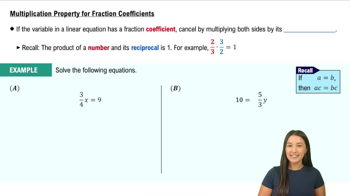
Multiplication Property for Fraction Coefficients
167
views
6
rank
06:42
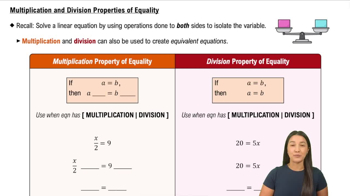
Multiplication and Division Properties of Equality
244
views
11
rank
01:22
Multiplication and Division Properties of Equality Example 2
155
views
6
rank
이 집합의 용어 (15)
하이드의 정의
Linear Equation
An expression showing equality between two algebraic sides, often used to solve for unknown values.
Variable
A symbol representing an unknown value that can be isolated through algebraic operations.
Coefficient
A numerical factor attached to a variable, which can be whole or fractional and is canceled to isolate the variable.
Fractional Coefficient
A coefficient expressed as a fraction, requiring multiplication by its reciprocal to isolate the variable.
Reciprocal
A value obtained by flipping a fraction, used to cancel fractional coefficients in equations.
Multiplication Property of Equality
A rule stating that multiplying both sides of an equation by the same value keeps the equation balanced.
Division Property of Equality
A rule stating that dividing both sides of an equation by the same value maintains equality.
Equivalent Equation
An equation formed by applying the same operation to both sides, preserving the original solution.
Balance
The concept of keeping both sides of an equation equal by performing identical operations.
Solution
The value for a variable that makes an equation true when substituted back into the original expression.
Standard Form
An arrangement of a linear equation where terms are organized, often with variables and coefficients on one side.
True Statement
An outcome where both sides of an equation are equal after substituting the solution for the variable.
Operation
A mathematical process such as addition, subtraction, multiplication, or division applied to both sides of an equation.
Scale Analogy
A comparison used to illustrate the importance of keeping equations balanced during algebraic manipulations.
Variable Term
A part of an equation containing a variable and its coefficient, which is isolated before solving for the variable.
 뒤로뒤로
뒤로뒤로

 03:56
03:56