Skip to main content
Beginning & Intermediate Algebra
나의 코스
배우기
시험 준비
AI 튜터
학습 가이드
플래시카드
탐험해 보세요
앱을 사용해 보세요
나의 코스
배우기
시험 준비
AI 튜터
학습 가이드
플래시카드
탐험해 보세요
앱을 사용해 보세요
뒤로
The Multiplication and Division Properties of Equality quiz
카드를 뒤집기 위해 탭할 수 있습니다.
What does the multiplication property of equality state?
카드를 뒤집기 위해 탭할 수 있습니다.
👆
What does the multiplication property of equality state?
If a = b, then a times c = b times c for any value c.
진행 상황 추적
컨트롤 버튼이 '내비게이션' 모드로 변경되었습니다.
1/15
관련 플래시카드
관련 실천
추천 영상
The Multiplication and Division Properties of Equality definitions
The Multiplication and Division Properties of Equality
15 용어
The Multiplication and Division Properties of Equality
2. Linear Equations and Inequalities
5 문제점
주제
JustinRaimundo
Solving Linear Equations
2. Linear Equations and Inequalities
5 문제점
주제
JustinRaimundo
2. Linear Equations and Inequalities
4 주제
12 문제점
장
ErnestBlazevic
03:56
Multiplication Property for Fraction Coefficients
167
views
6
rank
06:42
Multiplication and Division Properties of Equality
244
views
11
rank
01:22
Multiplication and Division Properties of Equality Example 2
155
views
6
rank
이 집합의 용어 (15)
하이드의 정의
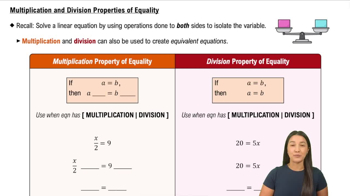
What does the multiplication property of equality state?
If a = b, then a times c = b times c for any value c.
When should you use the multiplication property of equality when solving equations?
Use it when your equation has division and you want to cancel it out to isolate the variable.
How do you isolate x in the equation x/2 = 9?
Multiply both sides by 2 to get x = 18.
What does the division property of equality state?
If a = b, then a divided by c = b divided by c for any nonzero value c.
When should you use the division property of equality?
Use it when your equation has multiplication and you want to cancel it out to isolate the variable.
How do you solve 20 = 5x for x?
Divide both sides by 5 to get x = 4.
Why must you perform the same operation on both sides of an equation?
To keep the equation balanced and maintain equality.
What is the first step in solving 3a - 4 = 11?
Add 4 to both sides to isolate the variable term, giving 3a = 15.
After isolating the variable term in 3a = 15, what is the next step?
Divide both sides by 3 to solve for a, resulting in a = 5.
How can you check your solution to a linear equation?
Plug the solution back into the original equation to see if it creates a true statement.
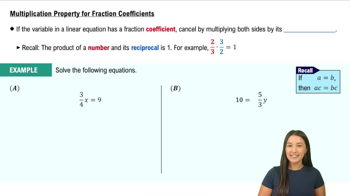
How do you solve an equation with a fractional coefficient, like (3/4)x = 9?
Multiply both sides by the reciprocal of the fraction, which is 4/3, to isolate x.
What is the reciprocal of 3/4?
The reciprocal of 3/4 is 4/3.
What is the solution to (3/4)x = 9?
x = 12, after multiplying both sides by 4/3.
How do you solve 10 = (5/3)y for y?
Multiply both sides by the reciprocal 3/5 to get y = 6.
Why is understanding reciprocals important when solving equations with fractional coefficients?
Multiplying by the reciprocal cancels the fraction, making it easier to isolate the variable.
 뒤로뒤로
뒤로뒤로

 03:56
03:56