Skip to main content
Biochemistry
나의 코스
배우기
시험 준비
AI 튜터
학습 가이드
플래시카드
탐험해 보세요
앱을 사용해 보세요
나의 코스
배우기
시험 준비
AI 튜터
학습 가이드
플래시카드
탐험해 보세요
앱을 사용해 보세요
뒤로
Titration quiz
카드를 뒤집기 위해 탭할 수 있습니다.
What is the primary purpose of a titration in biochemistry labs?
카드를 뒤집기 위해 탭할 수 있습니다.
👆
What is the primary purpose of a titration in biochemistry labs?
Titrations are used to measure pH changes and determine the pKa values and concentrations of acids, especially weak acids, in biological systems.
진행 상황 추적
컨트롤 버튼이 '내비게이션' 모드로 변경되었습니다.
1/15
관련 플래시카드
관련 실천
추천 영상
Titration definitions
Titration
15 용어
Titration
2. Water
7 문제점
주제
Buffer Solution
2. Water
7 문제점
주제
2. Water - Part 1 of 3
4 주제
11 문제점
장
2. Water - Part 2 of 3
5 주제
11 문제점
장
2. Water - Part 3 of 3
4 주제
11 문제점
장
VideoThumbView.guidedCourse
04:19
Titration of Monoprotic Weak Acids
1382
views
9
rank
2
comments
VideoThumbView.guidedCourse
06:33
Titration of Polyprotic Weak Acids
1325
views
13
rank
1
comments
VideoThumbView.guidedCourse
07:44
Titrations
1851
views
18
rank
1
comments
이 집합의 용어 (15)
하이드의 정의
What is the primary purpose of a titration in biochemistry labs?
Titrations are used to measure pH changes and determine the pKa values and concentrations of acids, especially weak acids, in biological systems.
What is the titrant in a titration experiment?
The titrant is the solution of known concentration that is gradually added to the analyte solution during a titration.
What is the analyte in a titration experiment?
The analyte is the solution of unknown concentration being analyzed in a titration.
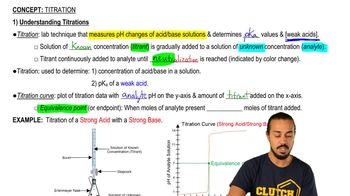
How is the equivalence point visually indicated during a titration?
The equivalence point is indicated by a color change in the solution, signaling that neutralization has occurred.
What happens at the equivalence point in a titration?
At the equivalence point, the moles of titrant added are exactly equal to the moles of analyte present.
What is plotted on the axes of a titration curve?
The y-axis shows the pH of the analyte solution, and the x-axis shows the amount of titrant added.
What is the pH at the equivalence point for a strong acid-strong base titration?
The equivalence point for a strong acid-strong base titration occurs at pH 7.
How can you identify a strong acid-strong base titration from its titration curve?
The curve starts with a very low pH, rises sharply, and the equivalence point is at pH 7.
What is the inflection point (midpoint) on a titration curve of a weak acid?
The inflection point is where half of the acid is neutralized, and the pH equals the pKa of the weak acid.
What is true about the equivalence point pH in a weak acid-strong base titration?
The equivalence point pH is above 7, typically corresponding to the pKa of the weak acid.
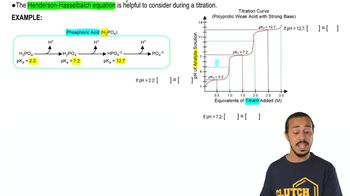
What does the inflection point indicate in a polyprotic acid titration?
Each inflection point indicates the pKa value of one of the acidic hydrogens in the polyprotic acid.
How many equivalence points and inflection points does a polyprotic acid with three acidic hydrogens have?
It has three equivalence points and three inflection points, one for each acidic hydrogen.
What are the pKa values for the three acidic hydrogens in phosphoric acid (H3PO4)?
The pKa values are 2.2, 7.2, and 12.7 for the three acidic hydrogens in phosphoric acid.
At each inflection point in a polyprotic acid titration, what is true about the concentrations of conjugate acid and base?
At each inflection point, the concentration of conjugate acid equals the concentration of conjugate base.
What happens at the first equivalence point in the titration of phosphoric acid?
At the first equivalence point, H3PO4 is completely neutralized and H2PO4- is at its maximum concentration.
 뒤로
뒤로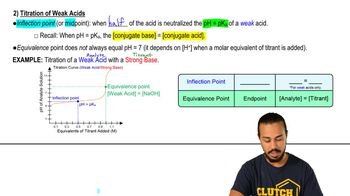
 04:19
04:19