 뒤로
뒤로Amino Acid Structure of Leucine at High pH
스터디 가이드 - 스마트 노트
 자료에 맞춘 맞춤형 노트, 핵심 정의, 예시, 맥락을 확장해 제공합니다.
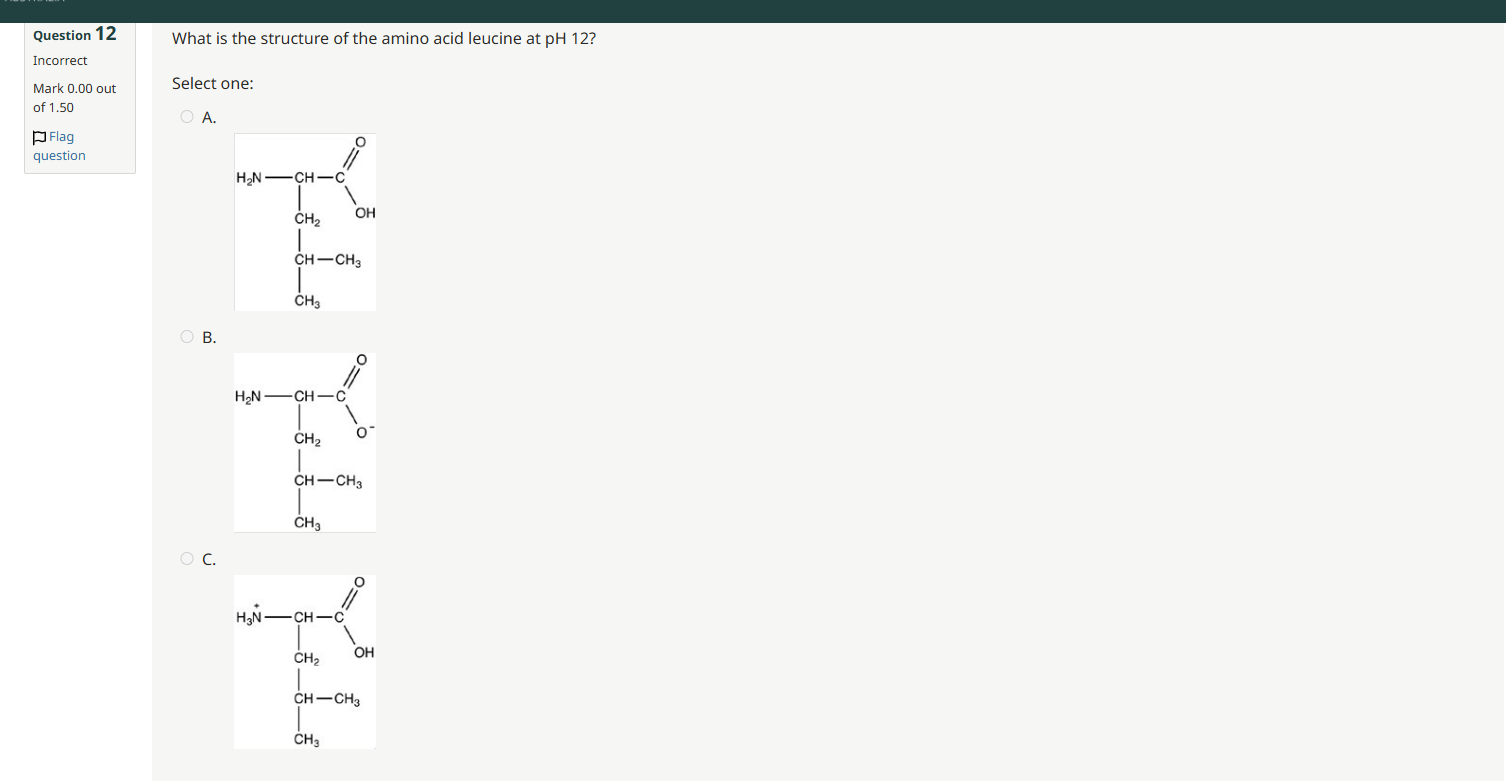
Q12. What is the structure of the amino acid leucine at pH 12?
Background
Topic: Amino Acid Ionization States
This question tests your understanding of how amino acids exist in different ionization states depending on the pH of the environment. At high pH (basic conditions), the amino and carboxyl groups of amino acids can lose or gain protons, affecting their charge and structure.
Key Terms and Concepts:
Leucine: A nonpolar, aliphatic amino acid with the side chain -CH2-CH(CH3)2.
pH 12: This is a basic (alkaline) environment. At this pH, the carboxyl group is deprotonated (COO-), and the amino group is typically unprotonated (NH2).
Zwitterion: The form of an amino acid that has both a positive and a negative charge, usually at physiological pH (~7.4).
Ionization: The process by which an atom or molecule acquires a positive or negative charge by gaining or losing electrons or protons.
Key Structures to Recognize:
At low pH: Amino group is protonated (NH3+), carboxyl group is not (COOH).
At neutral pH: Zwitterion form (NH3+ and COO-).
At high pH: Amino group is unprotonated (NH2), carboxyl group is deprotonated (COO-).
Step-by-Step Guidance
Recall the general structure of an amino acid: a central carbon (alpha carbon) bonded to an amino group, a carboxyl group, a hydrogen atom, and a side chain (R group).
Identify the side chain for leucine: .
Consider the effect of pH 12 (basic conditions):
The carboxyl group () will lose a proton and become .
The amino group () will lose a proton and become .
Examine each structure option (A, B, C) and determine which one matches the expected ionization state at pH 12:
Look for a structure with a deprotonated carboxyl group () and an unprotonated amino group ().
Compare the side chains in each structure to ensure they match leucine's side chain.
Try solving on your own before revealing the answer!
Final Answer: Structure B
At pH 12, leucine exists with a deprotonated carboxyl group () and an unprotonated amino group (). Structure B correctly shows these features and the correct side chain for leucine.
Structure A shows a protonated carboxyl group, which is not correct at high pH. Structure C shows a protonated amino group, which is also not correct at high pH.
