 뒤로
뒤로Aqueous Chemistry: Water and Noncovalent Interactions in Biochemistry
스터디 가이드 - 스마트 노트
 자료에 맞춘 맞춤형 노트, 핵심 정의, 예시, 맥락을 확장해 제공합니다.
Aqueous Chemistry: Water
Noncovalent Interactions Define the Structure and Function of Biomolecules
Noncovalent interactions are fundamental to the structure and function of biomolecules, including proteins, nucleic acids, and cellular receptors. These weak interactions allow biomolecules to adopt flexible conformations and facilitate dynamic biological processes.
Types of Noncovalent Interactions: Include hydrogen bonds, van der Waals forces, ionic interactions, and dipole-dipole interactions.
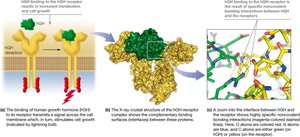
Biological Example: The binding of human growth hormone (hGH) to its receptor is mediated by noncovalent interactions, which trigger cellular responses.
Importance: Noncovalent bonds are weak and reversible, enabling biomolecules to interact transiently and adapt to changing cellular environments.
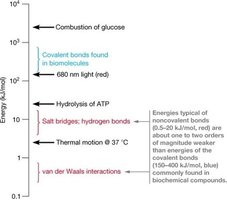
Energy Range: Noncovalent interactions typically range from 0.4 to 21 kJ/mol, much weaker than covalent bonds.
Covalent and Noncovalent Bond Energies
Covalent bonds are strong and stable, forming the backbone of biomolecules, while noncovalent bonds are weaker and facilitate reversible interactions.
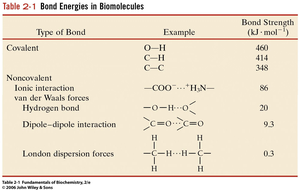
Covalent Bond Energies: Examples include O–H (460 kJ/mol), C–H (414 kJ/mol), and C–C (348 kJ/mol).
Noncovalent Bond Energies: Ionic interactions (~86 kJ/mol), hydrogen bonds (~20 kJ/mol), dipole-dipole interactions (~9.3 kJ/mol), and London dispersion forces (~0.3 kJ/mol).
Biochemical Relevance: Noncovalent bonds are two orders of magnitude weaker than covalent bonds, but their abundance makes them crucial for biological function.
Types of Noncovalent Interactions
Noncovalent interactions are classified based on the nature of the interacting groups. These include charge-charge, charge-dipole, dipole-dipole, dipole-induced dipole, dispersion (van der Waals), and hydrogen bonds.
Charge-Charge: Electrostatic attraction between oppositely charged ions.
Charge-Dipole: Interaction between an ion and a polar molecule.
Dipole-Dipole: Interaction between two polar molecules.
Dipole-Induced Dipole: Polar molecule induces a dipole in a nonpolar molecule.
Dispersion (van der Waals): Weak, transient interactions due to fluctuating charge distributions.
Hydrogen Bond: Special dipole-dipole interaction involving a hydrogen atom bonded to an electronegative atom.
Structure and Properties of Water
Distribution of Water in the Human Body
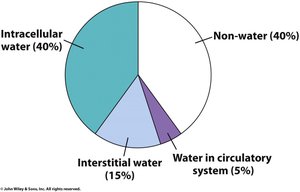
Water is essential for life, constituting about 60% of the human body. It is distributed across various compartments, including intracellular, interstitial, and circulatory systems.
Intracellular Water: 40% of body weight.
Interstitial Water: 15% of body weight.
Water in Circulatory System: 5% of body weight.
Non-water Components: 40% of body weight.
Molecular Structure of Water
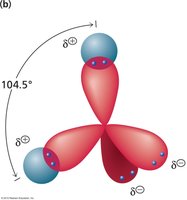
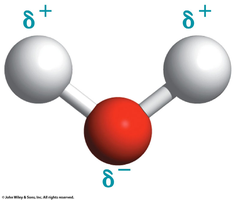
Water is a polar molecule with a bent geometry, resulting in a net dipole moment. The oxygen atom is more electronegative than hydrogen, creating partial charges and enabling hydrogen bonding.
Bond Angle: 104.5° between hydrogen atoms.
Partial Charges: Oxygen (δ−), Hydrogen (δ+).
Polarity: Water's polarity allows it to interact with other polar molecules and ions.
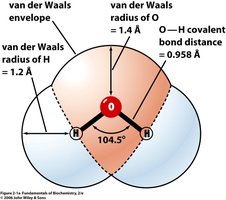
Dipole Moment of Water
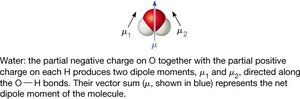
The dipole moment of water arises from the partial negative charge on oxygen and partial positive charges on hydrogen. This property is critical for water's solvent capabilities and its interactions with biomolecules.
Vector Sum: The dipole moments along O–H bonds combine to give a net dipole moment.
Solvent Properties: Water's dipole moment enables it to dissolve ionic and polar substances.
Hydrogen Bonding in Water
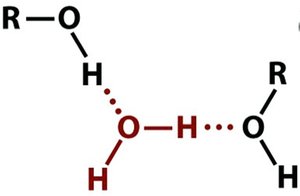
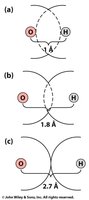
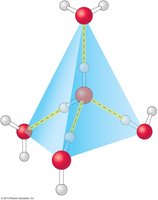
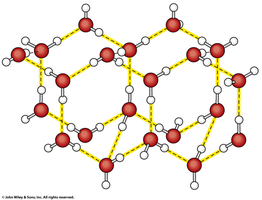
Hydrogen bonds are a key feature of water, allowing each molecule to form up to four hydrogen bonds. These interactions are responsible for water's high boiling point, surface tension, and unique density properties.
Bond Distances: O–H covalent bond (0.10 nm), hydrogen bond (0.18 nm), total O–O distance (0.28 nm).
Hydrogen Bond Geometry: Tetrahedral arrangement maximizes bonding in ice; flickering clusters in liquid water.
Density: Ice is less dense than liquid water, allowing it to float.
Hydrogen Bond Donors and Acceptors
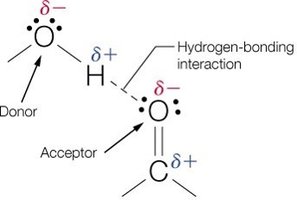
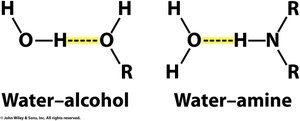
A molecule can act as both a hydrogen bond donor and acceptor. In water, the oxygen atom is the acceptor, and the hydrogen atom is the donor. This versatility is crucial for interactions with other biomolecules.
Donor: Atom bonded to hydrogen (e.g., O–H).
Acceptor: Atom with lone pairs (e.g., O or N).
Biological Relevance: Hydrogen bonds stabilize protein and nucleic acid structures.
Examples of Hydrogen Bonds in Proteins
Hydrogen bonds are prevalent in proteins, stabilizing secondary and tertiary structures. Common types include hydroxyl-hydroxyl, amide-carbonyl, amide-hydroxyl, and amide-imidazole nitrogen bonds.
Type of Hydrogen Bond | Typical Distance (nm) |
|---|---|
Hydroxyl-hydroxyl | 0.28 |
Amide-carbonyl | 0.29 |
Amide-hydroxyl | 0.30 |
Amide-imidazole nitrogen | 0.31 |
Properties of Water Compared to Other Compounds
Physical Properties of Water
Water exhibits unique physical properties compared to other low-molecular-weight compounds, such as high boiling point, high heat of vaporization, and high surface tension. These properties are attributed to extensive hydrogen bonding.
Boiling Point: 100°C (much higher than similar-sized molecules).
Heat of Vaporization: 40.71 kJ/mol.
Surface Tension: 71.97 dyne/cm.
Density: 0.997 g/cm³ (liquid water).
Dielectric Constant: 78.3 (high, enables dissolution of ions).
Water as a Solvent
Solvation of Ionic and Polar Solutes
Water's polarity and hydrogen bonding ability make it an excellent solvent for ionic and polar substances. Each ion is surrounded by a network of ordered water molecules, weakening interactions between ions and facilitating dissolution.
Ionic Solutes: NaCl dissociates in water, with Na+ and Cl− ions surrounded by water.
Biological Relevance: High concentrations of salts in blood and serum are maintained by water's solvent properties.
Solvation of Nonpolar Solutes and the Hydrophobic Effect
Nonpolar solutes do not form hydrogen bonds with water. Water maximizes its own hydrogen bonding by forming a highly ordered "water cage" around nonpolar molecules, resulting in a large entropic cost. This drives the hydrophobic effect, causing nonpolar substances to aggregate and minimizing their surface area exposed to water.
Hydrophobic Effect: Exclusion of nonpolar substances from aqueous solution, critical for protein folding and membrane formation.
Hydrophilic vs. Hydrophobic: Hydrophilic molecules dissolve well in water; hydrophobic molecules do not.
Amphipathic Molecules and Biological Membranes
Amphipathic molecules contain both polar and nonpolar regions. In aqueous solution, they can form monolayers, micelles, or bilayers. The phospholipid bilayer is the primary component of cell membranes, with polar groups interacting with water and nonpolar groups forming a hydrophobic core.
Micelles: Spherical aggregates with hydrophobic cores.
Bilayers: Sheet-like structures forming cell membranes.
Biological Relevance: Amphipathic lipids form barriers to diffusion, containing cellular and organelle contents.
Summary Table: Bond Energies in Biomolecules
Type of Bond | Example | Bond Strength (kJ/mol) |
|---|---|---|
Covalent | O–H | 460 |
Covalent | C–H | 414 |
Covalent | C–C | 348 |
Ionic interaction | COO− ⋯ NH3+ | 86 |
Hydrogen bond | O–H ⋯ O | 20 |
Dipole-dipole interaction | C=O ⋯ C=O | 9.3 |
London dispersion forces | H ⋯ H | 0.3 |
Key Equations
Energy Conversion:
Concentration of Water:
Conclusion
Water's unique structure and properties, along with the diversity of noncovalent interactions, are fundamental to biochemistry. These features enable the dynamic behavior of biomolecules, facilitate solvation, and drive essential biological processes such as protein folding and membrane formation.
