 뒤로
뒤로Carbohydrates: Structure, Functions, and Metabolism (Part 1) – Biochemistry Study Notes
스터디 가이드 - 스마트 노트
 자료에 맞춘 맞춤형 노트, 핵심 정의, 예시, 맥락을 확장해 제공합니다.
Carbohydrates: Structure, Functions, and Metabolism
Introduction to Carbohydrates
Carbohydrates are essential biomolecules that serve as energy sources, structural components, and mediators of cell signaling. They are classified based on their complexity and function, ranging from simple sugars to large polysaccharides.
Key Functions: Energy storage, metabolic intermediates, structural support (cell walls, exoskeletons), and cell-cell communication.
Major Types: Monosaccharides, disaccharides, oligosaccharides, and polysaccharides.
Examples: Glucose (energy), ribose (DNA/RNA precursor), cellulose (plant cell wall).

Basic Carbohydrate Structure
All carbohydrates share the general formula (CH2O)n. Their structure determines their classification and function.
Monosaccharides: Simple sugars, building blocks for larger carbohydrates.
Disaccharides: Two monosaccharides covalently linked.
Oligosaccharides: Short chains (3–15 units), often attached to proteins/lipids.
Polysaccharides: Long chains, structural or energy storage roles.
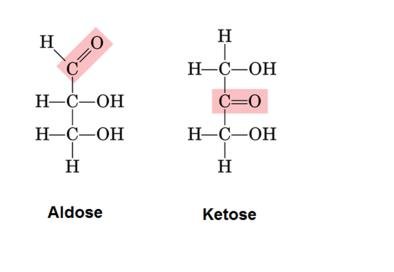
Aldoses and Ketoses
Monosaccharides are classified by their functional group and number of carbon atoms.
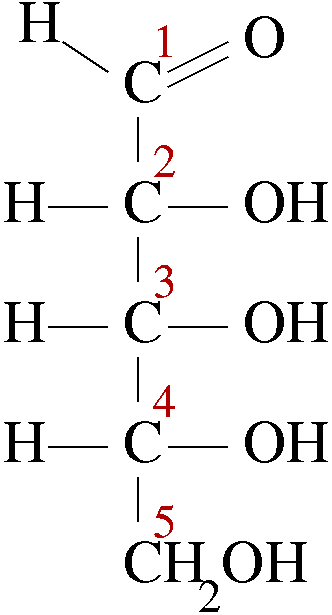
Aldoses: Contain an aldehyde group.
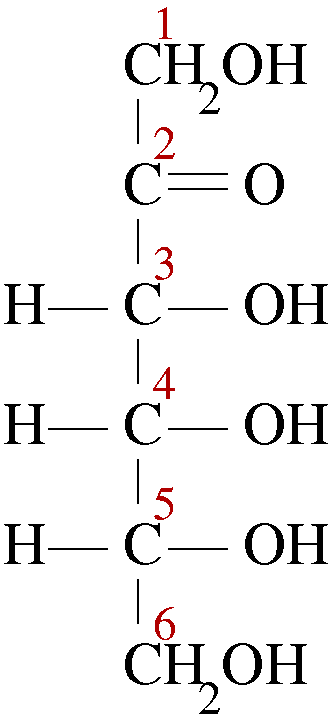
Ketoses: Contain a ketone group.
Carbon Number: Triose (3C), tetrose (4C), pentose (5C), hexose (6C), heptose (7C).
Monosaccharide Structure and Visualization
Monosaccharides can be represented in several ways, including Fischer projections and three-dimensional models. The orientation of hydroxyl groups determines their stereochemistry.
Fischer Projection: 2D representation of 3D molecules.
Line Angle and Haworth Projections: Used for cyclic forms.
Reactivity of Aldoses vs. Ketoses
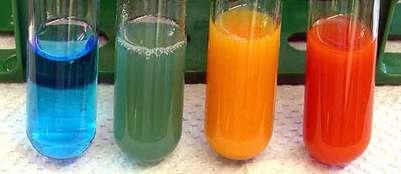
Aldoses can be oxidized to carboxylic acids and act as reducing agents, while ketoses cannot be further oxidized.
Benedict’s Test: Used to detect reducing sugars (aldoses) in urine.
Isomerism in Monosaccharides
Monosaccharides exhibit structural (constitutional) isomerism and stereoisomerism. Stereoisomers differ in spatial arrangement, including enantiomers, diastereomers, and epimers.
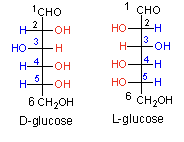
Enantiomers: Mirror images, same chemical properties except optical activity.
D- and L- Conformations: Determined by the position of the terminal –OH group.
Epimers: Differ at only one chiral center.
Cyclization of Monosaccharides
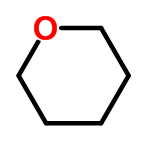
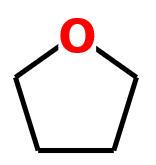
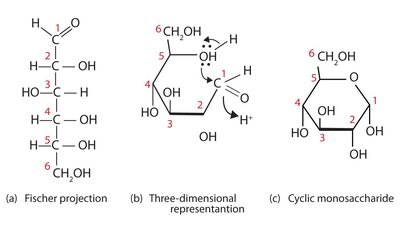
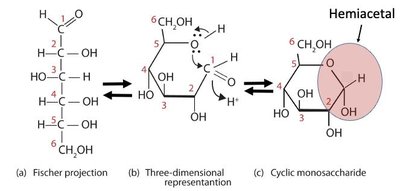
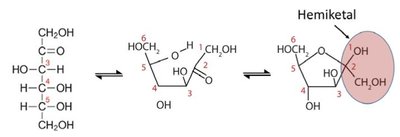
Five- and six-carbon sugars spontaneously cyclize in solution, forming furan (5-membered) or pyran (6-membered) rings. Cyclization creates a new stereocenter, resulting in alpha and beta anomers.
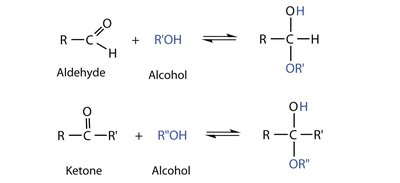
Hemiacetal Formation: Aldoses cyclize via reaction of aldehyde and alcohol groups.
Hemiketal Formation: Ketoses cyclize via reaction of ketone and alcohol groups.
Anomers: Isomers differing at the new stereocenter (anomeric carbon).
Alpha and Beta Anomers
During cyclization, the orientation of the hydroxyl group at the anomeric carbon determines whether the sugar is in the alpha or beta form.
Alpha Anomer: –OH group is trans to the CH2OH group.
Beta Anomer: –OH group is cis to the CH2OH group.
Important Sugar Isomerases
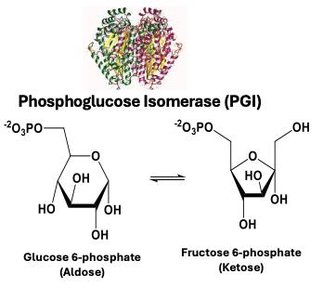
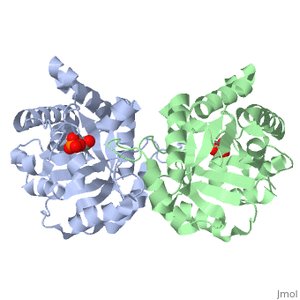
Isomerase enzymes catalyze the interconversion of aldoses and ketoses, playing crucial roles in metabolic pathways such as glycolysis.
Triose Phosphate Isomerase (TPI): Converts dihydroxyacetone phosphate (DHAP) to glyceraldehyde-3-phosphate (GAP).
Phosphoglucose Isomerase (PGI): Converts glucose-6-phosphate (aldose) to fructose-6-phosphate (ketose).
Formation of Glycosidic Bonds
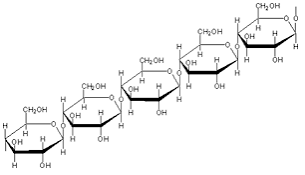
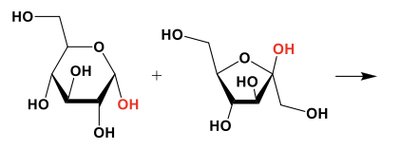
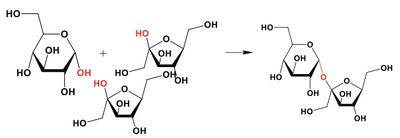
Monosaccharides are joined by glycosidic bonds, formed via dehydration synthesis. The bond occurs between the anomeric carbon of one sugar and a hydroxyl group of another.
Disaccharides: Two monosaccharides linked (e.g., maltose, sucrose, lactose).
Oligosaccharides: Short chains, often attached to proteins/lipids.
Polysaccharides: Long chains, structural or energy storage roles.
Polysaccharides: Structure and Function
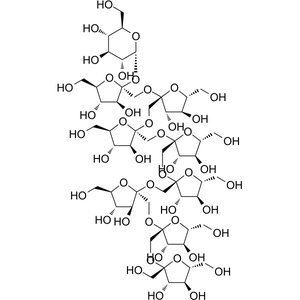
Polysaccharides are large carbohydrate polymers with diverse functions, including energy storage and structural support.
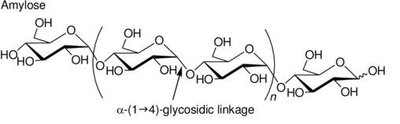
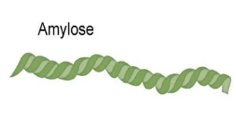
Amylose: Linear polymer of α-D-glucopyranose units with α(1→4) linkages.
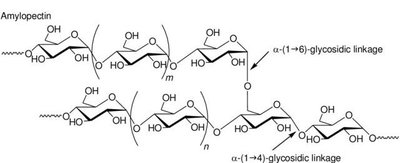
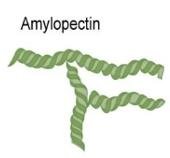
Amylopectin: Branched polymer with α(1→4) and α(1→6) linkages.
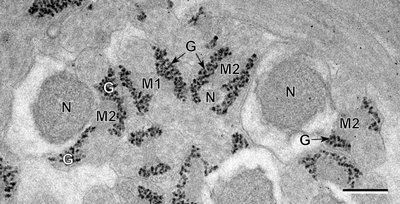
Glycogen: Highly branched, main storage form in animals.
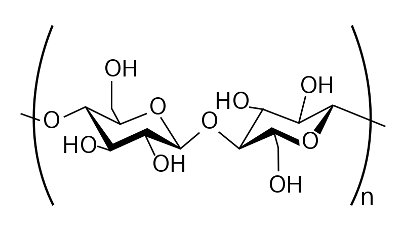
Cellulose: Linear polymer of β-D-glucopyranose units with β(1→4) linkages, structural role in plants.
Summary Table: Types of Carbohydrates
Type | Structure | Function | Example |
|---|---|---|---|
Monosaccharide | Single sugar unit | Energy, precursor | Glucose, ribose |
Disaccharide | Two sugar units | Energy | Sucrose, lactose |
Oligosaccharide | 3–15 units | Cell signaling | Glycoproteins |
Polysaccharide | Many units | Storage, structure | Starch, cellulose, glycogen |
Key Equations
General formula for carbohydrates:
Benedict’s Test (for reducing sugars):
Conclusion
Carbohydrates are fundamental to biochemistry, serving as energy sources, structural materials, and mediators of cellular communication. Understanding their structure, classification, and metabolism is essential for comprehending their biological roles.
