 뒤로
뒤로Citric Acid Cycle: Structure, Mechanism, and Fate of Carbon
스터디 가이드 - 스마트 노트
 자료에 맞춘 맞춤형 노트, 핵심 정의, 예시, 맥락을 확장해 제공합니다.
The Citric Acid Cycle (TCA Cycle)
Overview of the Cycle
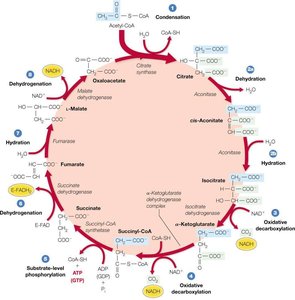
The Citric Acid Cycle (also known as the Krebs cycle or TCA cycle) is a central metabolic pathway that completes the oxidative degradation of carbohydrates, fats, and amino acids. It consists of eight enzyme-catalyzed reactions that occur in the mitochondrial matrix. The cycle is crucial for energy production and provides intermediates for various biosynthetic pathways.
Eight reactions occur in the cycle, each catalyzed by a specific enzyme.
The product of the eighth reaction (oxaloacetate) and the product of the pyruvate dehydrogenase (PDH) complex (acetyl-CoA) are the reactants for the first reaction, making the cycle continuous.
Each turn of the cycle generates two CO2, three NADH, and one FADH2 molecule, as well as one GTP (or ATP) by substrate-level phosphorylation.
The carbon atoms transferred from acetyl-CoA are highlighted in blue in the referenced diagrams.
After step 5, the carbons are not highlighted because succinate is symmetrical and the fate of individual carbons cannot be distinguished.

Reaction 1: Citrate Synthase
Condensation of Acetyl-CoA and Oxaloacetate
The first reaction of the cycle is the condensation of acetyl-CoA and oxaloacetate to form citrate, catalyzed by the enzyme citrate synthase. This reaction introduces two new carbon atoms into the cycle and is highly exergonic, ensuring the cycle proceeds even at low concentrations of oxaloacetate.
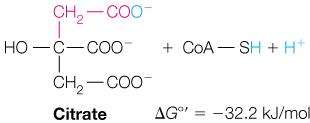
Reactants: Acetyl-CoA, oxaloacetate, and water
Products: Citrate, CoA-SH, and H+
ΔG'°: -32.2 kJ/mol (highly exergonic)
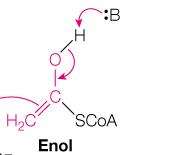
Mechanism: Involves nucleophilic attack by an enol intermediate of acetyl-CoA on oxaloacetate, followed by hydrolysis of the thioester bond.
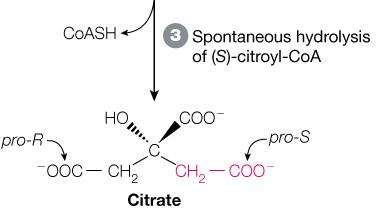
Citrate is prochiral: It can become chiral if one of its carboxymethyl groups is changed.
Equation:
Mechanism of Citrate Synthase
Step 1: Proton transfers activate the nucleophilic enol form of acetyl-CoA for attack on oxaloacetate (OAA).
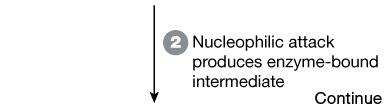
Step 2: Nucleophilic attack produces an enzyme-bound intermediate (citroyl-CoA).
Step 3: Spontaneous hydrolysis of (S)-citroyl-CoA releases citrate and CoA-SH.

Biological Significance
Hydrolysis of thioester bond in acetyl-CoA drives the reaction forward.
Ensures cycle continuity even when oxaloacetate is present at low concentrations.
Citrate is prochiral: It can become chiral if one carboxymethyl group is modified.
Citrate Synthase Structure
Conformational Changes
Citrate synthase undergoes significant conformational changes upon substrate binding. The enzyme exists in an "open" form in the absence of substrate or when only citrate is bound, and adopts a "closed" conformation when both oxaloacetate and acetyl-CoA are bound, which is catalytically competent.
Open form: Substrate-free or citrate-bound state.
Closed form: Both substrates bound, ready for catalysis.


Reaction 2: Isomerization of Citrate to Isocitrate
Aconitase-Catalyzed Isomerization
The second reaction of the cycle is the isomerization of citrate to isocitrate, catalyzed by the enzyme aconitase. This reaction converts a prochiral molecule (citrate) into a chiral molecule (isocitrate), preparing it for subsequent oxidative decarboxylation steps.
Enzyme: Aconitase
Function: Rearranges the hydroxyl and hydrogen groups on citrate to form isocitrate.
Significance: Only the correct isomer (isocitrate) can undergo the next reaction in the cycle.
Equation:
Summary Table: Key Products of One Turn of the Citric Acid Cycle
Product | Number Produced per Turn | Notes |
|---|---|---|
CO2 | 2 | Released during decarboxylation steps |
NADH | 3 | Electron carrier for oxidative phosphorylation |
FADH2 | 1 | Electron carrier for oxidative phosphorylation |
GTP (or ATP) | 1 | Produced by substrate-level phosphorylation |
Additional info:
The cycle is amphibolic, serving both catabolic and anabolic roles.
Intermediates of the cycle are precursors for amino acids, nucleotide bases, and other biosynthetic pathways.
