 뒤로
뒤로Enzyme Function and Kinetics: Principles and Mechanisms
스터디 가이드 - 스마트 노트
 자료에 맞춘 맞춤형 노트, 핵심 정의, 예시, 맥락을 확장해 제공합니다.
Protein Function: Enzymes
Introduction to Enzymes
Enzymes are biological catalysts, typically globular proteins, that accelerate the rate of chemical reactions without being consumed in the process. They are essential for maintaining life by facilitating reactions under physiological conditions that would otherwise proceed too slowly.
Enzyme Definition: Globular proteins that catalyze biochemical reactions.
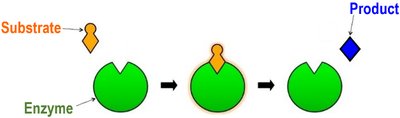
Reactants (Substrates): Molecules that bind to the enzyme's active site and are transformed into products.
Ribozyme: RNA molecules with catalytic activity.
Example: Hexokinase uses ATP to convert glucose into glucose-6-phosphate during glycolysis.
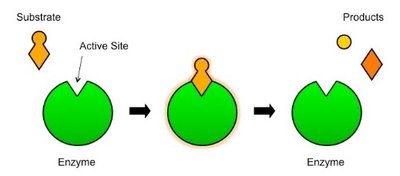
Enzymes and Reaction Equilibrium
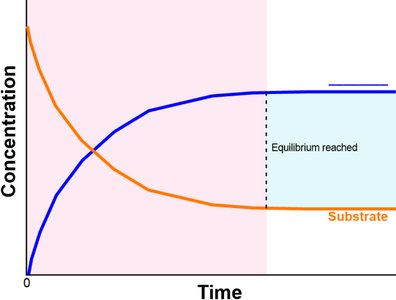
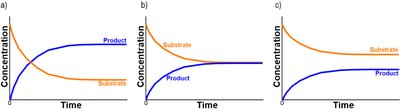
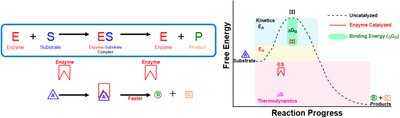
Enzymes do not alter the equilibrium constant (Keq) or the thermodynamic favorability (ΔG) of a reaction. Instead, they increase the rate at which equilibrium is reached by lowering the activation energy (EA).
Key Point: Enzymes speed up the approach to equilibrium but do not change the equilibrium concentrations of substrates and products.
Misconception: Enzymes do not convert 100% of substrate into product.
Enzyme Mechanism: Lowering Activation Energy
Activation Energy and Transition State
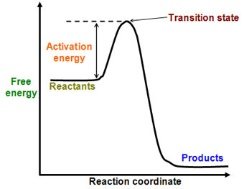
Enzymes accelerate reactions by lowering the energy of activation (EA or ΔG‡), which is the energy difference between substrates and the transition state required to initiate a reaction. The transition state is a transient, high-energy configuration.
Activation Energy (EA): The energy barrier between substrates and the transition state.
Transition State (‡): An unstable, high-energy intermediate.
Enzyme Effect: Enzymes stabilize the transition state, lowering EA and increasing reaction rate.
Equation: $\Delta G^{\ddagger}$ = Activation energy
Enzyme-Substrate Complex and Binding Energy
Formation of ES Complex
The enzyme-substrate (ES) complex is an intermediate formed when an enzyme binds to its substrate. The interactions are primarily mediated by weak noncovalent forces, which provide the driving force for catalysis.
Binding Energy (ΔGB): The energy difference between uncatalyzed and catalyzed transition states, derived from the formation of noncovalent interactions in the ES complex.
Role: Binding energy is used to stabilize the transition state and lower EA.
Models of Enzyme-Substrate Specificity
Lock & Key vs. Induced Fit Models
Two main models describe enzyme-substrate specificity:
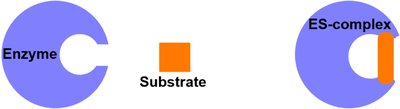
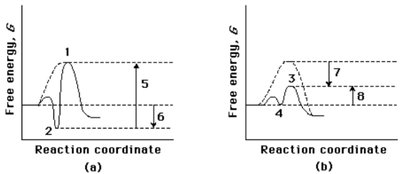
Lock & Key Model: The active site is rigid and complementary to the substrate shape, fitting like a puzzle piece. Less likely for catalysis since EA may stay the same or increase.
Induced Fit Model: The active site is flexible and becomes more complementary to the transition state, stabilizing it and decreasing EA. Conformational changes are induced in both the enzyme and substrate.
Optimal Enzyme Conditions
Optimal pH and Temperature
Enzyme activity depends on specific conditions, including pH and temperature. Most enzymes have an optimal pH and temperature where they are most active. Changes in these conditions can alter the charge and conformation of active site amino acids, potentially leading to denaturation.
Optimal pH: Pepsin (≈2), Chymotrypsin (≈8).
Optimal Temperature: Human enzymes (~37°C), Thermophilic bacterial enzymes (~77°C).
Activation Energy and Catalysis Mechanisms
Factors Affecting Activation Energy
Several factors contribute to the activation energy barrier:
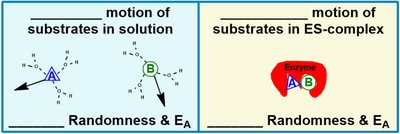
Entropy and random motion
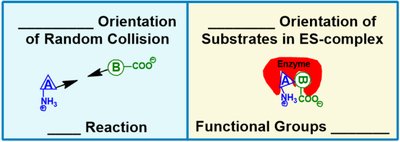
Proper orientation of substrates
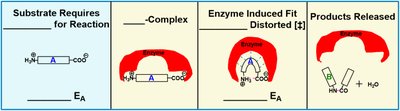
Distortion of substrate
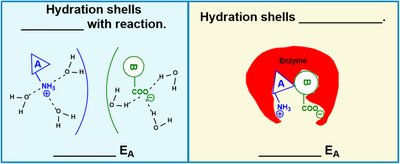
Solvation effects
Enzymes use binding energy to reduce EA by restricting substrate motion, orienting functional groups, stabilizing transition state distortions, and desolvating substrates.
Types of Enzymes
Six Major Classes
Enzymes are classified into six major classes based on the type of reaction they catalyze:
Class | Function | Example |
|---|---|---|
Oxidoreductases | Redox reactions (electron transfer) | Lactate dehydrogenase |
Transferases | Transfer functional groups | Kinases |
Hydrolyases | Hydrolysis (break bonds with H2O) | Trypsin, lipases |
Isomerases | Isomerization (rearrange atoms) | Triose phosphate isomerase |
Lyases | Add/remove groups without H2O or redox | Pyruvate decarboxylase |
Ligases | Join molecules using ATP | DNA ligase |

Cofactors and Enzyme Catalysis
Cofactors, Coenzymes, and Metal Ions
Many enzymes require cofactors for catalytic activity. Cofactors can be organic molecules (coenzymes) or metal ions. The enzyme without its cofactor is called an apoenzyme; with the cofactor, it is a holoenzyme.
Coenzymes: Organic molecules, often derived from vitamins.
Metal Ions: Essential for enzyme function, can be tightly or loosely bound.
Mechanisms of Enzyme Catalysis
Types of Catalysis
Enzyme catalysis occurs via several mechanisms:
General Acid-Base Catalysis: Transfer of protons (H+) to stabilize intermediates.
Electrostatic Catalysis: Stabilization of charges in the transition state.
Metal Ion Catalysis: Metal ions facilitate substrate binding and stabilization.
Covalent Catalysis: Formation of transient covalent bonds between enzyme and substrate.
Enzyme Kinetics
Reaction Rate and Velocity
The reaction rate (velocity, v) is the speed at which a reaction proceeds, typically measured as the change in product concentration over time. Enzyme kinetics studies how reaction rates are affected by variables such as substrate concentration, enzyme concentration, and environmental conditions.
Initial Velocity (V0): The rate at the very beginning of a reaction, before product accumulation affects the reverse reaction.
Maximum Velocity (Vmax): The theoretical maximum rate when all enzyme active sites are saturated with substrate.
Michaelis Constant (Km): The substrate concentration at which V0 = ½ Vmax; measures enzyme affinity for substrate.
Michaelis-Menten Equation
The Michaelis-Menten equation describes the relationship between initial velocity (V0), substrate concentration ([S]), Vmax, and Km:
Equation: $V_0 = \frac{V_{max} [S]}{K_m + [S]}$
At [S] = Km, V0 = ½ Vmax.
Lineweaver-Burk Plot
The Lineweaver-Burk plot is a double reciprocal plot used to determine Vmax and Km graphically:
Equation: $\frac{1}{V_0} = \frac{K_m}{V_{max}} \frac{1}{[S]} + \frac{1}{V_{max}}$
Y-intercept gives 1/Vmax; X-intercept gives -1/Km.
Enzyme Inhibition
Types of Inhibition
Enzyme inhibitors decrease the rate of enzyme-catalyzed reactions. Inhibition can be reversible or irreversible, and reversible inhibitors are further classified as competitive, uncompetitive, mixed, or noncompetitive.
Type | Binding Site | Km Change | Vmax Change |
|---|---|---|---|
Competitive | Active site (free enzyme) | Increase | No change |
Uncompetitive | ES-complex | Decrease | Decrease |
Mixed | Free enzyme or ES-complex | Increase or decrease | Decrease |
Noncompetitive | Allosteric site (E or ES) | No change | Decrease |
Allosteric Regulation
Allosteric Enzymes and Effectors
Allosteric enzymes are regulated by molecules binding to sites other than the active site, causing conformational changes that affect activity. These enzymes often display sigmoidal (S-shaped) kinetics and are key regulators in metabolic pathways.
Homotropic Effectors: Substrate itself acts as an effector.
Heterotropic Effectors: Other molecules act as effectors.
Positive Feedback: Product stimulates pathway.
Negative Feedback: Product inhibits pathway.
Post-Translational Modifications
Regulation of Enzyme Activity
Enzyme activity can be regulated by post-translational modifications such as phosphorylation, methylation, acetylation, ubiquitination, and proteolytic cleavage. These modifications alter enzyme activity, stability, or localization.
Phosphorylation: Addition of phosphate groups, often mediated by kinases.
Ubiquitination: Attachment of ubiquitin, marking proteins for degradation.
Zymogens: Inactive enzyme precursors activated by proteolytic cleavage.
Chymotrypsin: A Case Study
Chymotrypsin Mechanism
Chymotrypsin is a digestive enzyme that hydrolyzes peptide bonds adjacent to aromatic amino acids. Its catalytic mechanism involves both acylation and deacylation phases, utilizing covalent and general acid-base catalysis.
Active Site: Asp-102, His-57, Ser-195.
Acylation: Formation of covalent intermediate.
Deacylation: Hydrolysis to regenerate enzyme.
Summary Table: Enzyme Kinetics Variables
Variable | Description |
|---|---|
[E] | Concentration of free enzyme |
[S] | Concentration of free substrate |
[ES] | Concentration of enzyme-substrate complex |
[P] | Concentration of product |
[E]T | Total enzyme concentration ([E] + [ES]) |
k | Rate constants |
V0 | Initial reaction velocity |
Km | Michaelis constant |
Vmax | Maximum reaction velocity |
kcat | Catalytic constant (turnover number) |
Additional info: These notes expand on the original content by providing definitions, examples, and context for each concept, ensuring completeness and academic quality for biochemistry students.
