 뒤로
뒤로Enzyme Function and Kinetics: Principles and Mechanisms
스터디 가이드 - 스마트 노트
 자료에 맞춘 맞춤형 노트, 핵심 정의, 예시, 맥락을 확장해 제공합니다.
Protein Function: Enzymes and Catalysis
Introduction to Enzymes
Enzymes are biological catalysts, primarily globular proteins, that accelerate the rate of chemical reactions without being consumed in the process. They are essential for sustaining life by enabling metabolic reactions to occur rapidly and efficiently under physiological conditions.
Enzyme Definition: Globular proteins that catalyze biochemical reactions.
Ribozymes: RNA molecules with catalytic activity.
Substrate: The reactant molecule(s) upon which an enzyme acts, binding specifically at the enzyme's active site.
Product: The molecule(s) generated from the enzymatic reaction.
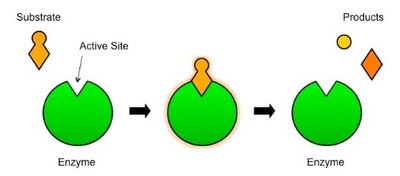
Enzymes and Chemical Equilibrium
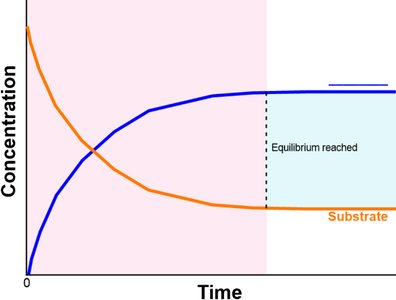
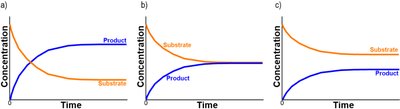
Enzymes do not alter the equilibrium position of a reaction; instead, they increase the rate at which equilibrium is achieved. The final ratio of substrate to product is determined by the reaction's equilibrium constant (Keq), not by the enzyme.
Key Point: Enzymes accelerate both the forward and reverse reactions equally, allowing the system to reach equilibrium faster.
Misconception: Enzymes do not convert 100% of substrate to product; they only speed up the approach to equilibrium.
Mechanism of Enzyme Action
Lowering Activation Energy
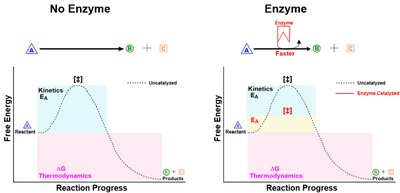
Enzymes increase reaction rates by lowering the activation energy (EA or ΔG‡), which is the energy barrier that must be overcome for reactants to be converted into products. They do not affect the overall free energy change (ΔG) or the equilibrium constant (Keq) of the reaction.
Activation Energy (EA): The energy difference between substrates and the transition state.
Transition State (‡): A high-energy, unstable intermediate during the reaction.
Effect of Enzymes: Lower EA by stabilizing the transition state, thus increasing the reaction rate.
Enzyme-Substrate Complex and Binding Energy
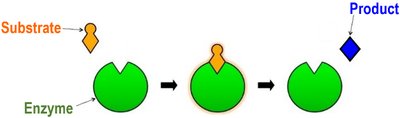
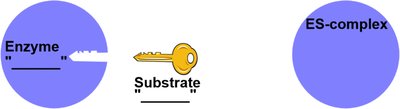
The enzyme-substrate (ES) complex is a transient intermediate formed when the substrate binds to the enzyme's active site. The binding energy (ΔGB) released upon ES complex formation is used to lower the activation energy and stabilize the transition state.
Noncovalent Interactions: Hydrogen bonds, ionic interactions, van der Waals forces, and hydrophobic effects stabilize the ES complex.
Binding Energy (ΔGB): The energy derived from ES complex formation, used to facilitate catalysis.
Models of Enzyme-Substrate Interaction
Lock & Key vs. Induced Fit Models
Two primary models describe enzyme-substrate specificity:
Lock & Key Model: The active site is a rigid structure, complementary in shape to the substrate. This model explains specificity but not the stabilization of the transition state.
Induced Fit Model: The active site is flexible and undergoes conformational changes upon substrate binding, becoming more complementary to the transition state and enhancing catalysis.
Factors Affecting Enzyme Activity
Optimal Conditions: pH and Temperature
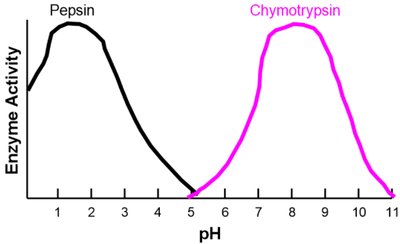
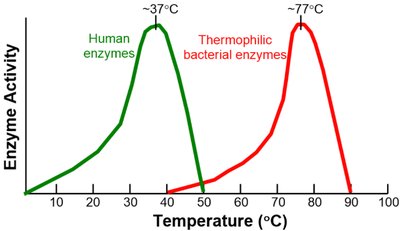
Enzyme activity is highly dependent on environmental conditions such as pH and temperature. Each enzyme has an optimal pH and temperature at which its activity is maximal.
Optimal pH: The pH at which an enzyme exhibits maximum activity. Deviations can alter the ionization state of amino acids, affecting substrate binding and catalysis.
Optimal Temperature: The temperature at which enzyme activity is highest. Higher temperatures may denature the enzyme, while lower temperatures reduce kinetic energy and reaction rates.
Enzyme Kinetics
Reaction Rate and Initial Velocity
The reaction rate (v) is the speed at which substrate is converted to product, typically measured as the change in product concentration over time. The initial velocity (V0) is measured at the very beginning of the reaction, when substrate concentration is highest and product accumulation is negligible.
V0: Initial reaction velocity, best measured before substrate depletion or product inhibition occurs.
Vmax: Theoretical maximum velocity when all enzyme active sites are saturated with substrate.
Km: Michaelis constant; the substrate concentration at which V0 is half of Vmax. It reflects the enzyme's affinity for its substrate (lower Km = higher affinity).
Michaelis-Menten Equation
The Michaelis-Menten equation describes the relationship between reaction velocity and substrate concentration for many enzymes:
At low [S], the reaction is first order with respect to [S].
At high [S], the reaction approaches zero order (rate independent of [S]).
Lineweaver-Burk Plot
The Lineweaver-Burk plot is a double reciprocal transformation of the Michaelis-Menten equation, yielding a straight line that allows for easier determination of Km and Vmax:
Y-intercept:
X-intercept:
Enzyme Inhibition
Types of Inhibition
Enzyme inhibitors are molecules that decrease or abolish enzyme activity. They are classified as reversible or irreversible, with reversible inhibitors further divided into competitive, uncompetitive, mixed, and noncompetitive types.
Competitive Inhibitors: Bind to the active site, competing with the substrate. Increase apparent Km, Vmax unchanged.
Uncompetitive Inhibitors: Bind only to the ES complex. Decrease both apparent Km and Vmax.
Mixed Inhibitors: Bind to either the free enzyme or ES complex, affecting both Km and Vmax (direction depends on relative affinities).
Noncompetitive Inhibitors: Special case of mixed inhibition where inhibitor binds equally well to E and ES; Km unchanged, Vmax decreased.
Allosteric Regulation and Feedback Control
Allosteric Enzymes
Allosteric enzymes are regulated by molecules that bind to sites other than the active site (allosteric sites), causing conformational changes that affect enzyme activity. These enzymes often display sigmoidal (S-shaped) kinetics and are key regulators in metabolic pathways.
Homotropic Effectors: The substrate itself acts as an allosteric effector.
Heterotropic Effectors: Other molecules (not the substrate) act as allosteric effectors, which can be activators or inhibitors.
Feedback Inhibition: The end product of a metabolic pathway inhibits an earlier step, preventing overproduction.
Post-Translational Modifications
Regulation by Covalent Modification
Enzyme activity can be regulated by covalent modifications such as phosphorylation, methylation, acetylation, ubiquitination, and proteolytic cleavage. These modifications can activate or deactivate enzymes, alter their stability, or target them for degradation.
Phosphorylation: Addition of phosphate groups, often mediated by kinases and reversed by phosphatases.
Ubiquitination: Attachment of ubiquitin targets proteins for degradation by the proteasome.
Zymogens: Inactive enzyme precursors activated by proteolytic cleavage (e.g., digestive enzymes like trypsinogen and chymotrypsinogen).
Summary Table: Types of Enzyme Inhibition
Type | Binding Site | Km Change | Vmax Change | Reversibility |
|---|---|---|---|---|
Competitive | Active site (E only) | Increases | No change | Reversible |
Uncompetitive | ES complex only | Decreases | Decreases | Reversible |
Mixed | E or ES complex | Increases or decreases | Decreases | Reversible |
Noncompetitive | E or ES complex (equal affinity) | No change | Decreases | Reversible |
Irreversible | Active site or elsewhere | Varies | Decreases (often to zero) | Irreversible |
