 뒤로
뒤로Enzymes: Structure, Function, and Clinical Relevance
스터디 가이드 - 스마트 노트
 자료에 맞춘 맞춤형 노트, 핵심 정의, 예시, 맥락을 확장해 제공합니다.
Enzymes: Biological Catalysts
Definition and Role
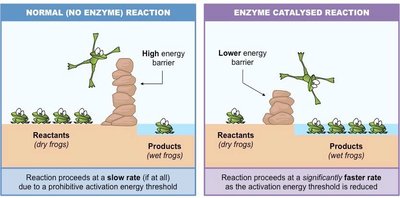
Enzymes are biological catalysts that accelerate chemical reactions in living organisms, often increasing reaction rates by over a million times compared to uncatalyzed reactions. They are essential for sustaining life by enabling metabolic processes to occur rapidly and efficiently under physiological conditions.
Catalyst: A substance that increases the rate of a chemical reaction without being consumed in the process.
Activation Energy: Enzymes lower the activation energy required for reactions, making them proceed faster.
Enzyme Structure and Specificity
Active Site and Substrate Binding
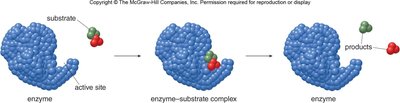
The active site of an enzyme is the region where substrate molecules bind and undergo a chemical reaction. Enzyme specificity is determined by the compatibility between the active site and the substrate.
Lock-and-Key Model: The active site is a rigid structure that fits the substrate precisely, explaining high specificity.
Induced-Fit Model: The active site is flexible and can adjust to fit substrates with similar shapes, allowing broader specificity.
Cofactors and Coenzymes
Enzyme Activation
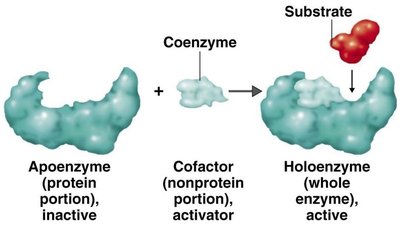
Some enzymes require non-protein molecules called cofactors to be active. These can be organic molecules (coenzymes, e.g., NAD+) or inorganic ions (e.g., Fe2+, Cu2+).
Apoenzyme: The protein portion of an enzyme, inactive without its cofactor.
Holoenzyme: The active enzyme with its cofactor bound.
Classification of Enzymes
Major Classes and Their Functions
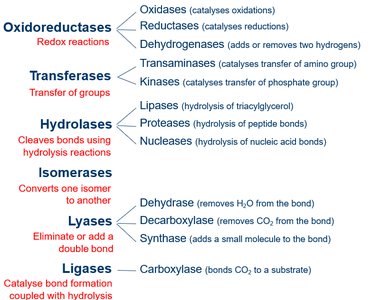
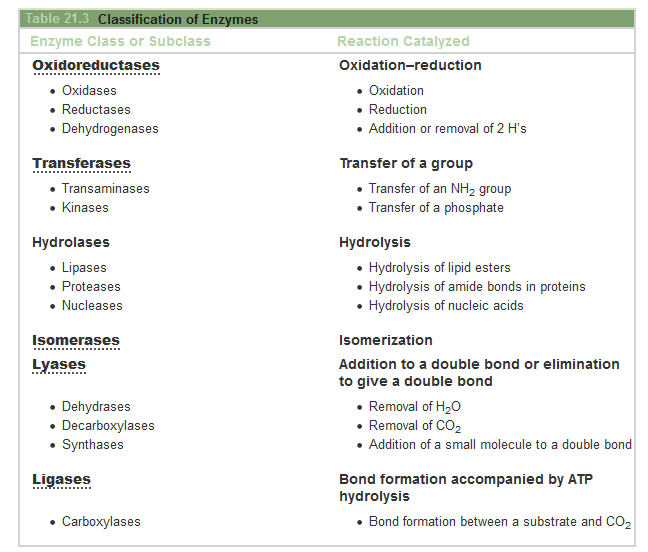
Enzymes are classified based on the type of reaction they catalyze. The six major classes are:
Class | Reaction Catalyzed |
|---|---|
Oxidoreductases | Oxidation–reduction reactions (e.g., oxidases, dehydrogenases) |
Transferases | Transfer of functional groups (e.g., kinases, transaminases) |
Hydrolases | Hydrolysis of bonds (e.g., lipases, proteases, nucleases) |
Isomerases | Isomerization (rearrangement of atoms within a molecule) |
Lyases | Addition to or elimination from double bonds (e.g., decarboxylases, synthases) |
Ligases | Bond formation coupled with ATP hydrolysis (e.g., carboxylases) |
Naming of Enzymes
Systematic and Common Names
Enzymes are typically named by combining the substrate name with the type of reaction catalyzed (e.g., lactate dehydrogenase). Some enzymes have traditional names (e.g., pepsin, lipase).
Systematic Name: Substrate + reaction type (e.g., alanine aminotransferase)
Common Name: Historical or widely used names (e.g., pepsin)
Enzyme Activity: Effects of Temperature and pH
Optimal Conditions
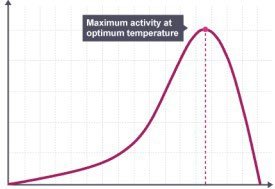
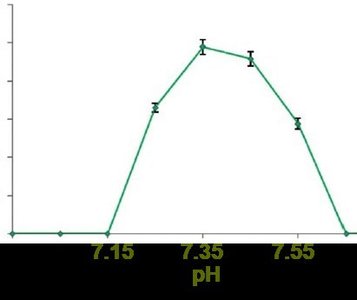
Enzyme activity is highly dependent on temperature and pH. Each enzyme has an optimal temperature and pH at which its activity is maximal.
Temperature: Activity increases with temperature up to an optimum (often ~37°C in humans), then declines rapidly due to denaturation.
pH: Each enzyme has an optimal pH, which varies depending on its physiological environment (e.g., pepsin at pH 2, trypsin at pH 8).
Allosteric Regulation of Enzymes
Positive and Negative Control
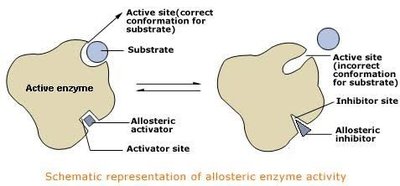
Allosteric regulation involves the binding of regulatory molecules at sites other than the active site, causing conformational changes that affect enzyme activity.
Negative Allosteric Control: Regulator binding decreases enzyme activity by making the active site less accessible to the substrate.
Positive Allosteric Control: Regulator binding increases enzyme activity by enhancing substrate binding at the active site.
Enzyme Inhibition
Types of Inhibition
Enzyme inhibitors are substances that decrease or abolish enzyme activity. There are three main types:
Irreversible Inhibition: Inhibitor binds covalently, permanently inactivating the enzyme (e.g., penicillin).
Competitive Reversible Inhibition: Inhibitor resembles the substrate and competes for the active site; inhibition can be overcome by increasing substrate concentration.
Non-competitive Reversible Inhibition: Inhibitor binds to a site other than the active site, altering enzyme conformation and reducing activity; effect is not overcome by increasing substrate concentration.
Zymogens (Proenzymes)
Inactive Precursors of Enzymes
Zymogens are inactive enzyme precursors that require a biochemical change (often cleavage of specific peptide bonds) to become active enzymes. This mechanism prevents premature enzyme activity that could damage tissues.
Example: Pepsinogen (inactive) is converted to pepsin (active) in the stomach by HCl.
Example: Trypsinogen (inactive) is converted to trypsin (active) in the small intestine by enteropeptidase.
Clinical Relevance: Enzymes in Diagnosis and Disease
Enzymes as Biomarkers
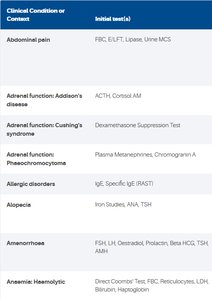
Changes in the levels of specific enzymes in bodily fluids (e.g., blood, urine) can indicate disease or tissue damage. For example, elevated serum amylase and lipase are markers of pancreatic injury.
Biomarker: A biological molecule whose presence or concentration indicates a physiological or pathological state.
Clinical Example: High serum lipase and amylase suggest acute pancreatitis.
Case Study: Enzyme Dysfunction in Acute Pancreatitis
Pathophysiology
In acute pancreatitis, blockage of the pancreatic duct (e.g., by a gallstone) leads to premature activation of digestive zymogens within the pancreas, causing autodigestion and tissue damage.
Trypsinogen Activation: Normally activated in the duodenum by enteropeptidase; premature activation in the pancreas is harmful.
Clinical Markers: Elevated serum amylase and lipase.
Summary Table: Enzyme Classes and Reactions
Enzyme Class or Subclass | Reaction Catalyzed |
|---|---|
Oxidoreductases | Oxidation–reduction (e.g., oxidases, dehydrogenases) |
Transferases | Transfer of functional groups (e.g., kinases, transaminases) |
Hydrolases | Hydrolysis of bonds (e.g., lipases, proteases, nucleases) |
Isomerases | Isomerization (rearrangement within a molecule) |
Lyases | Addition to or elimination from double bonds (e.g., decarboxylases, synthases) |
Ligases | Bond formation coupled with ATP hydrolysis (e.g., carboxylases) |

Additional info: Enzyme regulation and dysfunction are central to many diseases, making enzymes important drug targets and diagnostic markers in clinical biochemistry.
