 뒤로
뒤로Introduction to Biochemistry: History, Principles, and Biomolecules
스터디 가이드 - 스마트 노트
 자료에 맞춘 맞춤형 노트, 핵심 정의, 예시, 맥락을 확장해 제공합니다.
Chapter 1: Biochemistry and the Language of Chemistry
History of Biochemistry
Biochemistry emerged as a scientific discipline in the 19th century, challenging the doctrine of vitalism, which posited that living and nonliving matter were fundamentally different. Key experiments demonstrated that biological molecules could be studied and synthesized outside living organisms, laying the foundation for modern biochemistry.
Vitalism: The belief that life is governed by a special force distinct from physical and chemical laws.
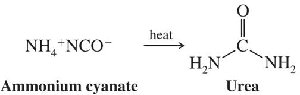
Friedrich Wöhler (1828): Synthesized urea from ammonium cyanate, disproving vitalism by showing that organic molecules could be created from inorganic precursors.
Louis Pasteur: Demonstrated that fermentation is caused by living organisms (yeast), but later work showed cell-free extracts could also ferment sugars.
Eduard and Hans Buchner (1897): Showed that yeast extracts (not intact cells) could ferment sugar, proving that biochemical reactions can occur outside living cells.
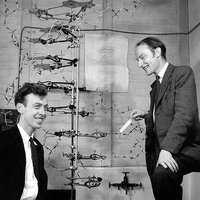
Watson and Crick (1953): Described the double-helical structure of DNA, revolutionizing molecular biology and genetics.
What is Biochemistry?
Biochemistry seeks to explain life at the molecular level, focusing on the structure and function of biomolecules and their roles in cellular processes. It bridges chemistry and biology, providing insights into disease mechanisms and therapeutic strategies.
Structure and Function: Examines biomolecules at atomic detail to understand their roles in life processes.
Molecular Biology: Studies the biology of molecules, emphasizing their overall function and interactions within the cell.
The Chemical Foundation of Life
Elements in Biological Systems
Cells are composed of a limited set of elements, primarily carbon, hydrogen, oxygen, nitrogen, phosphorus, and sulfur. These elements form the backbone of biomolecules essential for life.
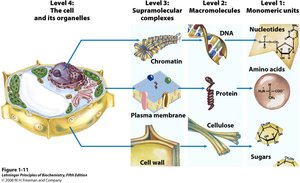
Levels of Cellular Organization
Biological systems are organized hierarchically, from simple molecules to complex cellular structures:
Level 1: Monomeric units (nucleotides, amino acids, sugars, fatty acids)
Level 2: Macromolecules (DNA, proteins, cellulose, etc.)
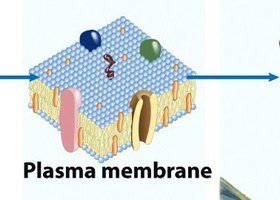
Level 3: Supramolecular complexes (chromatin, plasma membrane, cell wall)
Level 4: The cell and its organelles
Biological Macromolecules
Monomers and Polymers
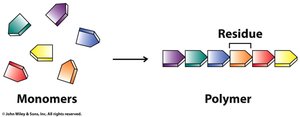
Many biomolecules are polymers, constructed from repeating monomeric units. The properties and functions of these polymers depend on the sequence and chemical nature of their monomers.
Monomer: A small molecule that can join with others to form a polymer.
Polymer: A large molecule composed of repeating monomer units.
Residue: The portion of a monomer that remains in the polymer after condensation reactions.
Major Classes of Biomolecules
There are four major classes of biological macromolecules, each with distinct structures and functions:
Nucleic Acids (DNA and RNA): Store and transmit genetic information.
Proteins: Perform a wide range of functions, including catalysis, structure, and regulation.
Polysaccharides (Carbohydrates): Serve as energy storage and structural components.
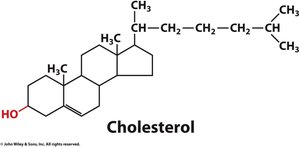
Lipids: Form membranes and store energy.
Functions of Biopolymers
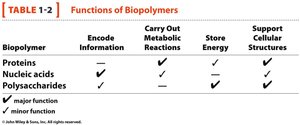
The table below summarizes the major and minor functions of the three main classes of biopolymers:
Biopolymer | Encode Information | Carry Out Metabolic Reactions | Store Energy | Support Cellular Structures |
|---|---|---|---|---|
Proteins | ✔ | ✔ | ✔ | |
Nucleic acids | ✔ | |||
Polysaccharides | ✔ | ✔ |
Nucleic Acids
Nucleic acids are polymers of nucleotide monomers, linked by phosphodiester bonds. DNA and RNA are the primary nucleic acids, responsible for storing and transmitting genetic information.
Nucleotide: Consists of a nitrogenous base, a sugar, and a phosphate group.
Phosphodiester linkage: Connects the 3' carbon of one sugar to the 5' carbon of the next via a phosphate group.
Proteins
Proteins are polymers of amino acids, joined by peptide (amide) bonds. There are 20 common amino acids, each with a unique side chain (R group), which determine the protein's structure and function.
Amino acid: Contains an amino group, a carboxyl group, a hydrogen atom, and a variable R group attached to a central carbon.
Peptide bond: Formed by condensation between the amino group of one amino acid and the carboxyl group of another, releasing water.
Polysaccharides (Carbohydrates)
Polysaccharides are polymers of monosaccharide monomers, linked by glycosidic bonds. They serve as energy storage (e.g., starch, glycogen) and structural components (e.g., cellulose).
Monosaccharide: Simple sugar unit (e.g., glucose, fructose).
Glycosidic bond: Covalent bond joining two monosaccharides, with variable chemical identity and geometry.
Lipids and Membranes
Lipids are hydrophobic molecules that form noncovalent assemblies, such as biological membranes. They are not true polymers but are essential for membrane structure and energy storage.
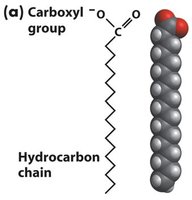
Fatty acids: Composed of a hydrocarbon chain and a carboxyl group.
Membranes: Formed by the self-assembly of lipid molecules due to the hydrophobic effect.
Why Study Biochemistry?
Understanding biochemistry provides insights into the molecular basis of life, disease mechanisms, and the development of pharmaceuticals such as antibiotics (e.g., vancomycin, streptomycin). It is foundational for advances in medicine, biotechnology, and molecular biology.
Additional info: The study of biochemistry integrates concepts from chemistry, biology, and physics to explain how molecular interactions give rise to the complexity of living systems.
