 뒤로
뒤로Manipulating DNA: Tools and Techniques in Nucleic Acid Biochemistry
스터디 가이드 - 스마트 노트
 자료에 맞춘 맞춤형 노트, 핵심 정의, 예시, 맥락을 확장해 제공합니다.
Manipulating DNA
Introduction to DNA Manipulation
Modern biochemistry utilizes a variety of techniques to manipulate the genetic information encoded within DNA. These methods are foundational for research in genetics, molecular biology, and biotechnology. The most common applications include chemical synthesis of oligonucleotides, polymerase chain reaction (PCR), gene cloning, site-directed mutagenesis, and DNA sequence analysis.
Chemical synthesis of oligonucleotides: Artificial creation of short DNA fragments with defined sequences.
Polymerase Chain Reaction (PCR): Amplification of specific DNA sequences.
Gene cloning: Insertion of DNA fragments into vectors for propagation in host cells.
Site-directed mutagenesis: Introduction of specific mutations into DNA sequences.
DNA sequence analysis: Determination of the nucleotide order in DNA molecules.
Chemical Synthesis of Oligonucleotides
Phosphoramidite Method
The phosphoramidite method is the standard approach for synthesizing oligonucleotides. It involves stepwise addition of nucleotide residues to a growing chain anchored to a solid support. Each cycle consists of coupling, oxidation, and deprotection steps, allowing precise control over the sequence.
Coupling: Addition of a protected nucleotide to the chain.
Oxidation: Stabilization of the newly formed phosphite triester linkage.
Deprotection: Removal of protecting groups to allow further chain extension.
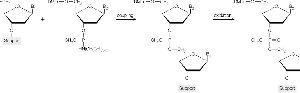
Example: Automated DNA synthesizers use this method to produce primers for PCR and sequencing.
Polymerase Chain Reaction (PCR)
Principle and Steps of PCR
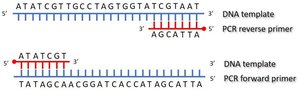
PCR is a technique used to amplify a specific DNA segment exponentially. It relies on repeated cycles of denaturation, annealing, and extension, using thermostable DNA polymerase and sequence-specific primers.
Denaturation: Heating the DNA to separate strands (typically 94–98°C).
Annealing: Cooling to allow primers to bind to complementary sequences (50–65°C).
Extension: DNA polymerase synthesizes new DNA strands from the primers (72°C).
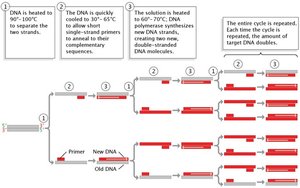
Example: PCR is widely used in diagnostics, cloning, and forensic analysis.
Restriction Enzymes and DNA Fragmentation
Restriction Endonucleases
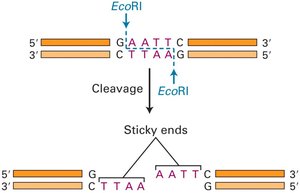
Restriction enzymes are proteins that cleave double-stranded DNA at specific sequences, often palindromic. They are essential tools for genetic engineering, allowing precise cutting and manipulation of DNA fragments.
Recognition sequence: Specific nucleotide sequence recognized by the enzyme (e.g., EcoRI recognizes GAATTC).
Sticky ends: Overhanging single-stranded DNA produced by staggered cuts, facilitating ligation.
Example: EcoRI cleaves DNA at G^AATTC, generating sticky ends useful for cloning.
Gel Electrophoresis
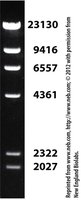
Gel electrophoresis separates DNA fragments by size using an agarose matrix. DNA is visualized by staining with intercalating agents such as ethidium bromide, which fluoresces under UV light.
Smaller fragments: Migrate faster through the gel.
Visualization: Bands correspond to DNA fragments of different lengths.
Example: Analysis of restriction digests or PCR products.
Gene Cloning and Ligation
Cloning Vectors and DNA Ligation
Gene cloning involves inserting a DNA fragment into a vector (such as a plasmid) and introducing it into a host cell for replication. Restriction enzymes and DNA ligase are used to prepare and join the DNA fragments.
Vector: DNA molecule capable of independent replication in a host cell.
Ligation: DNA ligase covalently joins DNA fragments with compatible ends.
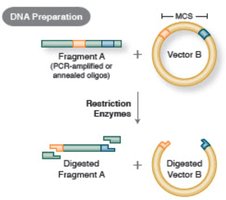
Example: Cloning a gene of interest into a plasmid for protein expression.
DNA Sequencing
Sanger (Dideoxy) Sequencing Method
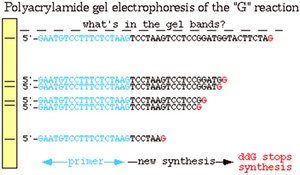
The Sanger method determines DNA sequence by synthesizing complementary strands in the presence of dideoxynucleotides (ddNTPs), which terminate chain elongation. The resulting fragments are separated by size to deduce the sequence.
ddNTPs: Lack a 3'-OH group, preventing further extension once incorporated.
Primer: Short oligonucleotide that initiates DNA synthesis.
DNA polymerase: Enzyme that adds nucleotides to the growing chain.
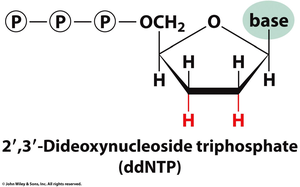
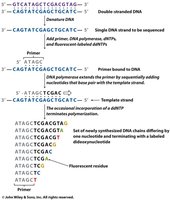
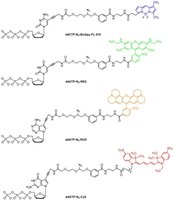
Example: Automated sequencers use fluorescently labeled ddNTPs for high-throughput sequencing.
Interpreting Sequencing Gels
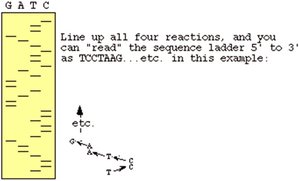
Fragments generated by Sanger sequencing are separated by polyacrylamide gel electrophoresis. Each band corresponds to a DNA fragment ending with a specific ddNTP, allowing the sequence to be read from the gel.
Four reactions: Each with a different ddNTP (ddATP, ddTTP, ddGTP, ddCTP).
Reading the sequence: Bands are read from bottom (shortest fragment, 5' end) to top (longest fragment, 3' end).
Site-Directed Mutagenesis
Introduction of Specific Mutations
Site-directed mutagenesis is a technique used to introduce targeted changes into a DNA sequence. It often employs synthetic oligonucleotide primers containing the desired mutation, which are used to replicate the DNA in vitro or in vivo.
Single-stranded vector: Such as M13 phage, used as a template for mutagenesis.
Mutant primer: Contains the desired nucleotide change.
Replication: Produces a population of DNA molecules, some carrying the mutation.
Example: Creating point mutations to study protein function.
Summary of Nucleic Acids
Key Properties and Functions
Nucleic acids, DNA and RNA, are polymers of nucleotides linked by phosphodiester bonds. DNA stores genetic information, while RNA plays roles in gene expression and regulation. Both molecules can form complex secondary and tertiary structures.
DNA: Double-stranded, right-handed helix, contains deoxyribose and thymine.
RNA: Single-stranded, contains ribose and uracil.
Base pairing: Adenine pairs with thymine (DNA) or uracil (RNA); guanine pairs with cytosine.
Replication: Semiconservative mechanism requiring energy input.
Biological functions: Storage, transmission, and expression of genetic information.
Applications: Techniques such as cloning, sequencing, and mutagenesis are essential for research and biotechnology.
