 뒤로
뒤로The Payoff Phase of Glycolysis: Reactions, Energetics, and Regulation
스터디 가이드 - 스마트 노트
 자료에 맞춘 맞춤형 노트, 핵심 정의, 예시, 맥락을 확장해 제공합니다.
The Payoff Phase of Glycolysis
Introduction to the Payoff Phase
The payoff phase is the second half of glycolysis, where energy is harvested from glucose breakdown. After the preparatory phase, each glucose molecule yields two molecules of glyceraldehyde-3-phosphate, which are further metabolized through five reactions (Reactions 6–10) to produce ATP, NADH, and pyruvate. This phase is crucial for cellular energy production and metabolic regulation.
Overview of Reactions 6–10
Reaction 6: Oxidation of glyceraldehyde-3-phosphate to 1,3-bisphosphoglycerate (NADH formation)
Reaction 7: Substrate-level phosphorylation to produce ATP from 1,3-bisphosphoglycerate
Reaction 8: Rearrangement of 3-phosphoglycerate to 2-phosphoglycerate
Reaction 9: Dehydration to form phosphoenolpyruvate (PEP)
Reaction 10: Substrate-level phosphorylation to produce ATP and pyruvate from PEP
Each reaction occurs twice per glucose molecule, resulting in the production of 4 ATP, 2 NADH, and 2 pyruvate molecules. Since 2 ATP were consumed in the preparatory phase, the net ATP yield is 2 per glucose.
Detailed Mechanisms and Energetics
Reaction 6: Oxidation of Glyceraldehyde-3-Phosphate
This is the only oxidation-reduction reaction in glycolysis. Glyceraldehyde-3-phosphate is oxidized and phosphorylated to form 1,3-bisphosphoglycerate, while NAD+ is reduced to NADH. The enzyme glyceraldehyde-3-phosphate dehydrogenase (GAPDH) catalyzes this reaction, coupling the exergonic oxidation to the endergonic phosphorylation using inorganic phosphate (not ATP).
Overall reaction:
Energetics: The oxidation is strongly exergonic ( kJ/mol), while phosphorylation is endergonic ( kJ/mol). The overall reaction is slightly endergonic under standard conditions but proceeds forward in cells due to substrate/product concentrations.
Key concept: Energy from oxidation is conserved in NADH and the high-energy acyl phosphate bond of 1,3-bisphosphoglycerate.
Enzyme Mechanism and Structure
GAPDH is a tetrameric enzyme, each subunit binding NAD+ and containing an essential cysteine residue. The cysteine forms a covalent thioester intermediate with the substrate, conserving oxidation energy for subsequent phosphorylation.
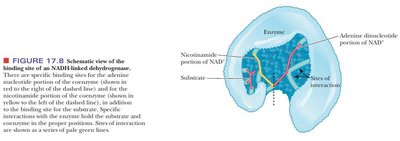
Reaction 7: ATP Formation by Phosphoglycerate Kinase
1,3-Bisphosphoglycerate donates its high-energy phosphate group to ADP, forming ATP and 3-phosphoglycerate. This is the first substrate-level phosphorylation in glycolysis, catalyzed by phosphoglycerate kinase (requires Mg2+).
Reaction:
Energetics: kJ/mol (exergonic)
Substrate-level phosphorylation: Direct transfer of phosphate from a high-energy substrate to ADP, independent of oxygen or the electron transport chain.
Reaction 8: Isomerization by Phosphoglyceromutase
Phosphoglyceromutase catalyzes the intramolecular transfer of the phosphate group from carbon 3 to carbon 2, converting 3-phosphoglycerate to 2-phosphoglycerate. This rearrangement prepares the molecule for the subsequent dehydration step.
Reaction:
Energetics: kJ/mol
Reaction 9: Dehydration by Enolase
Enolase removes a water molecule from 2-phosphoglycerate, forming phosphoenolpyruvate (PEP), a compound with a very high phosphate-group transfer potential. Mg2+ is required as a cofactor.
Reaction:
Energetics: kJ/mol
Reaction 10: ATP Formation by Pyruvate Kinase
PEP donates its phosphate group to ADP, forming ATP and pyruvate. This is the second substrate-level phosphorylation in glycolysis, catalyzed by pyruvate kinase (requires Mg2+ and K+).
Reaction:
Energetics: kJ/mol (strongly exergonic)
Key point: The high transfer potential of PEP and the conversion of enol to keto pyruvate drive the reaction forward.
ATP Yield and Product Summary
Gross ATP produced: 4 ATP (2 each from Reactions 7 and 10)
ATP consumed: 2 ATP (in the preparatory phase)
Net ATP yield: 2 ATP per glucose
Other products: 2 NADH, 2 pyruvate
Regulation of Glycolysis
Major Control Points
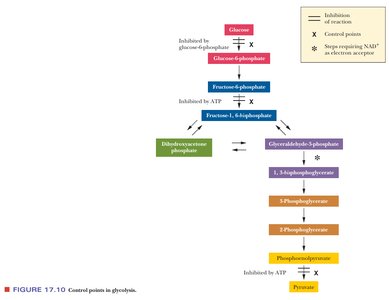
Glycolysis is regulated at three key irreversible steps, catalyzed by:
Hexokinase: Inhibited by its product, glucose-6-phosphate
Phosphofructokinase (PFK): Inhibited by ATP (the committed step of glycolysis)
Pyruvate kinase: Inhibited by ATP
These control points allow the cell to adjust glycolytic flux according to energy needs and metabolic status.
Substrate-Level vs. Oxidative Phosphorylation
Substrate-level phosphorylation: Direct transfer of phosphate from a high-energy substrate to ADP (Reactions 7 and 10)
Oxidative phosphorylation: ATP synthesis driven by electron transport and a proton gradient (occurs in mitochondria, requires oxygen)
Key Definitions and Concepts
High-energy compounds: 1,3-bisphosphoglycerate and phosphoenolpyruvate have higher phosphate-group transfer potentials than ATP, enabling them to drive ATP synthesis.
Mutase: An enzyme that moves a functional group within a molecule (e.g., phosphoglyceromutase in Reaction 8).
Dehydrogenase: An enzyme that catalyzes oxidation-reduction reactions, often using NAD+ or NADH as cofactors.
Summary Table: Glycolytic Payoff Phase (Reactions 6–10)
Step | Substrate | Product | Enzyme | Major Event |
|---|---|---|---|---|
6 | Glyceraldehyde-3-phosphate | 1,3-Bisphosphoglycerate | Glyceraldehyde-3-phosphate dehydrogenase | Oxidation, NADH formation, phosphorylation |
7 | 1,3-Bisphosphoglycerate | 3-Phosphoglycerate | Phosphoglycerate kinase | ATP formation (substrate-level phosphorylation) |
8 | 3-Phosphoglycerate | 2-Phosphoglycerate | Phosphoglyceromutase | Phosphate-group rearrangement |
9 | 2-Phosphoglycerate | Phosphoenolpyruvate | Enolase | Dehydration |
10 | Phosphoenolpyruvate | Pyruvate | Pyruvate kinase | ATP formation (substrate-level phosphorylation) |
Review Questions (Selected)
Which reaction in glycolysis is the only oxidation–reduction reaction? Conversion of glyceraldehyde-3-phosphate to 1,3-bisphosphoglycerate (Reaction 6)
Define substrate-level phosphorylation. Name the two glycolytic reactions in which it occurs. Direct formation of ATP by transfer of a phosphate group from a high-energy substrate to ADP; occurs in Reactions 7 and 10.
Distinguish between gross ATP yield and net ATP yield during glycolysis. Gross ATP yield is the total ATP produced (4 per glucose); net ATP yield subtracts ATP consumed (2), resulting in a net gain of 2 ATP per glucose.
