22. Evolution of Populations
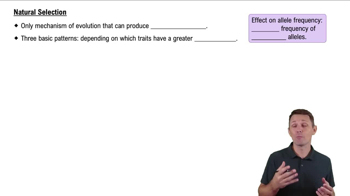
Natural Selection
 04:43
04:43



이 주제를 연습하세요
- 객관식
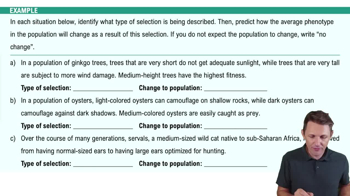
Which of the following statements regarding disruptive selection is true?
1517views5rank - 객관식
The graph below shows the birthweights and infant mortality rate as recorded by researchers in London between 1935 and 1946. The bars represent the number of births recorded in 0.5-pound increments. The orange dots represent the mortality rate for each birthweight and are shown on a logarithmic scale. What type of selection does this graph suggest directly affects human birth weight?
Graph adapted from: M.N. Karn and L.S. Penrose, Birth Weight and Gestation Time in Relation to Maternal Age, Parity, and Infant Survival. Annals of Eugenics, January 1951, Vol. 16 No. 1., Page 147-164.
1416views5rank - 객관식
The graph below shows the average tail length of a population of deer mice. The first graph shows the tail length of the mice while living in a prairie ecosystem, and the second shows the tail length many generations after a group of mice moved into a forest ecosystem. Which of the following types of natural selection describes this scenario, and what conclusion could you draw from these data?
1943views4rank - 객관식
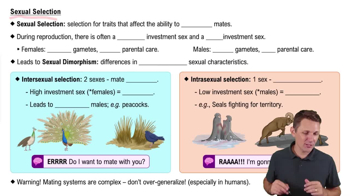
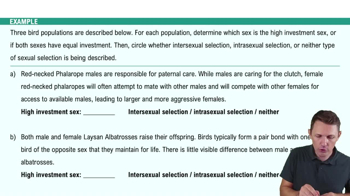
In many species of salmon, there are two mating types in males: large aggressive males and small sneaker males. Large aggressive males fight for territory in which they mate with resident females, while small sneaker males hide and try to quickly enter larger males’ territories to mate with females. “Sneaking” is, on average, a more successful strategy when there are many large males competing for territory, while “Fighting” is, on average, a better strategy when there are few large males present. As described, this scenario describes what two types of selection?
1769views4rank