 뒤로
뒤로An Introduction to Invertebrates (Campbell Biology, Ch. 33): Study Notes
스터디 가이드 - 스마트 노트
 자료에 맞춘 맞춤형 노트, 핵심 정의, 예시, 맥락을 확장해 제공합니다.
An Introduction to Invertebrates
Overview of Invertebrate Diversity
Invertebrates are animals that lack a backbone and account for over 95% of all known animal species. They inhabit nearly every environment on Earth and display remarkable morphological diversity, ranging from microscopic organisms to those over 18 meters long.
Definition: Invertebrates are animals without a vertebral column (backbone).
Diversity: Over 1.3 million described species, with estimates reaching up to 10–20 million.
Habitats: Found in marine, freshwater, and terrestrial environments.
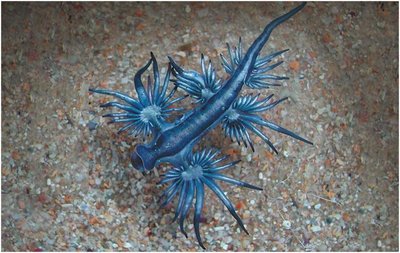
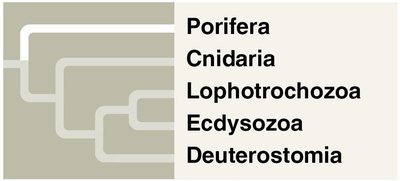
Classification: Invertebrates are classified into major groups based on evolutionary relationships, including Porifera, Cnidaria, Lophotrochozoa, Ecdysozoa, and Deuterostomia.
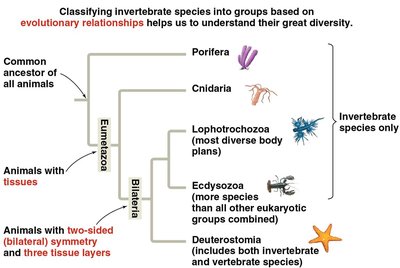
Major Invertebrate Phyla
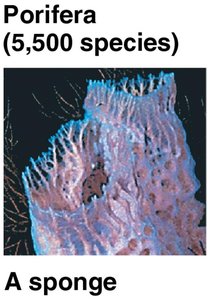
Porifera (Sponges)
Sponges are among the simplest animals and are considered basal due to their early divergence from other animal lineages. They are mostly marine, sessile filter feeders that lack true tissues.
Key Features: Lack true tissues, have several specialized cell types, and possess a body with pores and channels for water flow.
Feeding: Filter feeders; water enters through pores into a central cavity (spongocoel) and exits through the osculum.
Cell Types: Choanocytes (collar cells) capture food, amoebocytes digest and transport nutrients, and produce skeletal fibers.
Reproduction: Most are hermaphrodites, often exhibiting sequential hermaphroditism. Larvae are flagellated and free-swimming before settling as adults.
Cnidaria
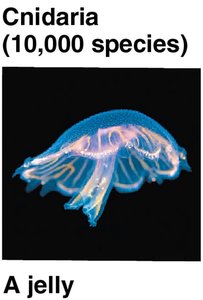
Cnidarians are ancient eumetazoans with true tissues, radial symmetry, and a simple body plan. This phylum includes corals, jellies, and hydras.
Key Features: Diploblastic (two tissue layers), radially symmetrical, possess a gastrovascular cavity with a single opening serving as both mouth and anus.
Body Forms: Two main forms: sessile polyp and motile medusa.
Feeding: Predators using tentacles armed with cnidocytes (stinging cells) containing nematocysts (stinging organelles).
Nervous System: Noncentralized nerve net coordinates movement and response to stimuli.
Lophotrochozoa
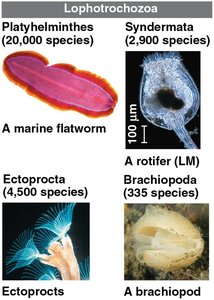
Lophotrochozoa is a diverse clade of bilaterians, identified by molecular data, that includes animals with bilateral symmetry and triploblastic development. Many have a lophophore (feeding structure) or a trochophore larval stage.
Key Phyla: Platyhelminthes (flatworms), Rotifera, Ectoprocta, Brachiopoda, Mollusca, Annelida, among others.
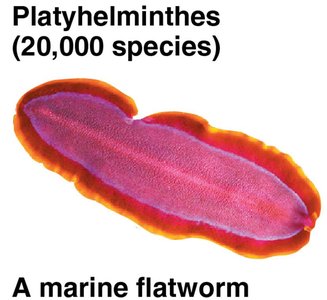
Platyhelminthes (Flatworms)
Flatworms are dorsoventrally flattened acoelomates with bilateral symmetry. They lack a body cavity and circulatory organs, and many are parasitic.
Key Features: Bilateral symmetry, central nervous system, gastrovascular cavity with one opening.
Examples: Tapeworms, planarians, flukes.
Adaptations: Flat body increases surface area for diffusion of gases and elimination of waste.
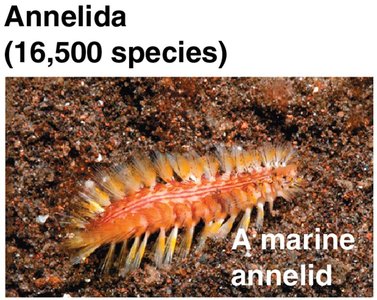
Annelida (Segmented Worms)
Annelids are coelomate, segmented worms found in marine, freshwater, and terrestrial habitats. They play important roles in soil health and nutrient cycling.
Key Features: Segmented body, true coelom, closed circulatory system.
Examples: Earthworms, leeches, polychaetes.
Reproduction: Many are hermaphrodites; some reproduce asexually by fragmentation and regeneration.
Mollusca
Molluscs are soft-bodied animals, many of which are protected by a hard calcium carbonate shell. This phylum includes snails, clams, squids, and octopuses.
Key Features: Body plan with muscular foot (movement), visceral mass (internal organs), and mantle (secretes shell).
Feeding: Many use a radula (toothed tongue) to scrape food.
Major Clades: Polyplacophora (chitons), Gastropoda (snails, slugs), Bivalvia (clams, oysters), Cephalopoda (squids, octopuses).
Ecdysozoa
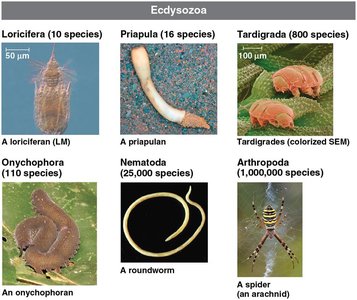
Ecdysozoans are animals that grow by molting their cuticle, a tough external covering. This group includes the most species-rich animal phyla: Nematoda and Arthropoda.
Key Features: Cuticle that is periodically shed (ecdysis), bilateral symmetry, protostome development.
Major Phyla: Nematoda (roundworms), Arthropoda (insects, arachnids, crustaceans).
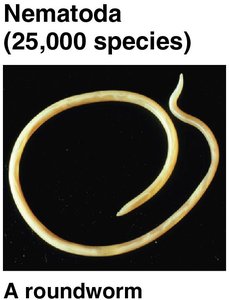
Nematoda (Roundworms)
Nematodes are unsegmented, cylindrical worms with a tough cuticle. They are abundant in soil and aquatic habitats, with many species being parasitic.
Key Features: Complete digestive tract, no circulatory system, body wall muscles are longitudinal only.
Examples: Caenorhabditis elegans (model organism), Trichinella spiralis (causes trichinosis in humans).
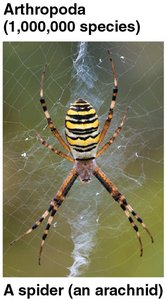
Arthropoda
Arthropods are the most diverse and abundant animal phylum, characterized by a segmented body, jointed appendages, and a hard exoskeleton made of chitin.
Key Features: Segmented body, exoskeleton, jointed appendages, open circulatory system.
Major Groups: Chelicerates (spiders, scorpions), Myriapods (centipedes, millipedes), Pancrustaceans (insects, crustaceans).
Adaptations: Exoskeleton provides protection and support, must be shed for growth (molting).
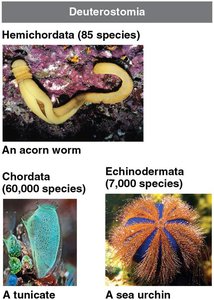
Deuterostomia
Deuterostomes include both invertebrate and vertebrate species. This group is defined by developmental characteristics such as radial cleavage and the formation of the anus from the blastopore.
Major Phyla: Hemichordata (acorn worms), Echinodermata (sea stars, sea urchins), Chordata (vertebrates and invertebrate chordates).
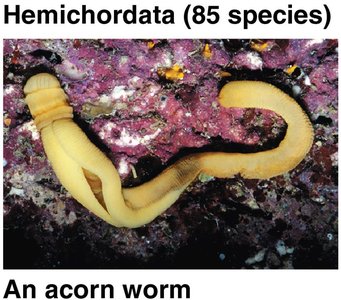
Hemichordata
Hemichordates share some features with chordates, such as gill slits and a dorsal nerve cord. The largest group is the acorn worms, which are marine animals living in mud or under rocks.
Echinodermata
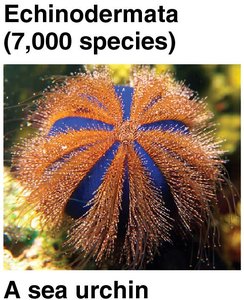
Echinoderms are marine animals with a unique water vascular system used for locomotion and feeding. Adults typically have radial symmetry, while larvae are bilaterally symmetrical.
Key Features: Endoskeleton of calcareous plates, tube feet, water vascular system.
Examples: Sea stars, sea urchins, sand dollars, brittle stars, sea cucumbers, sea lilies, and feather stars.
Chordata
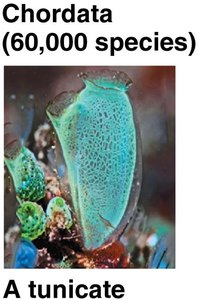
Chordates include all vertebrates and two groups of invertebrates (lancelets and tunicates). They are bilaterally symmetrical coelomates with segmented bodies and share a common ancestry with echinoderms.
Summary Table: Major Invertebrate Groups
Group | Key Features | Examples |
|---|---|---|
Porifera | No true tissues, filter feeders | Sponges |
Cnidaria | Radial symmetry, stinging cells | Jellyfish, corals, hydras |
Lophotrochozoa | Bilateral symmetry, diverse body plans | Flatworms, molluscs, annelids |
Ecdysozoa | Molting cuticle, bilateral symmetry | Roundworms, arthropods |
Deuterostomia | Radial cleavage, anus from blastopore | Acorn worms, sea urchins, tunicates |
