 뒤로
뒤로Angiosperm Sporophyte Anatomy and Plant Structure
스터디 가이드 - 스마트 노트
 자료에 맞춘 맞춤형 노트, 핵심 정의, 예시, 맥락을 확장해 제공합니다.
Angiosperm Sporophyte Anatomy
What Defines ‘Plants’?
Plants are multicellular, primarily photosynthetic organisms that are distinct from their closest relatives, green algae, due to several key adaptations. These adaptations allow plants to thrive in terrestrial environments and include specialized structures and life cycles.
Apical meristems: Regions of continuous cell division at the tips of roots and shoots, enabling growth in length.
Alternation of generations: Life cycle with multicellular diploid (sporophyte) and haploid (gametophyte) stages.
Walled spores in sporangia: Protective structures for spore production and dispersal.
Multicellular gametangia: Organs that produce gametes (sperm and eggs).
Multicellular dependent embryos: Embryos are retained and nourished within parental tissues.
Example: Ferns, mosses, and flowering plants all exhibit alternation of generations, but only angiosperms produce flowers and seeds enclosed in fruit.
Alternation of Generations in Plants
The plant life cycle alternates between a multicellular diploid sporophyte (2n) and a multicellular haploid gametophyte (1n). The sporophyte produces spores by meiosis, which develop into gametophytes. Gametophytes produce gametes by mitosis; fertilization forms a new sporophyte.
Sporophyte (2n): Produces haploid spores via meiosis.
Gametophyte (1n): Produces gametes (sperm and egg) via mitosis.
Fertilization: Fusion of gametes forms a diploid zygote, which grows into a new sporophyte.
Additional info: This life cycle is a defining feature of all land plants, though the relative dominance of each generation varies among groups.
Flowering Plant Diversity
Flowering plants, or angiosperms, are the most diverse group of plants, with approximately 250,000 species. They are divided into two major classes:
Eudicots: About 170,000 species; typically have two seed leaves (cotyledons).
Monocots: About 70,000 species; typically have one seed leaf.
Angiosperm Organs
Overview of Plant Organs
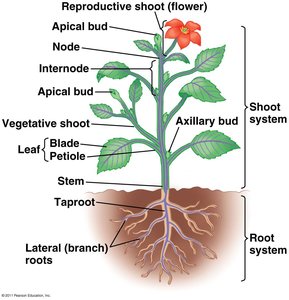
The angiosperm sporophyte body is composed of three main organs: roots, stems (shoots), and leaves. Each organ has specialized functions essential for plant survival and reproduction.
Roots: Anchor the plant, absorb water and nutrients, and store organic nutrients.
Stems: Elevate leaves, transport nutrients and carbohydrates, and may store food or conduct photosynthesis.
Leaves: Primary site of photosynthesis, may attract pollinators, store water, or form defensive structures like spines.
Root Systems
Taproot system: Found in eudicots; consists of a large, central root with smaller lateral roots.
Fibrous root system: Found in monocots; consists of many roots of similar size, forming a dense mat near the soil surface.
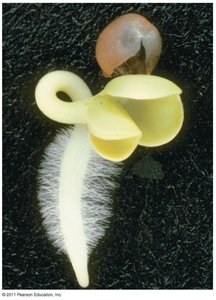
Root hairs: Extensions of epidermal cells that increase surface area for absorption.
Stem Functions
Support and elevate leaves for optimal light capture.
Transport water, minerals, and sugars between roots and leaves.
May store nutrients or perform photosynthesis in some species.
Leaf Functions and Adaptations
Photosynthesis: Main site for converting light energy to chemical energy.
Pollinator attraction: Some leaves are modified to attract pollinators.
Water storage: Succulent leaves store water in arid environments.
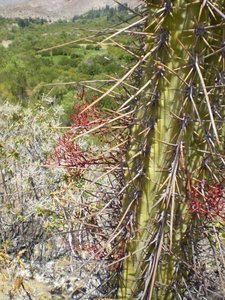
Defense: Leaves may be modified into spines to deter herbivores.
Leaf Venation
Monocots: Parallel venation (veins run side by side).
Eudicots: Reticulate (net-like) venation.
Angiosperm Tissues
Three Tissue Types
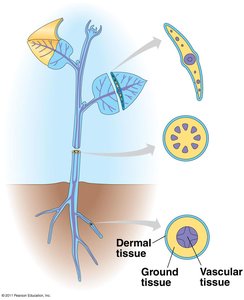
All three tissue types are present in each organ of the angiosperm sporophyte:
Dermal tissue: Outer protective covering; regulates water loss and protects against pathogens and physical damage.
Vascular tissue: Conducts water, minerals, and carbohydrates throughout the plant.
Xylem: Transports water and dissolved minerals from roots to shoots.
Phloem: Transports sugars and organic nutrients from leaves to other parts of the plant.
Ground tissue: Functions in photosynthesis, storage, and support. Contains cells with chloroplasts and may have reinforced cell walls for structural support.
Arrangement of Vascular Tissue
Eudicot stems: Vascular bundles arranged in a ring around central ground tissue.
Monocot stems: Vascular bundles scattered throughout ground tissue; no central column.
Summary Table: Comparison of Monocots and Eudicots
Feature | Monocots | Eudicots |
|---|---|---|
Number of cotyledons | 1 | 2 |
Leaf venation | Parallel | Reticulate (net-like) |
Root system | Fibrous | Taproot |
Vascular bundle arrangement (stem) | Scattered | Ring |
Additional Information
Supplemental Instruction: Students are encouraged to utilize supplemental instruction sessions for additional support.
Grade Calculation: Grades are calculated based on proportional contribution of assignments and exams to the final grade.
