 뒤로
뒤로Atoms, Elements, and Chemical Bonds: Foundations of Biological Chemistry
스터디 가이드 - 스마트 노트
 자료에 맞춘 맞춤형 노트, 핵심 정의, 예시, 맥락을 확장해 제공합니다.
Atoms, Elements, and the Periodic Table
Atomic Structure and Subatomic Particles
Atoms are the fundamental units of matter, composed of three main subatomic particles: protons, neutrons, and electrons. The arrangement and number of these particles determine the properties of each element.
Protons: Positively charged particles found in the nucleus; the number of protons defines the atomic number and the identity of the element.
Neutrons: Neutral particles in the nucleus; they contribute to the atomic mass and can vary in number, resulting in isotopes.
Electrons: Negatively charged particles orbiting the nucleus; they are involved in chemical bonding and reactions.
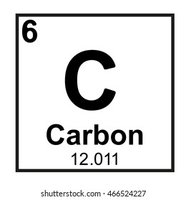
Example: The element carbon has 6 protons, 6 neutrons (in its most common isotope), and 6 electrons.
Atomic Number and Atomic Mass
The atomic number is the number of protons in an atom's nucleus, while the atomic mass (or mass number) is the sum of protons and neutrons. Electrons have negligible mass.
Isotopes: Atoms of the same element with different numbers of neutrons (e.g., Carbon-12 vs. Carbon-14).
Radioactive Isotopes: Unstable isotopes that decay over time, emitting particles and energy. Used in radiometric dating and medical diagnostics.
Essential and Trace Elements
Living organisms require certain elements in large (essential) or small (trace) amounts:
Essential Elements: Carbon, Oxygen, Hydrogen, Nitrogen (~96% of living matter), plus Calcium, Phosphorus, Potassium, Sulfur, Sodium, Chlorine, Magnesium (~4%).
Trace Elements: Required in minute quantities (e.g., iron, iodine).
Electron Configuration and the Periodic Table
Electron Shells and Energy Levels
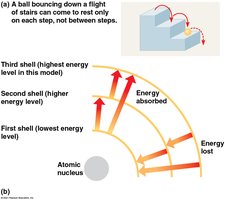
Electrons occupy energy levels or shells around the nucleus. The further an electron is from the nucleus, the higher its potential energy. Electrons can only exist at specific energy levels, not between them.
The first shell holds up to 2 electrons.
Subsequent shells can hold up to 8 electrons each.
Electrons in the outermost shell are called valence electrons and determine chemical reactivity.
Electron Orbitals
Electron shells are composed of orbitals, which are three-dimensional regions where electrons are likely to be found. Each orbital can hold up to 2 electrons.
s orbitals: Spherical, one per shell, hold 2 electrons.
p orbitals: Dumbbell-shaped, three per shell (starting from the second shell), hold 6 electrons total.
d orbitals: More complex, five per shell (starting from the third shell), hold 10 electrons total.
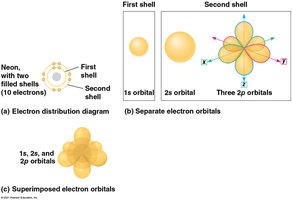
Example: The electron configuration of carbon (6 electrons): 1s2 2s2 2p2.
Chemical Bonds and Molecular Structure
Covalent Bonds
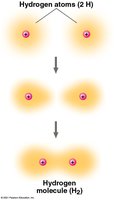
Covalent bonds form when two atoms share pairs of valence electrons. These bonds are strong and can involve single, double, or triple pairs of electrons.
Single bond: Sharing one pair of electrons (e.g., H—H).
Double bond: Sharing two pairs of electrons (e.g., O═O).
Molecule: Two or more atoms held together by covalent bonds.
Electronegativity: The ability of an atom to attract electrons in a covalent bond. Unequal sharing leads to polar covalent bonds (partial charges), while equal sharing results in nonpolar covalent bonds.
Ionic Bonds
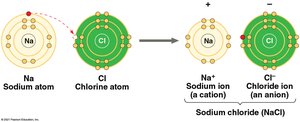
Ionic bonds form when one atom transfers electrons to another, creating charged ions. The resulting electrostatic attraction holds the ions together.
Cation: Positively charged ion (loses electrons).
Anion: Negatively charged ion (gains electrons).
Salts: Compounds formed by ionic bonds, often crystalline and dissociate easily in water.
Hydrogen Bonds
Hydrogen bonds are weak attractions between a hydrogen atom covalently bonded to an electronegative atom (like oxygen or nitrogen) and another electronegative atom. These bonds are crucial in stabilizing the structures of proteins and DNA.
Van der Waals Interactions
Van der Waals interactions are weak attractions that occur when transient, uneven electron distributions create temporary dipoles in molecules. Collectively, these interactions can be significant, as seen in gecko adhesion.
Hybridization of Orbitals and Molecular Shape
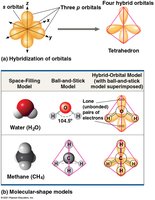
Hybridization occurs when atomic orbitals mix to form new, hybrid orbitals, influencing molecular geometry. The shape of a molecule is critical to its function in biological systems.
Example: Methane (CH4) forms a tetrahedral shape due to sp3 hybridization.
Chemical Reactions and Equilibrium
Chemical Reactions
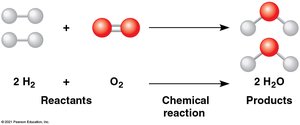
Chemical reactions involve the making and breaking of chemical bonds, transforming reactants into products. All reactions are reversible, and equilibrium is reached when the forward and reverse reactions occur at the same rate.
Reactants: Starting substances in a reaction.
Products: Substances formed as a result of the reaction.
Chemical equilibrium: The state where reactant and product concentrations remain constant.
Example Equation:
Half-Life Calculations for Radioactive Isotopes
The half-life of a radioactive isotope is the time required for half of the isotope to decay. The amount remaining after a given time can be calculated using the formula:
Example: If 60 grams of Np-240 (half-life = 1 hour) are present, after 4 hours (4 half-lives), the remaining amount is: grams.
Summary Table: Types of Chemical Bonds
Bond Type | Strength | How Formed | Example |
|---|---|---|---|
Covalent | Strong | Sharing of electron pairs | H2, O2, CH4 |
Ionic | Strong (in dry state) | Transfer of electrons, attraction between ions | NaCl |
Hydrogen | Weak (individually) | Attraction between H and electronegative atom | Water, DNA base pairing |
Van der Waals | Very weak (individually) | Transient dipole interactions | Gecko adhesion |
