 뒤로
뒤로Atoms, Molecules, and Chemical Bonds in Biology
스터디 가이드 - 스마트 노트
 자료에 맞춘 맞춤형 노트, 핵심 정의, 예시, 맥락을 확장해 제공합니다.
Introduction to Chemistry in Biology
The Chemical Basis of Life
All living organisms are composed of chemicals, which are organized into atoms, molecules, organelles, and cells. Understanding the structure and behavior of atoms and molecules is fundamental to biology, as these principles underlie the structure and function of biomolecules and cells.
Atoms are the basic units of matter, composed of protons, neutrons, and electrons.
Molecules are formed when atoms bond together through chemical interactions.
Biological molecules, such as proteins, lipids, carbohydrates, and nucleic acids, are essential for life.
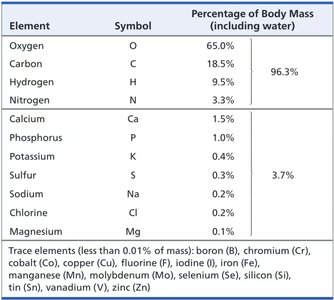
Chemical Elements in Living Organisms
Major and Trace Elements
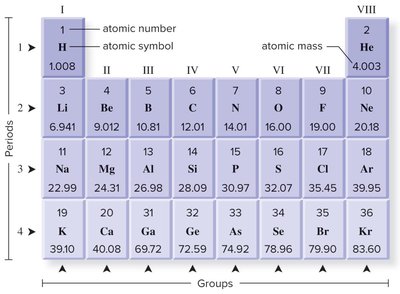
Living organisms are primarily composed of a few major elements, with trace elements required in smaller amounts. These elements are essential for the structure and function of biomolecules.
Element | Symbol | Percentage of Body Mass (including water) |
|---|---|---|
Oxygen | O | 65.0% |
Carbon | C | 18.5% |
Hydrogen | H | 9.5% |
Nitrogen | N | 3.3% |
Calcium | Ca | 1.5% |
Phosphorus | P | 1.0% |
Potassium | K | 0.4% |
Sulfur | S | 0.3% |
Sodium | Na | 0.2% |
Chlorine | Cl | 0.2% |
Magnesium | Mg | 0.1% |
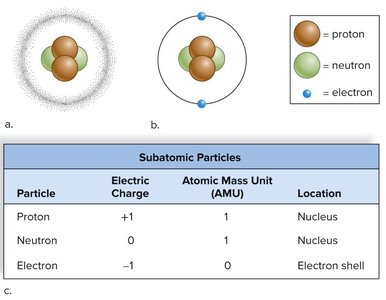
Atomic Structure
Subatomic Particles
Atoms consist of a nucleus containing protons and neutrons, surrounded by electrons in shells. The number of protons defines the element, while the arrangement of electrons determines chemical behavior.
Proton: Positively charged particle in the nucleus.
Neutron: Neutral particle in the nucleus.
Electron: Negatively charged particle in electron shells around the nucleus.
Particle | Electric Charge | Atomic Mass Unit (AMU) | Location |
|---|---|---|---|
Proton | +1 | 1 | Nucleus |
Neutron | 0 | 1 | Nucleus |
Electron | -1 | 0 | Electron shell |

Atomic Number and Mass Number
Atomic number is the number of protons in an atom and defines the element.
Mass number is the sum of protons and neutrons in the nucleus.
For example, carbon has 6 protons and typically 6 neutrons, giving it a mass number of 12.
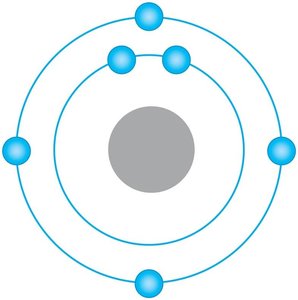
Electron Shells and Valence Electrons
Electrons are arranged in shells around the nucleus. The outermost shell, called the valence shell, determines the chemical reactivity of the atom.
The first shell holds up to 2 electrons.
The second shell holds up to 8 electrons.
Atoms are most stable when their valence shell is full (the "octet rule").
Chemical Bonds
Types of Chemical Bonds
Atoms interact to achieve stable electron configurations, forming chemical bonds. The main types of bonds in biology are ionic, covalent, and hydrogen bonds.
Ionic Bonds: Formed when electrons are transferred from one atom to another, creating ions with opposite charges that attract each other.
Covalent Bonds: Formed when two atoms share one or more pairs of electrons. Can be polar (unequal sharing) or nonpolar (equal sharing).
Ionic Bond Example: Sodium Chloride (NaCl)
Sodium (Na) donates an electron to chlorine (Cl), forming Na+ and Cl- ions, which are held together by ionic bonds to form table salt.
Covalent Bonding and the HONC Rule
The number of covalent bonds an atom can form is determined by the number of electrons needed to fill its valence shell. The "HONC" rule summarizes the typical bonding patterns of hydrogen, oxygen, nitrogen, and carbon:
Hydrogen (H): 1 bond
Oxygen (O): 2 bonds
Nitrogen (N): 3 bonds
Carbon (C): 4 bonds
Polarity and Electronegativity
Polarity arises when atoms in a covalent bond have different electronegativities, causing unequal sharing of electrons. This results in partial charges (δ+ and δ-) on the atoms.
Nonpolar covalent bond: Electrons are shared equally (e.g., H2).
Polar covalent bond: Electrons are shared unequally (e.g., H2O).
Electronegativity: The ability of an atom to attract shared electrons. Oxygen and nitrogen are highly electronegative.
Redox Reactions
Redox (reduction-oxidation) reactions involve the transfer of electrons between atoms or molecules. These reactions are fundamental to energy transfer in biological systems.
Oxidation: Loss of electrons.
Reduction: Gain of electrons.
Mnemonic: O.I.L. R.I.G. (Oxidation Is Loss, Reduction Is Gain)
Biological Molecules and Their Components
Major Classes of Biomolecules
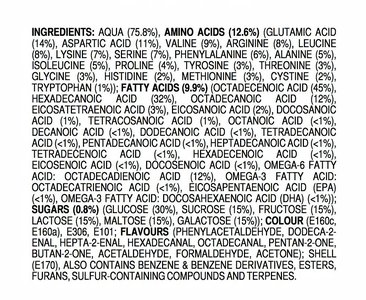
Biomolecules are built from atoms and are essential for life. The four major classes are:
Proteins: Polymers of amino acids; perform structural, enzymatic, and regulatory functions.
Lipids: Hydrophobic molecules; important for membranes and energy storage.
Carbohydrates: Sugars and polymers of sugars; provide energy and structural support.
Nucleic Acids: DNA and RNA; store and transmit genetic information.
Cellular Organization
Cell Structure and Organelles
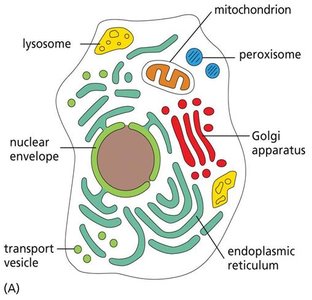
Cells are the basic units of life, containing specialized structures called organelles that perform distinct functions. Eukaryotic cells have membrane-bound organelles, while prokaryotic cells do not.
Nucleus: Contains DNA and controls cellular activities.
Mitochondria: Site of cellular respiration and energy production.
Endoplasmic Reticulum (ER): Synthesizes proteins and lipids.
Golgi Apparatus: Modifies, sorts, and packages proteins and lipids.
Lysosomes and Peroxisomes: Involved in digestion and detoxification.
Summary Table: Key Chemical Concepts in Biology
Concept | Definition | Example |
|---|---|---|
Atom | Smallest unit of an element | Carbon atom |
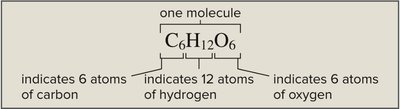
Molecule | Two or more atoms bonded together | H2O |
Ionic Bond | Transfer of electrons between atoms | NaCl |
Covalent Bond | Sharing of electrons between atoms | O2, H2O |
Polarity | Unequal sharing of electrons | H2O |
Redox Reaction | Transfer of electrons | Cellular respiration |
Additional info: Understanding atomic structure, chemical bonding, and the properties of biomolecules is foundational for all topics in General Biology, including cell structure, metabolism, genetics, and physiology.
