 뒤로
뒤로Basic Chemistry for Biology: Atoms, Elements, and Chemical Bonds
스터디 가이드 - 스마트 노트
 자료에 맞춘 맞춤형 노트, 핵심 정의, 예시, 맥락을 확장해 제공합니다.
Atoms and Subatomic Particles
Definition and Structure of Atoms
An atom is the smallest functional unit of matter that retains the properties of an element. Atoms are composed of three main subatomic particles: protons, neutrons, and electrons.
Protons: Positively charged particles found in the nucleus; the number of protons determines the element (atomic number).
Neutrons: Neutral particles found in the nucleus; the number of neutrons determines the isotope of an element.
Electrons: Negatively charged particles that orbit the nucleus in electron shells; electrons determine the chemical reactivity of the atom.
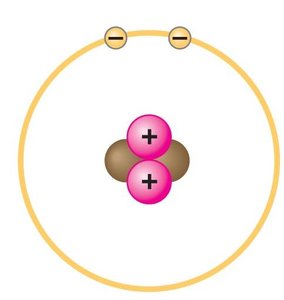
Atomic Nucleus
The atomic nucleus is located at the center of the atom and contains protons and neutrons. It is much smaller than the overall size of the atom, occupying about 1/10,000th of the atom's diameter.
Elements and the Periodic Table
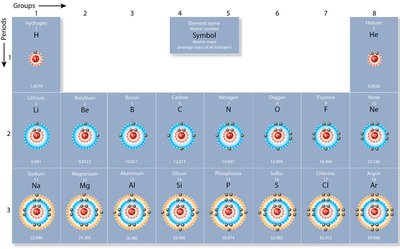
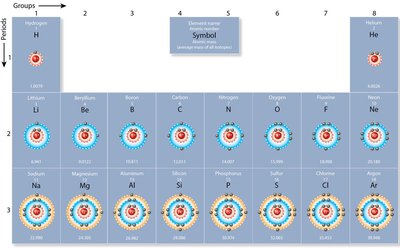
Each element is defined by its unique number of protons. The periodic table organizes elements by their atomic number and provides information about their subatomic structure and electron configuration.
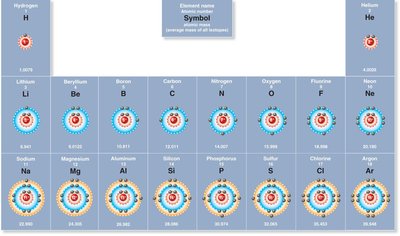
Electron Organization: Shells and Orbitals
Electron Shells and Orbitals
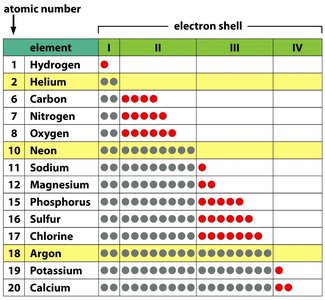
Electrons are arranged in shells around the nucleus. Each shell contains a fixed number of electrons, which are further organized into orbitals. An orbital is a three-dimensional region where an electron is likely to be found.
1s orbital: Spherical, holds up to 2 electrons.
2s orbital: Spherical, holds up to 2 electrons.
2p orbitals: Three dumbbell-shaped orbitals, each holding up to 2 electrons (6 total in 2p).
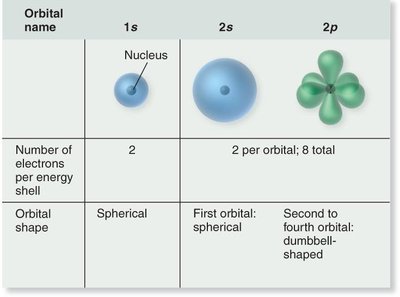
Filling of Electron Shells
Electrons fill the lowest energy orbitals first (1s, then 2s, then 2p, etc.). The arrangement of electrons in shells and orbitals determines the atom's chemical properties.
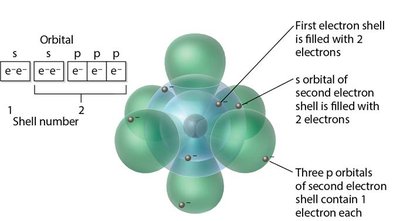
Valence Electrons and Reactivity
Valence electrons are the electrons in the outermost shell of an atom. The number of valence electrons determines an element's chemical reactivity. Atoms with full valence shells are chemically inert, while those with incomplete shells are reactive.
Isotopes
Definition and Importance
Isotopes are atoms of the same element that differ in the number of neutrons, and thus in atomic mass. Stable isotopes do not change over time, while radioactive isotopes decay spontaneously, emitting particles and energy.
Example: Carbon-12 (12C) has 6 protons and 6 neutrons; Carbon-14 (14C) has 6 protons and 8 neutrons.
Elements Essential for Life
Major Elements in Living Cells
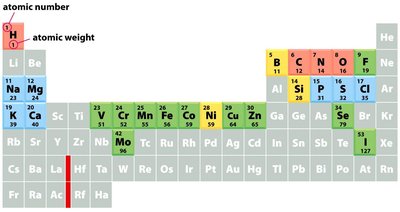
About 25 elements are required for life. Four elements—carbon (C), hydrogen (H), oxygen (O), and nitrogen (N)—make up about 99% of the mass of living cells.
Chemical Bonds and Molecules
Types of Chemical Bonds
Atoms with incomplete valence shells can share or transfer electrons to achieve stability, forming chemical bonds. The main types of bonds in biological systems are:
Covalent bonds: Atoms share pairs of electrons. These are strong bonds and can be single, double, or triple bonds.
Polar covalent bonds: Electrons are shared unequally due to differences in electronegativity, resulting in partial charges.
Nonpolar covalent bonds: Electrons are shared equally between atoms with similar electronegativities.
Hydrogen bonds: Weak attractions between a hydrogen atom covalently bonded to an electronegative atom and another electronegative atom.
Ionic bonds: Formed by the attraction between oppositely charged ions (cations and anions).
Covalent Bonds
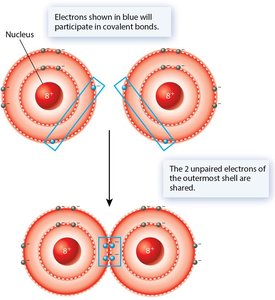
Covalent bonds are strong bonds where two atoms share one or more pairs of valence electrons. These bonds are essential for the structure of biological molecules.
Single bond: One pair of electrons shared.
Double bond: Two pairs of electrons shared (e.g., O2).
Polar and Nonpolar Covalent Bonds
Electronegativity is the ability of an atom to attract electrons in a bond. If atoms have different electronegativities, the bond is polar; if similar, the bond is nonpolar.
Polar covalent bond: Unequal sharing of electrons (e.g., in water, H2O).
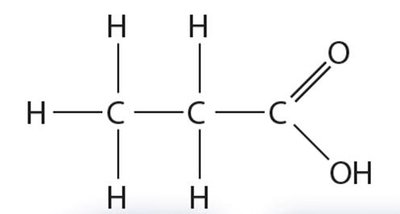
Nonpolar covalent bond: Equal sharing of electrons (e.g., in O2 or C-H bonds).
 Which of the following best explains why water is an excellent solvent for polar molecules?
Hydrogen Bonds
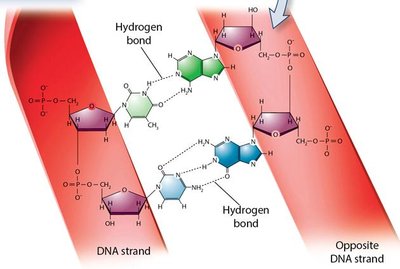
Hydrogen bonds form when a hydrogen atom covalently bonded to an electronegative atom is attracted to another electronegative atom. These bonds are individually weak but collectively significant in stabilizing biological molecules (e.g., DNA, proteins).
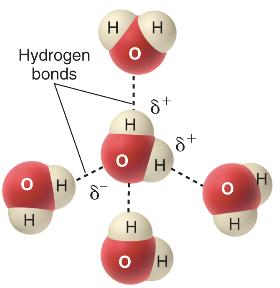
Intermolecular hydrogen bonds: Between different molecules.
Intramolecular hydrogen bonds: Within the same molecule.
Ionic Bonds
Ionic bonds are formed when one atom donates an electron to another, resulting in the formation of oppositely charged ions that attract each other.
Cation: Positively charged ion (lost electrons).
Anion: Negatively charged ion (gained electrons).
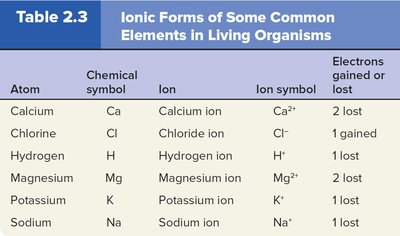
Table: Ionic Forms of Some Common Elements in Living Organisms
Atom | Chemical Symbol | Ion | Ion Symbol | Electrons Gained or Lost |
|---|---|---|---|---|
Calcium | Ca | Calcium ion | Ca2+ | 2 lost |
Chlorine | Cl | Chloride ion | Cl- | 1 gained |
Hydrogen | H | Hydrogen ion | H+ | 1 lost |
Magnesium | Mg | Magnesium ion | Mg2+ | 2 lost |
Potassium | K | Potassium ion | K+ | 1 lost |
Sodium | Na | Sodium ion | Na+ | 1 lost |
Summary Table: Electron Shells and Orbitals
Orbital Name | Number of Electrons per Energy Shell | Orbital Shape |
|---|---|---|
1s | 2 | Spherical |
2s | 2 per orbital; 8 total | First orbital: spherical |
2p | 2 per orbital; 8 total | Second to fourth orbital: dumbbell-shaped |
Key Equations
Atomic Mass:
Atomic Number:
Additional info:
These notes provide foundational chemistry concepts essential for understanding biological molecules and processes. Mastery of atomic structure, electron configuration, and chemical bonding is critical for further study in cell biology, biochemistry, and physiology.
