 뒤로
뒤로Basic Principles of Animal Form and Function
스터디 가이드 - 스마트 노트
 자료에 맞춘 맞춤형 노트, 핵심 정의, 예시, 맥락을 확장해 제공합니다.
Basic Principles of Animal Form and Function
Hierarchical Organization of Animal Body Plans
Animals are composed of cells organized into increasingly complex levels of structure. This hierarchical organization allows for specialization and division of labor among cells, tissues, organs, and organ systems.
Cells: The basic unit of life, specialized for various functions.
Tissues: Groups of cells with similar appearance and a common function.
Organs: Structures composed of multiple tissue types working together to perform specific functions.
Organ Systems: Groups of organs that work together to carry out major body functions.
Some organs, such as the pancreas, belong to more than one organ system (e.g., digestive and endocrine systems).
Major Organ Systems in Mammals
Each organ system in mammals has distinct components and functions. The table below summarizes the main organ systems and their primary components:
Organ System | Main Components |
|---|---|
Digestive | Mouth, pharynx, esophagus, stomach, intestines, liver, pancreas, anus |
Circulatory | Heart, blood vessels, blood |
Respiratory | Lungs, trachea, other breathing tubes |
Immune and lymphatic | Bone marrow, lymph nodes, thymus, spleen, lymph vessels |
Excretory | Kidneys, ureters, urinary bladder, urethra |
Endocrine | Pituitary, thyroid, pancreas, adrenal, and other hormone-secreting glands |
Reproductive | Ovaries or testes and associated organs |
Nervous | Brain, spinal cord, nerves, sensory organs |
Integumentary | Skin and its derivatives (hair, claws, sweat glands) |
Skeletal | Bones, tendons, ligaments, cartilage |
Muscular | Skeletal muscles |
Animal Tissues
There are four main types of animal tissues, each with specialized structure and function:
Epithelial Tissue
Connective Tissue
Muscle Tissue
Nervous Tissue
Epithelial Tissue
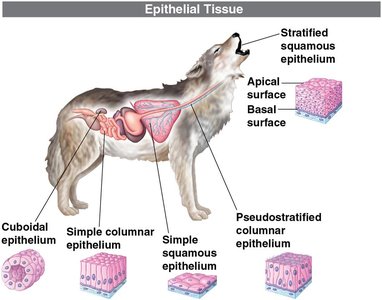
Epithelial tissue covers the outside of the body and lines organs and cavities. The cells are closely packed and can be classified by their shape:
Cuboidal: Dice-shaped cells
Columnar: Brick-shaped cells
Squamous: Tile-like, flat cells
Epithelial tissue serves as a barrier against mechanical injury, pathogens, and fluid loss, and is involved in absorption and secretion.
Connective Tissue
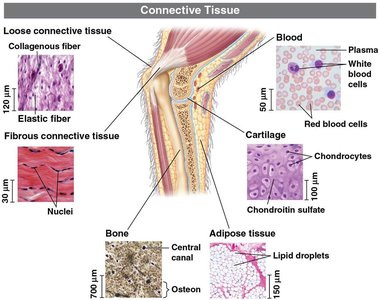
Connective tissue binds and supports other tissues and organs. It consists of sparsely packed cells scattered throughout an extracellular matrix, which may be liquid, jellylike, or solid. The main cell types include:
Fibroblasts: Secrete fiber proteins
Macrophages: Engulf foreign particles and debris by phagocytosis
There are three types of connective tissue fibers (all protein-based):
Collagenous fibers: Provide strength and flexibility
Reticular fibers: Join connective tissue to adjacent tissues
Elastic fibers: Allow tissues to stretch and return to original length
Major types of connective tissue in vertebrates:
Loose connective tissue: Binds epithelia to underlying tissues and holds organs in place
Fibrous connective tissue: Found in tendons (attach muscle to bone) and ligaments (connect bones at joints)
Bone: Mineralized tissue forming the skeleton
Cartilage: Strong, flexible support material
Adipose tissue: Stores fat for insulation and energy
Blood: Composed of cells and cell fragments in plasma
Types of Cartilage
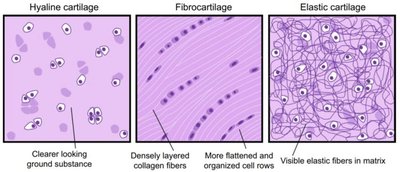
Type | Structure | Function |
|---|---|---|
Hyaline cartilage | Clearer ground substance, scattered cells | Flexible support, reduces friction |
Fibrocartilage | Densely layered collagen fibers, organized cell rows | Resists compression, found in intervertebral discs |
Elastic cartilage | Visible elastic fibers in matrix | Provides flexibility, found in ear |
Special Feature: Blood Cells in Amphibians
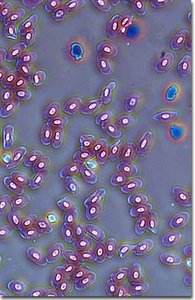
Unlike mammalian red blood cells, amphibian (e.g., frog) red blood cells contain a nucleus. Amphibian hearts have three chambers: two atria and one ventricle.
Muscle Tissue
Muscle tissue is responsible for nearly all types of body movement. Muscle cells contain filaments of the proteins actin and myosin, which enable contraction. There are three types of muscle tissue in vertebrates:
Skeletal muscle (striated muscle): Responsible for voluntary movement
Smooth muscle: Responsible for involuntary body activities; cells are spindle-shaped with a single nucleus
Cardiac muscle: Responsible for contraction of the heart
Nervous Tissue
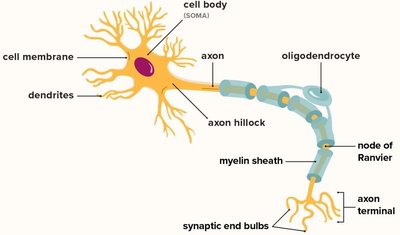
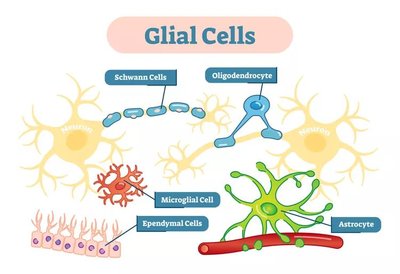
Nervous tissue functions in the receipt, processing, and transmission of information. It contains two main cell types:
Neurons (nerve cells): Transmit nerve impulses
Glial cells (glia): Support, nourish, and protect neurons
Additional info: The organization of animal tissues and organ systems is fundamental to understanding animal physiology and adaptation. The diversity of tissue types allows animals to perform complex functions necessary for survival.
