 뒤로
뒤로BIO 1511 Class Test #2 Study Guide: Genetics, Cell Biology, and Photosynthesis
스터디 가이드 - 스마트 노트
 자료에 맞춘 맞춤형 노트, 핵심 정의, 예시, 맥락을 확장해 제공합니다.
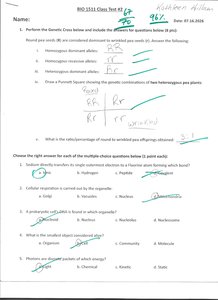
Q1. Perform the Genetic Cross below and include the answers to questions below (20 points)
Background
Topic: Mendelian Genetics
This question tests your understanding of dominant and recessive alleles, homozygous and heterozygous genotypes, and how to use a Punnett Square to predict offspring genotypes and phenotypes.
Key Terms and Formulas:
Dominant allele: An allele that masks the effect of a recessive allele (represented by uppercase letter, e.g., R).
Recessive allele: An allele whose effect is masked by a dominant allele (represented by lowercase letter, e.g., r).
Homozygous: Both alleles are the same (RR or rr).
Heterozygous: Two different alleles (Rr).
Punnett Square: A diagram used to predict the outcome of a genetic cross.
Step-by-Step Guidance
Identify the genotypes of the parents: One is homozygous dominant (RR), the other is homozygous recessive (rr).
Set up a Punnett Square with RR and rr as the parent genotypes.
Fill in the Punnett Square to show the possible genotypes of the offspring.
Determine the phenotype ratio based on the genotypes in the Punnett Square.
Stop here and try to complete the Punnett Square and phenotype ratio yourself!
Try solving on your own before revealing the answer!
Final Answer:
All offspring will be heterozygous (Rr) and display the dominant phenotype.
The phenotype ratio is 100% dominant trait.
Q2. What is the cellular/organismal result of a successful genotype/phenotype outcome?
Background
Topic: Genetics and Phenotype Expression
This question is about how genotype determines phenotype and what happens at the cellular or organismal level when a genotype successfully expresses a phenotype.
Key Terms:
Genotype: The genetic makeup of an organism.
Phenotype: The observable traits or characteristics.
Gene expression: The process by which information from a gene is used to synthesize a functional product (protein).
Step-by-Step Guidance
Recall that genotype codes for proteins via gene expression.
Proteins produced determine the observable phenotype.
Consider how the phenotype manifests at the cellular or organismal level (e.g., pigment, enzyme activity).
Think about how this outcome can affect the organism's survival or reproduction.
Try solving on your own before revealing the answer!
Final Answer:
The result is the expression of a specific trait (phenotype) determined by the genotype, which can affect the organism's appearance, function, or survival.
Q3. Cellular respiration is carried out by which organelle?
Background
Topic: Cell Biology
This question tests your knowledge of organelles and their functions, specifically which organelle is responsible for cellular respiration.
Key Terms:
Cellular respiration: The process of breaking down glucose to produce ATP.
ATP: Adenosine triphosphate, the energy currency of the cell.
Organelle: Specialized structure within a cell.
Step-by-Step Guidance
Recall the main organelles in eukaryotic cells: nucleus, mitochondria, chloroplast, etc.
Identify which organelle is known as the "powerhouse" of the cell.
Think about which organelle produces ATP through cellular respiration.
Try solving on your own before revealing the answer!
Final Answer:
The mitochondria are responsible for cellular respiration and ATP production.
Q4. Which process is responsible for the production of oxygen during photosynthesis?
Background
Topic: Photosynthesis
This question tests your understanding of the steps in photosynthesis and which step produces oxygen.
Key Terms:
Photosynthesis: The process by which plants convert light energy into chemical energy.
Light-dependent reactions: The stage of photosynthesis where light energy splits water molecules.
Oxygen production: Occurs when water is split during the light-dependent reactions.
Step-by-Step Guidance
Recall the two main stages of photosynthesis: light-dependent and light-independent reactions.
Identify which stage involves splitting water molecules.
Consider what happens to the oxygen atoms from water during this process.
Try solving on your own before revealing the answer!
Final Answer:
Oxygen is produced during the light-dependent reactions of photosynthesis when water is split.
Q5. Which chemical group in DNA holds a negative charge that helps it travel toward the gel's positive pole?
Background
Topic: Molecular Biology
This question tests your understanding of DNA structure and gel electrophoresis.
Key Terms:
DNA: Deoxyribonucleic acid, the molecule that carries genetic information.
Gel electrophoresis: A technique used to separate DNA fragments by size and charge.
Phosphate group: The part of DNA that carries a negative charge.
Step-by-Step Guidance
Recall the structure of DNA: sugar-phosphate backbone and nitrogenous bases.
Identify which part of the DNA molecule is negatively charged.
Think about how this negative charge affects movement in an electric field during gel electrophoresis.
Try solving on your own before revealing the answer!
Final Answer:
The phosphate group in DNA holds a negative charge, allowing DNA to move toward the positive pole in gel electrophoresis.
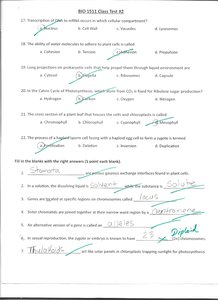
Q6. Fill in the blanks: Stomata are pores in plant leaves that permit gas exchange, especially oxygen and carbon dioxide.
Background
Topic: Plant Biology
This question tests your knowledge of plant anatomy and the function of stomata.
Key Terms:
Stomata: Small openings on the surface of leaves.
Gas exchange: The movement of gases like O2 and CO2 in and out of plant tissues.
Step-by-Step Guidance
Recall the location and function of stomata in plant leaves.
Think about which gases are exchanged through stomata.
Consider how stomata help plants maintain homeostasis.
Try solving on your own before revealing the answer!
Final Answer:
Stomata are pores in plant leaves that permit gas exchange, especially oxygen and carbon dioxide.
